Today’s Safety Class – Negligent Discharge

Good day, class. Please settle down.

First, for those of you who asked, YES, there will be a quiz. Every day. But you won’t know when it is. And if you fail, you may not know it.

Second, for today’s class, I have brought in a guest speaker, a man named Derek “Tex” Grebner. Please pay attention to his video.

Someone please get the lights.

Okay, okay, okay. Settle down.

Lots of lessons to learn here, students.

First, never attempt a new pistol technique with a loaded weapon. Especially the first time. Or probably for the first 10 times. Do this very slowly, with a training partner, until you are both sure you can do it without any problem. Then do it another 20 times before you load up. Then do it s l o w l y.

To me, the second lesson is that this is why I don’t like holsters with retention devices on them. This whole thing happened, admittedly, because the first holster he used – with another gun – had a retention device that was in the same place as the thumb safety on a 1911. Bad design, no matter what. Your mileage my vary, but I won’t own one.

Third, if you don’t have a first aid kit in your range bag, get one. You should have one with you every time you go shoot. If you look on your syllabus, we will cover First Aid next week. Those of you who get queasy looking at blood, get over it.

I’m glad he came out of all this safe. And I’m sorry he’s going to spend the rest of his life serving as a warning to the rest of us. But that’s the risk we all take.

Class dismissed.

Oh, hey, please look out for the quiz later.

But the Grip Angle is Wrong . . .


Video courtesy of Dave Sevigny

In honor of Gaston Glock’s birthday today . . .

By now you know that one of my crusades in life is against the pre-conceived notion, the entrenched opinion. I try to apply this to myself as much as anyone else.

One that particularly gets my ire is the 1911 aficionado who completely dismisses the Glock because “the grip angle is wrong.”

In defense, I call witness Dave Sevigny.

As I reported before, Dave became the first person to beat Rob Leatham in the US Single Stack Championship, shooting a 1911.

For those who don’t know, Dave is also Captain of Team Glock. He’s used a Glock to win just about every National Championship there is, in USPSA and IDPA. You can watch him shoot some amazing strings anywhere on Youtube, including my channel.

Yet Dave was somehow able to overcome the grip angle that has been such a stumbling block to so many.

So, maybe the grip angle of the Glock (or is it the 1911?) isn’t wrong, maybe it’s just different. Maybe the steps to shooting a gun are present the gun, align the sights visually, smoothly press the trigger until the gun goes off, and follow through. Maybe there’s nothing in there about grip angle.

All sarcasm aside (shock!), I would challenge those who say a particular gun feels wrong to deliberately set out to master that gun, for two reasons. First, you should never be limited by hardware, or more importantly, your perception of hardware. And second, you never know when that gun will be the only one available for you to use to defend yourself or your family. And that is more important than any championship.

Match Report

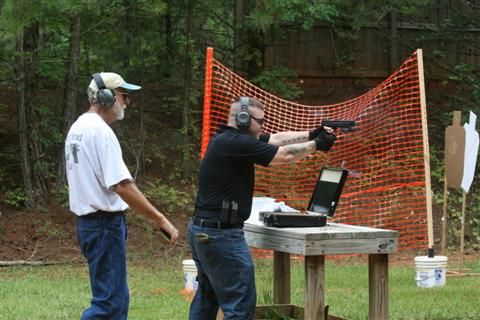
Photo courtesy of River Bend Gun Club Action Pistol group

Saturday July 16 was quite a shooting day. I had planned on shooting the GSSF match at the River Bend Gun Club in Dawsonville, Georgia, and I found out late in the week from Staci Boudreau, a fellow shooter on Twitter, that the club’s monthly Action Pistol match was also held that morning. So I met Staci and her husband Bruce at RBGC for a full day of shooting.

The River Bend Gun Club, RBGC, is a very well kept and well run club located a few miles off I-575 about 50 miles north of Atlanta. I first shot there as a guest of a co-worker a few years ago, and it’s only gotten better since. I’ve shot GSSF and USPSA there, and now Action Pistol.

The RBGC Action Pistol match is very much like the matches I first shot in Alabama 18 years ago. It’s not affiliated with any organization like USPSA, which gives them a lot of freedom in stage design, gun classifications, and the like. I shot Production class, because that’s what I shoot in USPSA, and I wanted to keep the more frequent magazine change as a part of the test. Oh, I was tempted to shoot Limited, since I could have loaded my magazines to 19 and blazed away. Maybe next time.

First, I think the safety briefing that was given was about the best briefing I have ever had. He went over all the rules of the match, and all the safety points. Nothing was glossed over, that there was no assumption about anyone’s previous shooting experience. It was presented with ease, and no one seemed anxious to move on. Very refreshing.

Also refreshing – literally – was the weather, around 75 degrees at the start of the match, and drizzling most of the time. Shooting a Glock, all I had to do was wipe off my grips before shooting. The weather started to dry up by the end of the match, though.

There were three stages, and each tested different shooting skills. The first stage was all steel plates, either classic round plates, steel bowling pins, pepper poppers, or steel IPSC targets. You either hit or not, and it all came down to time. The second stage was classic run and gun, with an added twist – the last series of targets included one target that had a badge around its neck, representing an undercover policeman, and the ROs changed which target was the LEO before each run. At least one shooter in our squad shot the cop.

Stage 3 took advantage of the non-USPSA rules, in that it only required shooters to neutralize the targets, which was defined as one shot in the A area, or 2 in the B and/or C area. Shots in the D range just made the target angry. There were several shots around barricades, and if you aimed center of mass and saw an A hit, move on.

There were unpleasant surprises, though, as some shooters received Failures to Neutralize, because they assumed a single headshot was a neutralizer, not seeing that they had actually hit the B area in the head.

After that, we enjoyed a great hamburger and hotdog lunch, then headed up the hill to the Cowboy range, where the GSSF match was already under way.

After signing in, we shot the three stages I talked about last week. I shot a very good match for me, with zero misses except one steel plate left standing. My score was 121 seconds and change, which is a 15 second improvement over my personal best.

Bruce shot a lot better than I, with a score of 83. Well done.

I arrived home about 4:30, after leaving the house at 7 AM. A quick peak as I cleaned out the car revealed that my Glock didn’t really need cleaning. I just brushed out the trigger group, ran a rod brush through the barrel, and put him away. The Glock 19 I took as a backup got the carry loads back in, and went in my waistband.

The GSSF scores will be posted later today, Monday, and in a few weeks, the prizes will be awarded. But believe me, before then, we’ll be back on the range.

Love The Smell of New Podcast in the Morning

Smells like . . . victory.

The Rimfire Podcast was my morning drive today, and I was impressed. Host Ken Kowalski dispensed with the whole “this is why I started this podcast” explanation, and even the “this is what a rimfire cartridge is,” and jumped right into a meaty subject, .22LR caliber AR-15 conversions. He covered two options, a .22LR bolt swap, and a complete dedicated .22LR upper. You’ll have to listen to his podcast to find out which one he recommends.

You can listen online at http://therimfirepodcast.com or subscribe via iTunes. The podcast has a Facebook page as well.

I look forward to future installments.