RIP Magazine Two (1992 – 2011)

When I bought my Glock 17 in 1992, it came with two 17-round magazines. I soon discovered that Glock made “plus 2” extenders that pushed the capacity to 19 rounds, plus one in the chamber giving me twenty rounds total. At the same time I bought the “plus 2’s” I also bought an extra magazine, so I could have two spares for defense or competition.

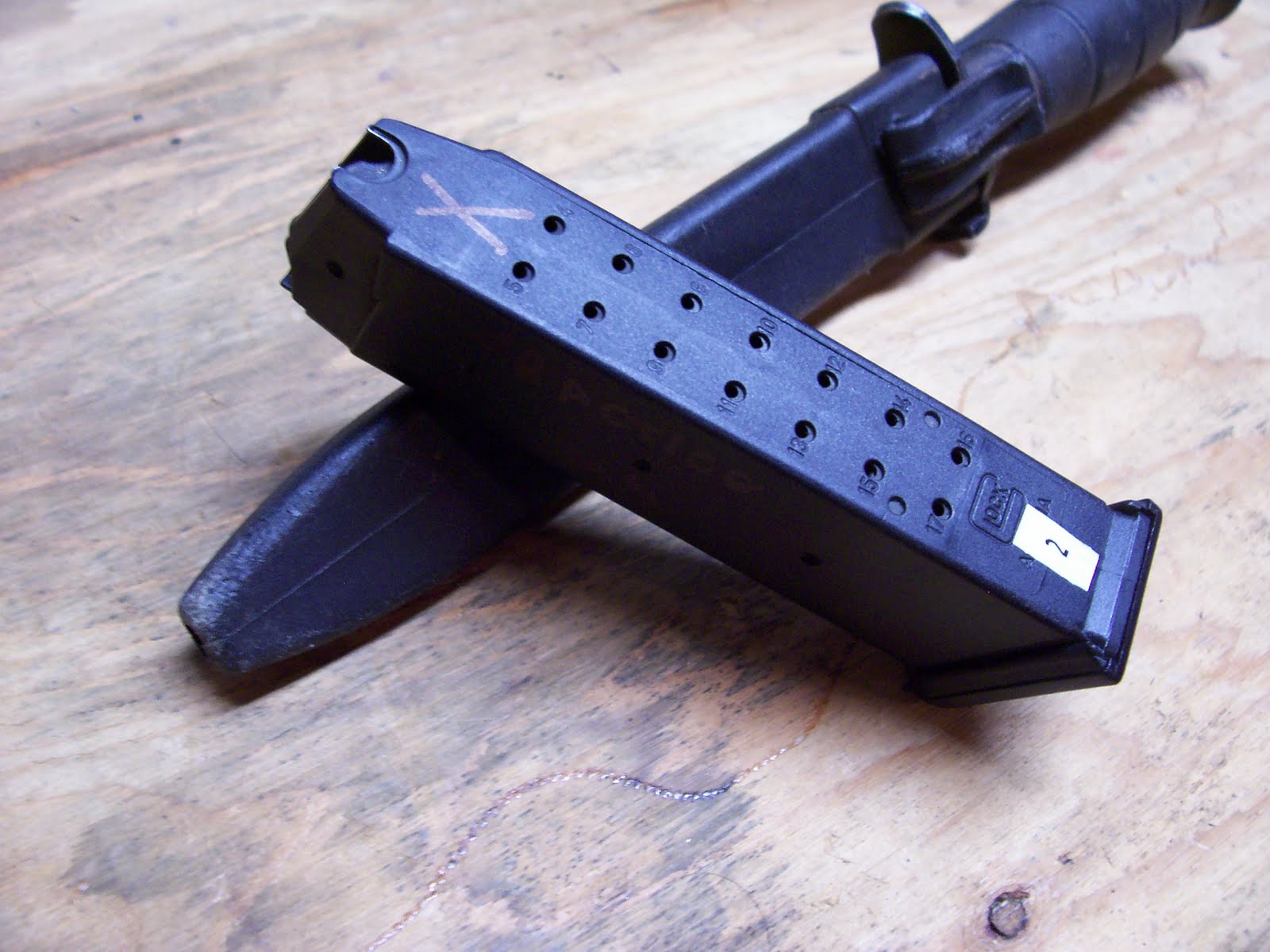
If you know anything about Glock magazines, these magazines were the Non Fully Metal Lined (NFML) magazines, essentially polymer bodies with a metal liner that didn’t go all the way around the inside if the magazine. Because of this, these magazines swell when they are loaded, hence their alternate name, “Non Drop Free” – when loaded, they don’t drop out of the gun under gravity when you press the magazine release.

There are obvious problems with this design. One, tactical reloads are problematic because you have to pull the magazine out. IDPA rules notwithstanding, if I want a magazine out of my gun in a hurry, I’d like gravity to do the work. Plus, over time, loading and unloading NFML magazines flexes the polymer and the metal lining, leading to material fatigue. Remember that part.

Glock fixed these problems later with the Fully Metal Lined (FML) mags, but they don’t swap old mags for new. (I know because I asked, nicely, just this week.) So I bought three FML magazines and three “Plus 2’s” for those, giving me six mags total.

Alas, nothing lasts forever.

When I was at the range last month with the Dauphin and his friends, I had a failure to feed using Magazine 2. I did the Tap-Rack drill, and still nothing. So I dropped the magazine (actually, I pulled the magazine out, since that’s what you have to do with NFML magazines) and I saw that a couple of the rounds, about midway down the magazine, had caused the mag to swell to the point where they weren’t in a nice straight staggered column any more. They were wedged in there so that the mag spring would not push the rounds up. Once I saw that, I banged the mag on a shooting bench, and the rounds loosened up and the mag worked again.

Then, last weekend at the Blogger Shoot, the same thing happened again. Since I numbered my magazines a couple of years ago, I knew this was the same mag that had given me problems before. Banging on the mag worked again, but I decided right then that Magazine Two was history.

I will keep it around, for reloading practice, but I plan to replace it with a FML magazine in the near future. As for the other two NFML magazines I still have, they haven’t given me any problems yet. But I will keep an eye on them, and I won’t use them for defense or competition. Yes, I could replace the mag springs with new ones, and that might fix the problem, for a while. But I think I’m still taking a risk with these mags, which means I need to get a few more FML mags to replace them.

Sounds like an excuse to head to the gun show this weekend, doesn’t it?
Be Prepared, Part 5 – Family Home Defense

I’ve owned a handgun, and kept it for personal defense, since 1992. I had a young family and I wanted to be able to defend them. My intentions and resolve were clear.

Just about the first accessory I bought besides a holster was a pistol safe. I bolted it down in a secure location, and whenever I wasn’t carrying, my Glock went in the safe. Now, if we were home, the safe was open, but I closed it when I went to bed, and if I left the house without my pistol, which was rare. I practiced getting the pistol out, even if the safe was closed, in the dark. When I got new glasses, the old ones went in the safe as a backup pair.

Soon, my wife asked if I would teach her to shoot, and it wasn’t long before we both felt she was good enough with it that I could leave the safe open when I left home.

I suppose I should address my gun safe. Did I worry that my children might get to my gun? Not really. They are both inquisitive kids, but not the kind that tear into things. I think this is due a lot to how we raised them. We never made any secret of the fact that I had a gun, and we never made it a taboo item. My kids came with me to pistol matches, and had a great time. But, just like the hot stove, my kids knew that the gun was something they didn’t need to mess with.

In fact, it wasn’t until my kids were old enough to be left alone, and trained, that they even knew where my pistol safe was located. And as far as I know, neither have given it the least thought. There’s no showing off Dad’s guns to the friends – my son has enough Airsoft and BB guns that it would be almost a letdown.

Home defense was pretty much left to me though, and the plan was to barricade ourselves in the bedroom as a safe room.

Last night, my wife told me about some home invasion stories she saw on the news. We talked about them, and she asked me if there was a way we could start keeping a gun in the living room with us, so that she or the kids could get to it quickly in the event of an invasion of our home. Since most burglaries happen in the day, and my family is home in the day but I’m not, this makes a lot of sense.

So this is my new planning task. We have a split level home with entry in a foyer that has stairs to get up to the living area, so we already have some built in defense. I know it’s going to take more than just keeping the gun handy – we need to train as a family, and work out plans for what to do, just as we have for fires or evacuation.

I’ll share more as the plan develops. And as always, suggestions are welcome.

New Youtube Channel

I now have a Youtube channel:

http://www.youtube.com/user/FillYerHands?feature=mhee

Take a look. I’ve uploaded some video from the Blogger Shoot, as well as some older videos from GSSF, like the 2009 Gunny Challenge finals, and some Glock exhibition shooting by Dave Sevigny, Randi Rogers, and Jessie Abbate when she was with the team.

I will upload more videos over time. Keep coming back.

Thoughts on Training

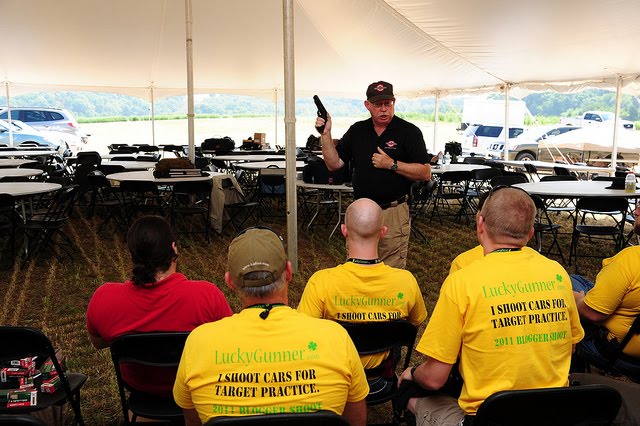
Photo by Oleg Volk courtesy of LuckyGunner.com

Last Sunday, as part of the Blogger Shoot, I got to participate in some defensive handgun training with Tom Givens of Rangemaster. I briefly covered the training in yesterday’s post, but I’ve thought about the training since then, and I wanted to share some additional thoughts.

While I am fairly new to handgun training, I am no stranger to training in general. I have a degree in chemical engineering, and I’ve attended training seminars and classes on everything from hazardous waste regulations, to how to get more out of Microsoft Excel, to how to deal with the media during a crisis.

One of the things I learned a long time ago is that, unlike college courses, for short seminars and classes, a student can probably expect to take away one really usable point per day. While you might remember more, if you can take one point to heart and make it part of your daily routine, you’re doing well.

Now, I usually try to relax my brain when I take classes, since I never know ahead of time what that one take away point will be. Inevitably, too, there will be a lot of material that is familiar, and I want to avoid letting my mind wander, so I will try to pay attention to the teacher regardless.

Sunday, I almost forgot all that.

Tom started the class with a presentation of the Four Rules of Gun Safety made familiar by Lt. Col. Jeff Cooper. These are well know. Heck, I’ve blogged about them, and about how we should make “Never try to catch a dropped gun” into Rule 5. So, in my mind, when Tom was talking, I was thinking about my blog post. Dumb.

You know what? Later, on the range, Tom told everyone never to try to catch a dropped gun. No, he didn’t make it Rule 5. He just said Don’t Do It.

Later, when we actually got to shooting, he talked about the concept of Follow Through. I had heard others talk about Follow Through before, but I had never been trained about it, but here it was – Follow Through is to complete the shot so that you are ready for another shot if needed. That means taking another sight picture, and having the trigger ready by only releasing it back to reset.

At that point, my mind wandered to a GSSF match at Fort Benning some years back, when an Army Marksmanship Unit RO asked me after one stage, “Do you mind if I give you a tip?” Heck, who turns down tips from the AMU? He then told me that I was taking my finger off the trigger between shots, and instead, I should only release it back until I felt it click, when the internals reset. He even cycled the empty gun for me so I could feel the difference.

Back to the training Sunday, and Sean Sorrentino of An NC Gun Blog and I are cycling each other’s gun so we can feel it reset. But my mind is at Fort Benning. And Sean is no AMU sergeant.

Then we start to shoot. Draw to ready, up, sight picture while taking up the trigger slack, squeeze a shot, follow through, take another sight picture, and let the trigger reset.

Only, after 3 or 4 rounds like this, I become aware that I AM LETTING MY FINGER LEAVE THE TRIGGER AFTER I SHOOT! Since we are only taking one shot, my mind thinks it’s over, and lets reset go out the window. How dumb.

Then, it’s Sean’s turn to shoot, and I’m watching, and he’s letting his trigger go to reset. After one shot.

So when it’s my turn, I concentrate, and let the trigger go to reset, and I put the sights back on the target. At the time, it’s no big deal.

Then comes multiple shots. First, one per second, then two per second, the four per second. I have to admit, in the past my groups have gotten very wide at this point. I’m talking about “Mike” wide. But, since I’m now following up the way I’ve been taught, my shots are still tight. In the end, my target has “one ragged hole.”

So, it turns out, Follow Up was my take away. And, I learned something about myself, that even an old skill can become a take away, if I’ve not used that old skill.

EPILOGUE

Monday, I shot a pistol steel challenge match at Creekside Firing Range in Taylorsville, GA. This was not your typical steel challenge match.

One stage involved taking 3 poppers from behind the left side of a barricade, the switching to the other side of the barricade and taking 3 more poppers, then hitting the stop plate. Sounds simple enough. Only the front popper on the right, it turns out if you watched the shooters, is set an a little bit of an angle, so that it takes multiple 9mm rounds striking it at the top to take it down. I watched one shooter in the squad ahead of us shoot this popper 9 times before it fell.

When my time to shoot came, I made my plan. I would start out on the multiple hit popper, then move on. I drew and aimed at the top center of the popper, and shot, and followed up. In four shots the popper was down, and I went on. Honestly, I don’t think I could have made that shot a week before. All because I followed through.

Thank you, Tom Givens.