What’s the Best Gun for Self-Defense? Part 2

Today I was talking with a colleague at work, and he mentioned he was planning to buy his wife a gun for self defense. I waited for him to ask my opinion, but he didn’t, so I asked what kind of gun he was planning to buy.

“Oh, a .22, of course.” He then went on the explain that it was perfect for his wife – lightweight, low recoil, inexpensive to buy and to practice, and deadly.

“After all, there was that woman in Duluth last week who used one to kill that home invader.”

He was referring to this story, which I wrote about last week. It’s probably been the most talked about shooting topic for me with non-shooters, in the past week.

What I wanted to say was, “Okay, that worked for her, because it was the one she had at the time, but it’s not the one I would pick, if I could pick ahead of time, which is what we’re doing.” But I didn’t.

Instead, we talked about the best way to make a .22 a viable self defense weapon. Whoever uses it has to be able to deliver a lot of shots to vulnerable areas of the attacker’s body. We’re probably talking about 8 or 10 shots to center of mass. Or being willing to make head shots.

I left him with the task of finding out if his wife was willing to do what it took to make a .22 work. Could she make head shots, or would she be able to hold her ground and make multiple shots to other areas, like the pelvic area?

Thanks to a woman who did what she had to do, I’ve changed the way I see self defense handguns. Would I pick a .22 for myself as a self defense gun? Probably not. But, if I’m ever in a situation where my Buck Mark is the only gun I have to use, at least I know what to do. And, more importantly, I know it can be done.

Glock Torture Test

Last weekend, Double Aught over at RomeoTangoBravo put 1000 rounds of .40 S&W through a Glock 23 with no lasting effects, unless you count scars.

I love torture tests, especially ones like this that are not beholden to anyone to report favorable results. Check this one out here.

2011 Gunnie Awards

LuckyGunner.com is sponsoring the 2011 Gunnie Awards, to recognize the best gun blogs, podcasts, and websites.

While I am not nominated for any award, you may want to go their website and vote for your favorites.

2011 Gunnie Awards

I will be at the awards ceremony Memorial Day weekend, and I look forward to meeting my favorites in person.

Disclosure: I will be attending the LuckyGunner.com Memorial Day Blogger Shoot in Knoxville, TN, but nobody has asked me to advertise for them.

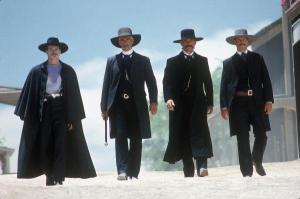
Oh No, Not Another Tombstone Discussion

Why am I drawn to the movie Tombstone?

Tombstone is the story of larger than life people. The two main characters, Wyatt Earp and Doc Holliday, are heroes, full of courage, strong of soul. Yet, they are fully human, not classic movie heroes at all. They have faults, fears, misgivings, and their actions aren’t always heroic.

For instance, in his first scene in the movie, Doc Holliday gets in a fight over a card game (in which he may or may not have been cheating), stabs a man, and robs the casino on his way out, skipping town and leaving his belongings in the room lest his enemies ambush him there.

The movie’s greatest hero, Wyatt Earp, has his light side and dark side. When Curly Bill Brocius shoots Marshall Fred White in a drunken stupor, Earp makes it a point to capture Brocius alive and protect him from a lynch mob. Yet, later after the Cowboys ambush Wyatt’s brothers, he shoots Frank Stillwell in the back with a shotgun.

And, as in real life, allegiances can change. Sherman McMasters, Texas Jack Vermillion, and “Turkey Creek” Jack Johnson are all Cowboys in the beginning of the movie, but they side with Earp and Holliday in the end. And Sheriff Behan deputizes Curly Bill and other Cowboys later, as they go after Earp’s bunch.

Probably the thing that draws me most to Tombstone, is the well written dialog. The movie is full of memorable lines, made better by strong performances by Val Kilmer as Doc Holliday and Kurt Russell as Wyatt Earp.

One excellent example is Wyatt Earp’s first encounter with Billy Bob Thornton as Johnny Tyler, the Faro dealer.

TYLER: For a man that don’t go heeled, you run your mouth kinda reckless.

WYATT: Don’t need to go heeled to get the bulge on a dub like you.

TYLER: That a fact?

WYATT: Yeah. It’s a fact.

TYLER: Well I’m real scared.

WYATT: Damn right you’re scared. I can see it in your eyes. . . . Go ahead. Skin it. Skin that smoke wagon and see what happens.

TYLER: Listen Mister, I’m getting’ tired –

WYATT: I’m getting tired of your gas. Jerk that pistol and go to work. . . . I said throw down, boy. You gonna do something or just stand there and bleed? No, I didn’t think so.

Yes, there is the famous gunfight at the OK Corral, and it is given a fair accounting, from what I’ve read. But rather than focus on this one fight, the movie is mostly the story of the aftermath – the Clantons’ retaliation against Virgil and Morgan Earp, and Wyatt’s vendetta against the Cowboys.

Then there is the feel of the movie, the visual. I love the scenes in the wild west, the open spaces. I lived in the panhandle of Texas for a while, and it reminds me of the land there, the land of the Lonesome Dove cattle drive, the land of Red River. It reminds me of rugged individualism, of men who are their own masters.

Are there things wrong with the movie? Yes, of course. But, I will leave that discussion for another time.

And, perhaps thankfully for my Twitter followers, that discussion will stay off line.