Be Prepared, Part 2 – Getting Home

I’ve talked here about the need to plan for emergencies. In the course of my planning I ranked possible scenarios, and made plans to deal with the most likely ones.

My Day Job is a great gig, but it means commuting 30 miles one way. My planning showed a number of possible scenarios where I could find myself stranded on the road. And, having lived in the Texas Panhandle, where getting stranded in your car by a snowstorm is almost a certainty, I knew the value of having emergency provisions, and a plan. I decided, though, to extend that to any scenario where I needed to survive on the road without my car, most likely having to walk home.

This leads us to the idea of the Get Home Bag. This bag is meant to support any number of people, for however long it takes to get to the safety of a better location. You keep it in your car, and when you need to, you grab it and go. For me, this means I planned for 2 people for a 3 day walk home.

Here is what I keep in my Get Home Bag. Naturally it contains all the things I used to keep in my cars for getting stranded by Texas winters, along with what we would need on the road. I check the contents at least monthly, and I put the bag on every now and then, and carry it around a while, to be sure it is manageable.

Granola bars
Water
Change of clothes (2 shirts and 2 pairs of socks)
Work gloves
Poncho
Shoelaces
Bandana
Rubber jar opener
Cell phone battery charger
AA Batteries
LED flashlight
Light sticks
Ammo
Lighter
Candles
Purel
Germicidal wipes
Bedroll and fleece blanket
Space blanket
Entrenching tool
Multitool
Trash bags
Map
Compass
Whistle
Pen & paper
Rope
Drugs – Aspirin, Immodium, Sudafed, Antacids

In addition, my plans would be to grab my gun, my cell phone, and the First Aid Kit out of my car. In the winter, I have a couple more blankets in the car any way, so I would grab those, too.

For you, you might find that your most likely scenarios don’t take you as far from home as mine do. If so, you can pare your contents down to a bag in the trunk. And, a simple Google search will find other suggested bag contents. Do some research and come up with what you would need. Then do it, because you never know when these things happen. If you did, you could stay home that day.

Make a Difference Locally

Tip O’Neill, Speaker of the House during the Reagan presidency, once said, “All politics is local,” and nowhere is this truer that with gun rights.

For most people, the gun laws and regulations that are applied by your state and local governments will affect your day to day gun life far more than anything the Congress will do on a national level. That’s why, once you are a member of the NRA, you need to seek out and join your local or state gun rights organization.

In Georgia, that group is GeorgiaCarry.org, or GCO. GCO has been instrumental in changing a lot of things that were wrong with Georgia’s gun laws, including the removal of a 140 year old law tha prohibited the carry of concealed weapons at “public gatherings,” even by license holders. They have also been successful in forcing Probate Judges, who are the ones in Georgia who issue Weapons Licenses, to issue licenses within the time frame mandated by law. Thanks to GCO, I wrote a lot of letters in the last couple of years to my state legislators, letting them know where I stood on the gun issues they faced.

So, I urge you to join your state gun rights organization, and your local organization as well, if you have one. A list can be found here. Then get involved. You’ll be glad you did

Join the NRA and Make a Difference

I first joined the NRA in 1993, by sending in a card that came with my first pistol. A couple of years later I decided to become a Life Member using one of their time payout plans.

The National Rifle Association is the largest voice for the Second Amendment and the rights of law abiding gun owners in America, with over 4 million members. It’s not the only voice we have, but it’s the loudest, and just about the only one that Congress and the anti-gun lobby both pay attention to.

Yet, most gun owners decide not to be members of the NRA. Whenever I meet a gun owner who isn’t a member, I ask them why. Here are some of the answers I get.

* I don’t want to be on any list for anybody to come after me for my gun.

Really? Don’t you think you’re on a few lists already? Have you bought a gun or ammunition using a credit card or debit card? Besides, what make you think, when the time comes, whoever is going to confiscate guns or round up gun owners is going to use a list? With over 75 million gun owners in the USA, door-to-door sounds a lot more effective. We’ll all be on the same list, then.

* I’m a hunter. Gun control doesn’t affect hunters. (A lot of these guys have Ducks Unlimited stickers on their trucks, too.)

What makes you think that? Ask Canada and Australia. Besides, there is nothing in the Second Amendment about hunting. And, what happens when they start confiscating “dangerous” rifles, and someone points out – correctly – that the average .270 deer rifle delivers a bullet with about 4 times the kinetic energy of the .223 Evil Black Rifles.

* I was a member once, but all they did was send me a bunch of mail asking for more money.

Okay. Either send them more money, or drop the mail in the trash. I do a little of both. Or, you can call them and tell them not to send you any more fund raising mailers. And, unlike a lot of organizations, they’ll stop.

* The NRA is so political now, about all they do is argue.

If you think that’s all they do, ask the Brady Campaign. Besides, every PTA in America is political, too. Unless you want to join the Board of Directors, the politics won’t affect you at all.

If you are a gun owner and you’re not a member of the NRA, shame on you. Visit http://membership.nrahq.org/ and join.

If you’re a gun owner and you think you have a good reason why you’re not a member, I’d love to hear it. But I’ve probably heard it before.

Practice for Competition, Part 2 – Target Transition

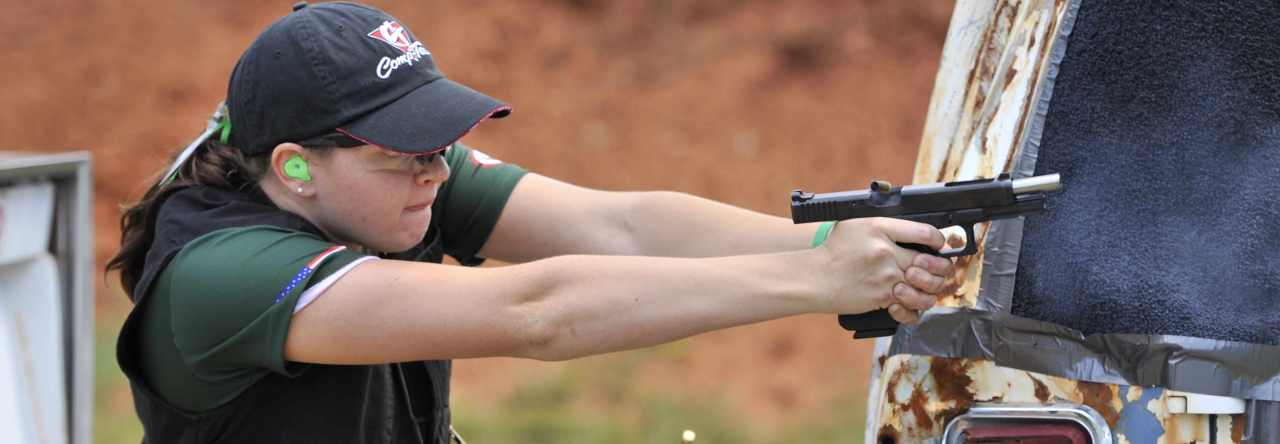
                                               Oops. I dropped a shot.

Most of the time I’m not able to get to an outdoor range and set up stages to shoot for practice. More often, when I do get to practice live fire, it’s in an indoor range. Here’s how I make the best of that practice time.

The best thing I practice indoors is improving my transition times between targets, and making sure my follow up shots to the same target are clean and fast.

First, I need to cheat. Since it’s tough to put multiple full size targets on a typical indoor range holder, the GlockFAQ has several competition targets that are scaled to 1/3 the normal size. This means that I can put the target at 25 feet and they are sized to be the same as if the full size target were at 25 yards. You can find those targets at http://glockfaq.com/targets.htm.

So, I mount two targets in one holder, and move the holder out to the desired distance. I start at about 15 feet, but I move it out as the session goes along. You’ll find that the farther you practice, the easier the closer shots get.

Unless your range allows drawing from a holster, all drills begin with the pistol in the GSSF start position – elbows at your side and pistol pointed down range. If you can draw, then draw, if you are practicing for USPSA or IDPA.

Here are my drills:

  • Fire one shot on the target and stop. Repeat until you are smooth and can do this in under 2 seconds.
  • Two shots on one target and stop. Take a 10 second break or so, then repeat, until you can make the first shot in under 2 seconds and both shots are in the center of the target
  • One shot on one target, then transition to the other target and fire one shot. Repeat until you are smooth and both shots are on target.
  • Two shots on one target, then transition to the other target and fire two shots. Repeat until you are smooth and both shots are on target.
  • Two shots on one target, then transition to the other target and fire two shots, then transition back to the first target and fire two shots . . . continued for 4 or 6 or 8 shots.
  • If your range allows reloads, load 6 rounds into one magazine and 6 in another. Shoot on three targets, reload, then three more.
  • Get creative. Fire two on one target, transition to the other target and make a head shot, then back.
  • An hour’s time and 100 rounds can make a big difference.