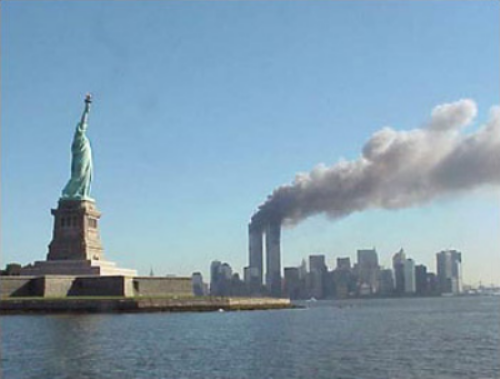
Today marks the twelfth anniversary of the attacks on the World Trade Center towers, Pentagon, and the crash of Flight 93 in Pennsylvania, September 11, 2001.
Personally I spent the day reliving memories of that day. I’ve writtenabout it before and don’t need to repeat myself.
I can only imagine what those who went through that day as part of the chaos, and the families of those killed, must go through, every day. Today has to be the worst.
So today I am filled with resolve that I will do whatever I can to make sure this never happens again. Yes, I know that’s bold talk for a one-eyed fat man, but by that I mean I will be ever alert, ever vocal, ever resolute. I’m not sure our country is any safer or better off than we were on September 10, 2001. I want to think we are, after all, there have been no successful attacks of any size on American soil since.
I also want to think the enormous expenditure of men and resources has bought us something, even if it’s experience points.
So what I resolve is to go forward and make America better, at least my part. To be alert, to be prepared, to be involved, to be armed, to be informed.
September is National Preparedness Month, so I thought I bring you at least one more installment in this popular series, Be Prepared.
As events like the Boston Marathon bombings, September 11, and Hurricane Katrina have shown us, our world can be thrown into Chaos any time. Keeping our families safe is always a priority, and in a time of Chaos, it becomes even more important, as it becomes more difficult.
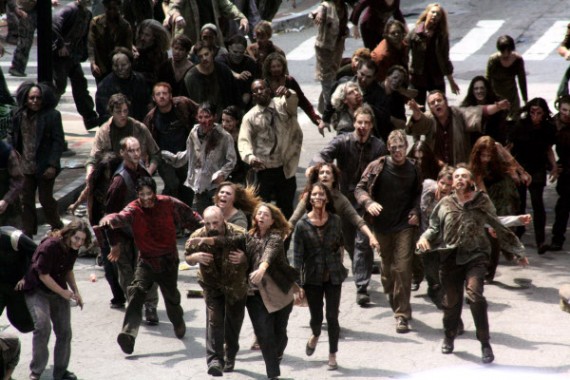
Of course, the problem with Chaos, as Jurassic Park’sDr. Ian Malcolm would tell you, is that anything can, and does, happen. It is, by nature, unpredictable. You cannot predict, with any degree of certainty, what will happen, or how people or systems will react to any given situation.
But that does not mean that we can’t make plans based on scenarios that we think are likely to happen. The best example of this is the reason every car comes with a spare tire and a jack. We can’t predict when or where, or even if, we will have a flat tire, but we can be prepared for it, and train for it by learning how to safely change a tire.
Most readers of this blog have also done that in a more specific way, by deciding that there is a finite probability, as Tom Givens would say, that we will encounter someone who needs to be shot. So, we carry a concealed weapon, we train ourselves in its use, and we prepare to deal with those consequences.
When we did our family plan, one thing we saw was that a lot of times we might not have a clear picture of what was happening – there would be Chaos. For us, the best way to mitigate that Chaos was to have everyone in the same place, preferably at home. So, in the event of Chaos, we need to know:
How is everybody? Are they injured? Are they threatened, or are they safe? If they are safe, are there threats in the area?
Where is everybody? If they aren’t at home, how can we get them home safely? Can they do it alone or do they need assistance?
What is the immediate situation, and what is the outlook for the foreseeable future? Do we need to move?
Then the plan becomes taking care of the answers to these questions – getting everyone safely home. In the course of this, here are some of the things our family came up with:
Every vehicle has a first aid kit, ponchos, food, and water.
My son goes to school with a first aid kid, poncho, food, and water. If has has to, he can walk home 5 miles. He knows the way home cross-country, avoiding main roads.
My daughter goes to college in downtown Atlanta, about 30 miles from where we live in the suburbs. One of the things we plan for is the possibility that she might need to evacuate downtown, but that she might be unable to do so safely by herself. As a result, I never leave my car at night without enough gasoline to get downtown and back.
I know 4 different ways to her college that don’t involve taking a main highway.
In the event of real unrest, communication is essential. For that reason, everyone in my family has a printed list of phone numbers of all the other members, plus others outside our area. We don’t rely on the phone list in our cell phones, since those may be lost, broken, or the batteries may be dead.
In real unrest, cell phones will be overloaded, as they were after the Boston Marathon bombing, and making calls will be nearly impossible. However, since the SMS text system uses the cell phone’s carrier signal to broadcast, if you have cell bars, you can almost always send text messages. Our family shares a text messaging plan, and we also know the codes to send emails to text messages. Look that up for your carrier.
Because it might not be easy or prudent to send a long text message, we all have a list of codes to use in text messages.
Family members outside our area are included in the system. Heaven forbid, “bug out” might get real.
In event of real bug out, we have a series of pre-chosen rendezvous points, depending on the direction we choose to go, which would be picked based on the threat and likelihood of threat in the direction we choose. We also have them picked based on how far we need to go.
In the end, you can’t plan for everything, but you can expect the Chaos that will come. Have a plan.
About a year ago I took a new job that has become everything I wanted it to be. The danger with that is that I have less time for this blog.
That’s no excuse, though. Shooting and civil rights are just as important to me as they ever were. So, I am going to make time, and endeavor to make this blog everything I want it to be.
“If you are finished, unload and show clear . . . “
I’ve shot in USPSA since 2008, and I finally got around to taking the Level 1 Range Officer course last month. I sincerely regret the delay.
As a bit of background, the National Range Officer Institute or NROI is part of USPSA, and administers the Range Officer functions for the sport worldwide. They write the rules, and give training around the world on how to run matches safely.
In all the years I’ve been competing, I have to confess, I have never run a competitor through a stage as the main RO, the one with the timer. I’ve not been certified so I’ve never felt qualified, even though I feel I know what to do.
Part of the problem was the USPSA didn’t put on many training classes in our area. But when I heard about this one, I signed up as quickly as I could.
Thus began the journey . . . .
DAY 1
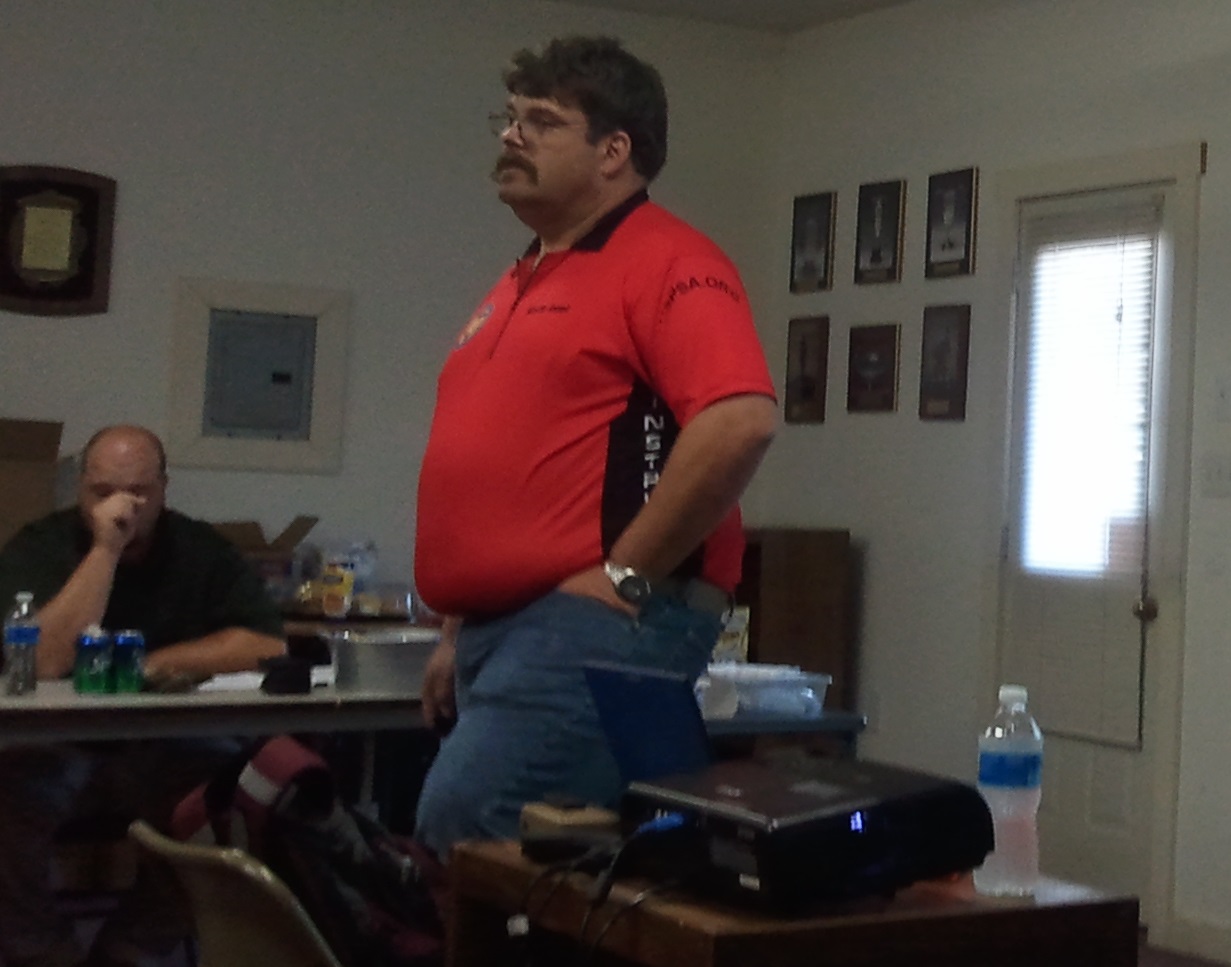
The class instructor was Kevin Imel, a veteran RO and Instructor from Washington state. His teaching style was very easy going, and it was obvious he had been there and done that.
The class is divided into two days, a classroom day devoted to the Rules, and a range day where we got to see the Rules in action, and show that we knew what we were doing.
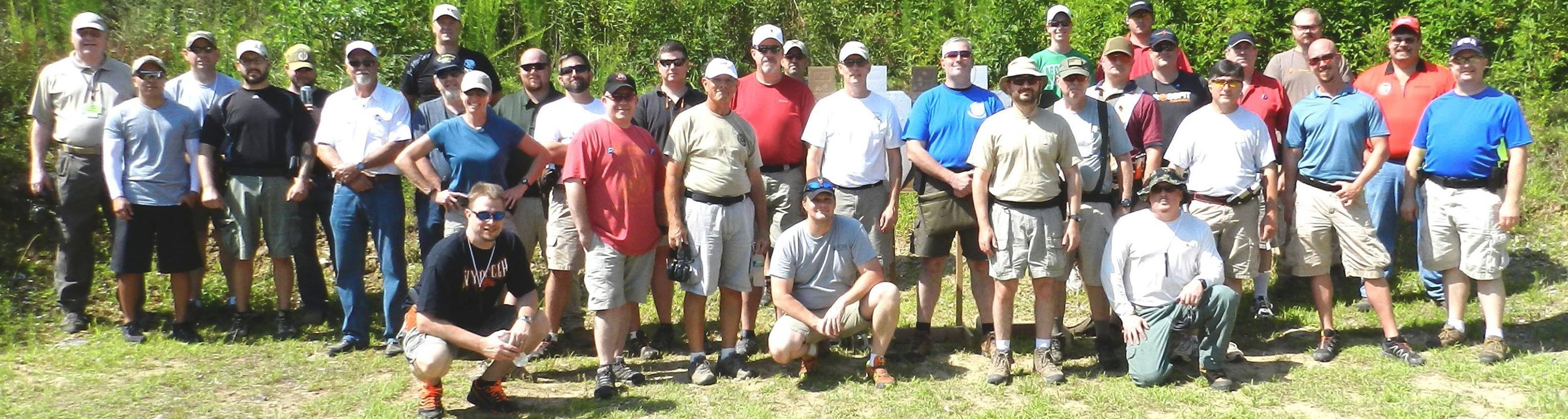
There were 30 people in our class, and as we introduced ourselves, I found that most of us had been shooting USPSA less than 5 years. Skills ranged from D Class shooters like me, up to World Champions. Seriously.
We were all asked why we were taking the class, and most of us responded like me: to learn more about the sport, and to give back by refereeing and making the sport safer. The best answer, though, came from the aforementioned World Champion, KC Eusebio, who said he was taking the class so he could DQ people.
Kevin then went through the Rules, from front to back. I have to admit, I had a passing knowledge of them coming in, but not very thorough. Kevin fixed that.
We covered all the Rules, along with examples of the usual kinds of things ROs come across. There was a lot of lively back and forth with the class, and a lot of “what if” and “there was this one time.” But in all, I really got a lot out of the day.
DAY 2
I won’t say that Day 2 was more interesting than Day 1, but, after all, USPSA is about shooting, and on Day 2, we shot.
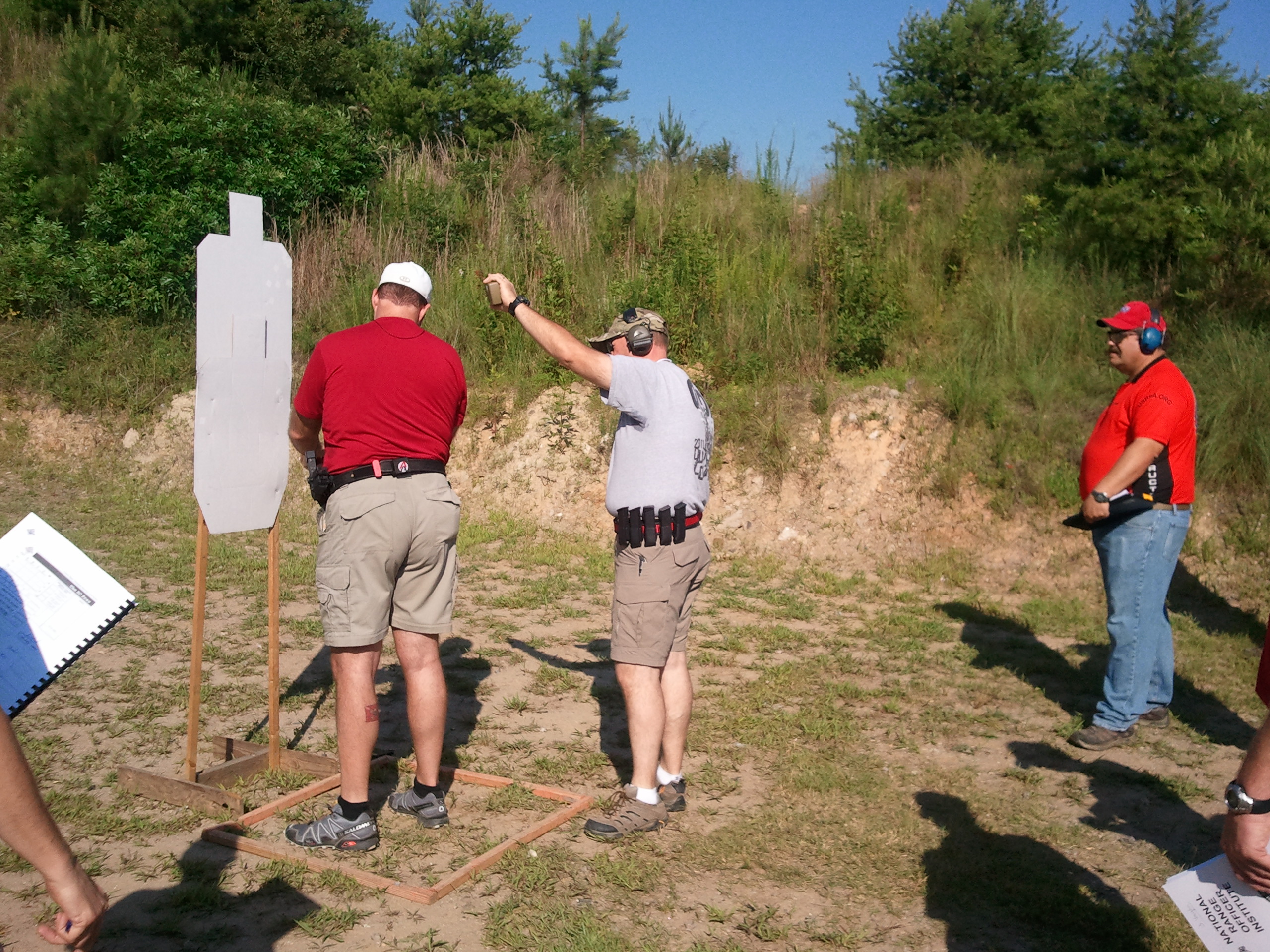
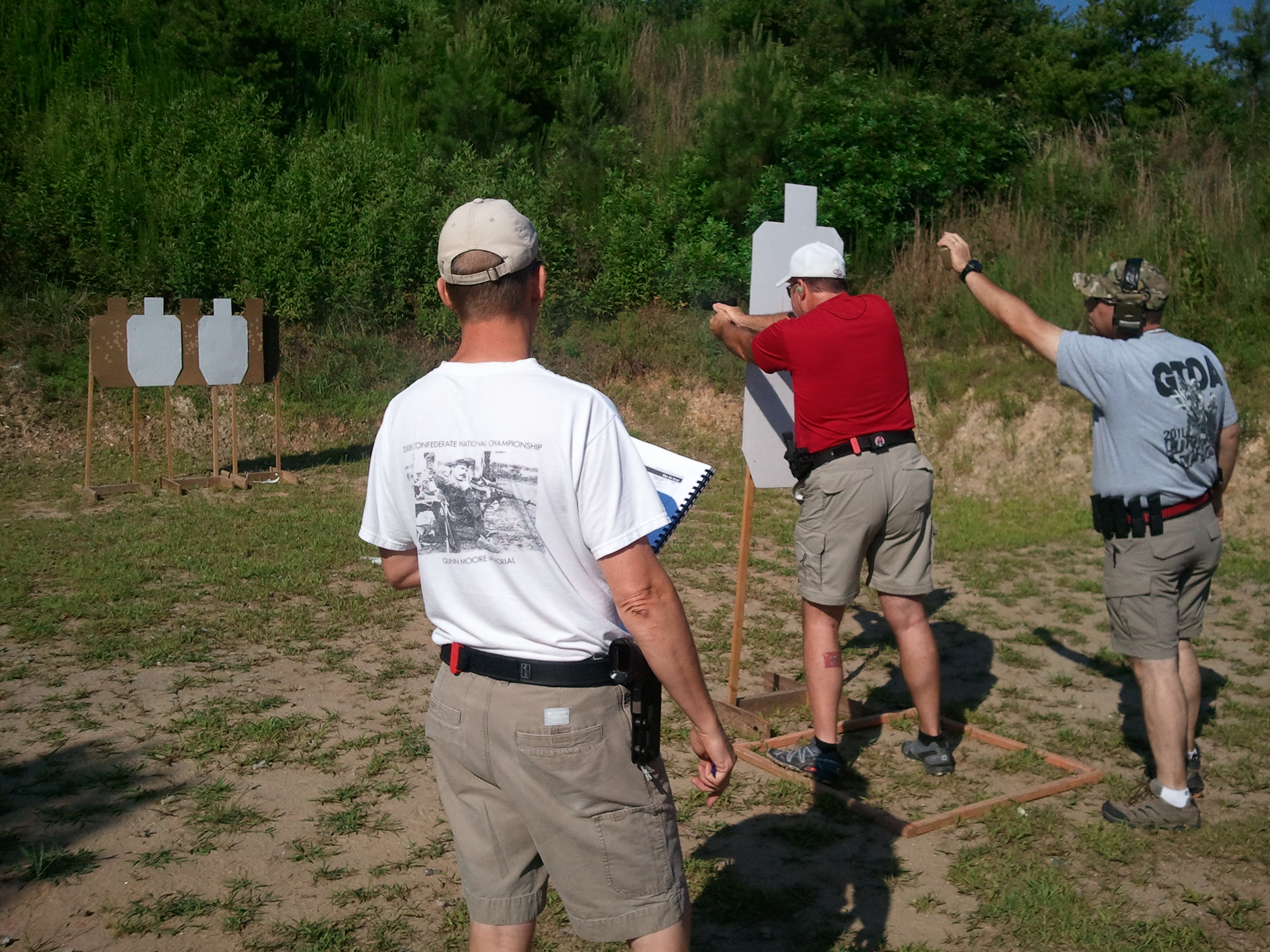
First, though, we set up the stage according to the diagram and written stage briefing. This is where you find out there is more to the setting up of a stage than it seems. To someone like me, who pretty much shows up and shoots (yes, I do help break down afterward), there was a lot more precision involved in how the targets are aligned and set. I admit, it took us a couple of goes at it to get the stage set, but soon, we were ready to shoot.
There are 2 tests involved to receive RO certification, a written rules test and a shooting test. The shooting test actually has 3 parts. In the first, you are the shooter. You shoot the stage safely and according to the rules, and the RO instructions.
The second part involves you acting as the main RO, the one with the timer. This is the one who calls out the stage commands, and a lot of us, having shot in other sports, were a little confused on some of the commands. But, we all eventually got them right.
The main RO is also the one who scores each target, and, as it turns out, there were wonderful examples of difficult calls all day. But again, we all learned how to do it.
The third part involves running the clipboard, and I have to admit, I never gave this role much serious thought in the past. In truth, this person has RO authority, and is the one who is supposed to look downrange and be sure each target is engaged.
In all, I made it through fine.
One note – KC Eusebio ran a really good shooter when it was his time to be the main RO. The shooter finished the stage with no penalties and no safety infractions.
But KC disqualified him anyway. After all, it was why he came to the class.
Oh, and he autographed that shooter’s book.
DAY 3
The last part of the class involved completing a written test over the rules. Each question required not only an answer, but we had to list the Rule number(s) that supported our answers.
I finally sent my test off to Kevin, knowing I had aced it.
Of course, I didn’t. But I did pass – so, but the tenth of next month, the USPSA will have at least one more Certified Range Officer, and, I suspect, 30 in all.

 Fill Yer Hands