
This is the second in my series of posts about practicing for competition. It is intended to lay out what a competitive shooter (me) can do to build muscle memory and improve pistol shooting. I should say by way of disclaimer that this isn’t a primer on practice for self defense – that will come in a later series. But a lot of the skills we will practice here will be useful for self defense, so this is where I start.
In competitive pistol shooting, seconds count. I’ve watched a lot of shooters at all levels, and one thing that separates the top shooters from the others is the time it takes to get the first shot off.
There are two parts to this – drawing the gun, and making the first shot. For some sports that start at a ready position not in the holster, like GSSF or Ruger Rimfire, this is distilled to the latter part.
I’m not going to go through the parts of the draw stroke, because a lot of people better than me have covered this in a lot better detail than I could. I suggest going to Youtube or Google and searching for “draw from holster” or similar.
BEGIN PRACTICE
Remember the mnemonic SPAR – Safety, Purpose, Action, Reflection. In this case, the purpose of the session will be to hone getting the pistol from rest to a first shot in the fastest time possible.
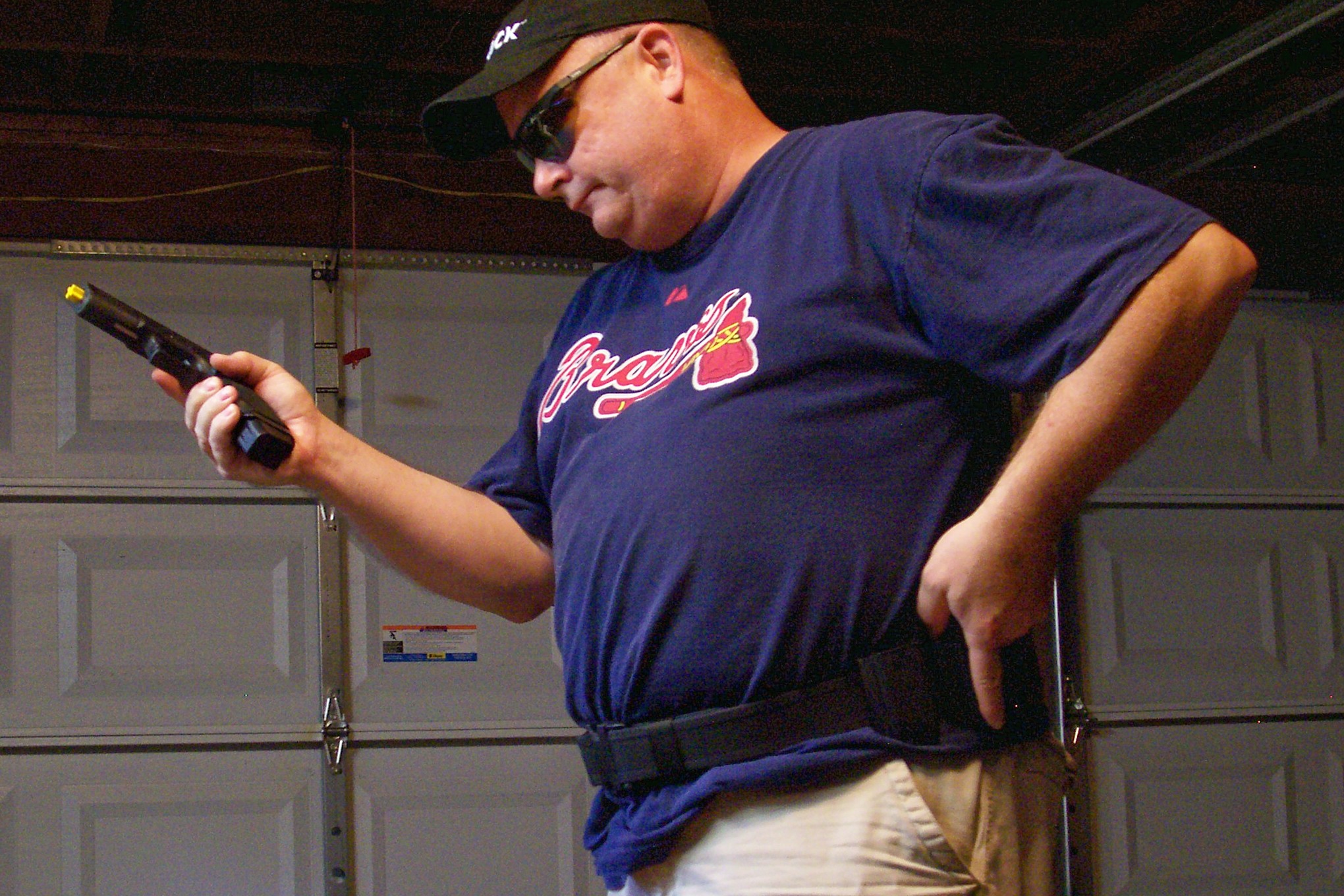
DRAWING FROM THE HOLSTER
To practice this, don your normal holster rig, and, if you’re practicing for IDPA, your normal cover garment. As with before, make sure your gun is unloaded, and all ammunition is removed from the room. This is especially vital if you will be practicing with magazines.
Starting with your hands in the desired initial position (relaxed or surrender) start out by drawing very slowly and intentionally, pressing out, and getting a good sight alignment. Press the trigger, and make sure the sights stay aligned. Concentrate on getting all the parts of the draw perfect. Speed is not the issue at this point.
Slowly increase speed until you are perfectly drawing as fast as you can. Then slow that back to 3/4 speed for most of the session.
Perform this with as many different hand positions as you can think of. Work on these with both hands, and with your strong hand and weak hand alone. Remember, you will see this in a stage, as well as a classifier or qualifier.
STARTING WITH THE GUN SOMEWHERE OTHER THAN THE HOLSTER
Many USPSA stages start with the gun unloaded on a table or somewhere other than in the holster. So it make sense to practice this. I usually practice it several ways:
- Standing, gun unloaded on a table. Grab the gun, insert a magazine, rack, press out to aim, and fire. Repeat.
- Seated, as above.
- Standing, gun unloaded on a table some distance away, magazine on a different table, some distance away. There are two ways to do this, grab the magazine first or grab the gun first. In a perfect world I grab the magazine first, but I practice it both ways, since I never know what sill come up in a stage.
- Standing or seated, with the gun in a drawer. This one is used a lot in IDPA stages.
STARTING WITH THE GUN AT READY
I devote the most practice to this, because this move is the most versatile. Think about it – starting with the gun at ready, I press out to the target, aim, and fire. This is what happens at the start of a GSSF stage and a Ruger Rimfire stage, but it’s also what happens every time I move from one shooting position to another in USPSA or IDPA.
This is where I have cut out the most wasted time, and I’ll share with you how. Watch a lot of shooters and you will see this: from ready, they press the gun out, bring it up to eye level, overshoot, bring it back down, overshoot, bring it back up, get the sights in alignment, and shoot.
What you see if the gun going out, then up, then bobbing up and down a few times until it stops. Then, they take aim, and fire.
What I learned to do is to bring the gun up to eye level as I press it forward. When it gets to eye level, I am still pressing out, and I am aligning the sights. Once the arms are extended, the sights are aligned, and I fire. Using a shot timer, I can go from ready to a first shot on target in less than a second. The key is to start aiming as the gun goes forward, and when the sights are on the target, fire.
As before, work on these with both hands, strong hand and weak hand.
PUT IT TOGETHER
Once you are comfortable with all these parts, put together a practice session, based on your upcoming competition. Here’s an example:
- From ready, press out, fire. Start slow and work up to full speed. 20 reps.
- From ready, strong hand, press out, fire. 10 reps.
- From ready, weak hand, press out, fire. 10 reps.
- From holster, draw, press out, fire. Start slow and work to full speed over 10 reps.
- From holster, draw, press out, fire, strong hand. 10 reps.
- From holster, draw, transfer to weak hand, press out, fire. 10 reps.
- Unloaded gun on table, standing: insert magazine, rack, press out, fire. 10 reps.
Again, there are countless permutations, and you can customize them to the matches you are shooting, and to the areas of your game you know need improvement.
REFLECTION
Now, as you put away your gun and holster, make note of what went well in your practice session. I like to keep a journal, and keep track of the drills I’ve worked on. When I find I have trouble with one, I can track my improvement, and make sure it gets fixed.
Next time: Sight Alignment and Trigger Control