Got It On Camera

My Quest for C Class

Note: I thought about delaying this post until I found some good video editing software that I like, so I could illustrate my points. But I think the points need to be made. When I finally settle on editing software I will post a follow-up.

When I first took up golf, one of the best tools I found to help my swing was to watch myself on video. While most people have no problem pointing out my faults, I tend to politely dismiss their help. But, on video, the good parts and bad parts of my swing stand out clearly, without comment or advice. The camera doesn’t lie, and it isn’t trying to get in my head and mess me up to make that $5 Nassau.

This past weekend I was using some software to capture individual frames of my shooting videos as photos. In the process, I got to look at my shooting stance, grip, and follow through in slow motion, and I found out that video works the same way with my shooting as it did for golf.

When I shot video of my golf, I would tape my practice sessions as well as my play, so I could compare what I did when I concentrated on it, versus what I did when I wasn’t concentrating as much as relying on muscle memory and training.

For my shooting, I reviewed match footage, but I don’t have video of any practice sessions. I am focusing on the match, and on making good shots, not on the mechanics. So, what I am seeing on video is my ingrained habits, my training.

Here’s what I found out:

> My draw is smooth, and it does what I think I have been practicing for it to do. The gun comes out and up smoothly, and I press straight out while the support hand takes a grip. It also goes straight to the target, without any oscillation at the top. That’s good.

> I control recoil a lot better than I think I do. From the beginning of my shooting career, I’ve always thought that I did a poor job of recoil control, almost like I was shooting one of those .500 Magnums you see on Youtube. It turns out, however, that my muzzle rise is actually on par with some of the best shooters I’ve seen. It goes up just a little and settles right down. This proves that not only do I have a bad image of myself as a shooter, I’m also focused well on the target such that muzzle flip isn’t even noticeable. That’s good.

> I do a decent job of positioning my body as I shoot. But, as I suspected, I move a lot like a sea lion. That will improve as I lose weight. I full imagine to be moving like a penguin in no time.

> On close up targets, I lack the confidence to make double taps. I will instead take two measured shots. It’s not that I can’t do double taps, so it has to be confidence. That should come with practice.

> I do a decent job keeping the muzzle down range when I move. I’ve never been warned or DQ’ed by a Range Officer, so that confirms it.

> I need to pay a little more attention to my trigger finger when I draw or move. I have been warned about this, so this is something to pay attention to and practice.

> Compared to someone like Dave Sevigny, my magazine changes look like I’m trying to force a live snake into a coke bottle. I think I can make this better by practicing. But it’s not because of the direction the bullets face in my magazine pouch. (Yes, I had someone point this out to me, again.)

> My Glock 17 Bruce runs flawlessly in every video I’ve shot. This jives with the fact that I’ve never had a malfunction of any kind in a match. In fact, apart from a broken extractor and a couple of limp-wristing incidents with my son, Bruce has had exactly 2 failures to extract in the 19 years I’ve had him.

At my next match, I’m going to try to get video of me on every stage. By then I will have some better editing video, and I’ll make another report showing what I’ve found.

I’m also planning a range trip on a week day in a couple of weeks. If the range is clear enough, I will get some video of some standard drills like El Presidente and the Mozambique. I can then compare my results to those I find on line.

Be Prepared, Part 9 – Stay Prepared

So, three years ago you did your part and put together a set of emergency supplies that you could carry in your car. Then comes the big snow, and you’re stuck. So, you get out the bag, and you find those batteries are dead, and the emergency food is gone, because your kids snacked on it a few times without telling you. Bummer.

A few months ago I wrote about my Get Home Bag that I carry with me in the car. Like just about everything in life, even a Get Home Bag takes maintenance. So, with winter approaching, I took some time to unpack the bag and make sure the perishable items were fresh.

You can see the contents of my bag above. I listed them in the previous post, and all was there except the granola bars, which I had commandeered for the most recent USPSA match.

I ended up replacing the water bottles, but everything else was good. I also shook out the blanket and bedroll and re-folded them, and I will wash and dry the towel, too.

I also checked out the compass (it was fine), and tried the lighter (it lit fine). Another change I made was replacing the two AA batteries with three AAA batteries, since I changed my every day carry flashlight to one that takes AAA.

For sure, repacking it all was a pain. I should have taken some pictures of what went where. But, in the end, it all went back.

You put good effort into planning. Take a few minutes now, and periodically, to make sure your work wasn’t in vain.

Where Were You?

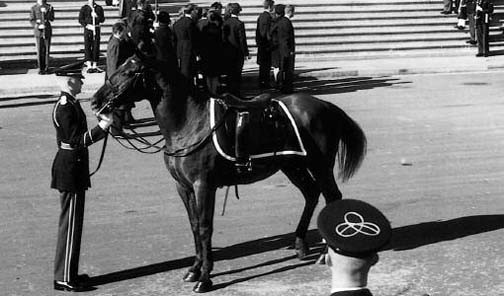
US Army Photograph

When I was a very young boy, we lived a couple of blocks from my grandparents, and my parents would take advantage of that as often as they could. For sure, this meant that I spent Sunday mornings with my Grandmother, while my folks went to church. I liked that a lot, since I was the only grandchild, and I was treated well, as you would expect.

I remember I really enjoyed watching cartoons on Sunday mornings, Popeye in particular, the old Max Fleischer classics, in black and white. At least, I remember them in black and white, probably because the TV was black and white.

One Sunday morning, my routine changed. Instead of my cartoons, there was something else on TV. In fact, it was on all 3 channels.

There was some kind of military parade going on, but there was no music. Everyone was quiet.

I distinctly remember one big black horse with no rider. Boots were in his stirrups, and they were in backward.

I didn’t know why my cartoons weren’t on. My Grandmother came in, and she looked at the TV, and started to cry. This made me cry, too.

++++

This is my earliest memory. It was Sunday, November 24, 1963, and an honor guard was moving the body of President John F. Kennedy from the White House to the US Capitol, to lie in state, following his assassination on November 22. I was 2 years and 8 months old.

For years, I thought this memory was of President Kennedy’s funeral, of the procession from the Capitol to Arlington National Cemetery. Then, in 1983, to mark the 20th anniversary of the events, MSNBC replayed the NBC coverage of the assassination and funeral, exact 20 years from the moment it occurred.

There, on the 24th, as the TV showed the President being moved to the Capitol, I saw the military escort, and the big black horse with the boots backward in the stirrups. I then realized it wasn’t the funeral I remembered, but the moving of the President to the Capitol.

I remember, in 1983, being 22 years and 8 months old, still being moved to tears by the sight of the horse, by the memories.

Every generation shares a “where where you” moment. For this one, it’s the September 11 attacks. For others, it’s the Challenger explosion, or Pearl Harbor. This is one of mine.

Paradigm Shift

When I first took up competitive shooting, back when the Earth was still cooling, I discovered something that, in retrospect, was detrimental to my growth as a shooter. It’s taken me a long time to change that, and even now, I have only changed half of it. The time has come to change the rest.

The Mistake

The club I first shot with in Alabama was filled with pistol shooters who had grown up in the time when Bullseye and PPC were the reigning games. So, they concentrated a lot on accurate shooting, and not as much on speed. I, on the other hand, was new to competition, and I looked at the scoring method, which was total shooting score divided by time, and realized I had an advantage. Most of the members were shooting 9s and 10s but shooting slower than me. I found that I could shoot 7s and 8s but shoot faster, and win. For two years this worked, and I either won or came in second in just about every match. This was my mistake.

Fast forward about five years, to an IDPA club in east Texas. I was still fast enough to get away with shooting not so well. Yes, there was an added penalty for a complete miss that wasn’t there in the Alabama club. But I still did well. I was shooting against some professionals – a couple of Border Patrol agents and some Texas DPS Troopers – and I usually managed to at least be the high amateur. So I settled for faster scores with poorer shooting, and I told myself that was good. My mistake continued.

The Truth

Now, I was faced with the Truth – I can’t shoot badly fast enough to win. So I concentrated on shooting better. In the past two years I’ve learned my about sight alignment and trigger control than I ever knew before. And my shooting scores have improved.

But, I can’t move as fast as I did, and it’s killing my overall scores.

I won’t re-post the video of me shooting the same stage as Dave Sevigny in USPSA, but it’s there in black and white. Dave shot the stage in 28 seconds and I shot it in 63 seconds. That means he could have started over again, and still beat me.

Now, the good side to this is, as I said, my shooting scores have improved. Dave had 174 points and I had 162, right in the middle of the pack. Looking at the other stages, and all 67 competitors, my shooting was in the middle, definitely C Class. But, over the last 20 years I’ve gained weight and slowed down, and that will keep me in D or worse.

And, I need to face it – if I am in a life and death struggle today, I probably won’t survive, because I’m so out of shape and overweight. I’ve been telling myself that I can survive on shooting skills or survival preparations, but that’s not true.

The Answer

If I am ever to get any better in this sport, and if I am going to have a chance of surviving TEOTWAWKI, I have to lose weight and get in shape. And the truth is, at my age, it’s only going to get worse, without hard work.

This isn’t anything new. I’ve been saying the same thing for a long time. My doctors have been saying the same thing for a long time. I would go on a diet and exercise program that was successful for a while, but only as long as I kept it up. Then the old habits would come back.

So I write this today, not to moan and complain, but to get it in black and white. I have to change my lifestyle, if I am going to get better. If I am going to live.

The Shift

I have a plan*, and over the next few months and years I’m going to share my progress, my ideas, my successes, and my failures.

I admit I was reluctant to do this publicly on my blog. But if I am going to succeed I need motivation and support, and maybe this is where I will find it. So, here it is.

* The Plan.

It’s a radical plan my doctor suggested. I suspect he got it from some shady website, maybe a late night infomercial. It has 2 crucial steps, and it scares me, but I’m going to try it.

1. Eat less.

2. Exercise.

I know, it’s radical. Wish me luck.