I may be late to the party, but check out the newly re-branded EmptyMags blog.
JP was one of the first gun bloggers to welcome me to the fold. He’s been a great source of information and entertainment both on his blog Eyes Never Closed, and on the Twitter.
He recently started the Empty Mags Podcast, and has now combined those efforts into a unified website. I’m glad – this will give me one place to go. Believe it or not, I try to read all those blogs listed on the right side at least once a week, many daily.
Congressman Phil Gingrey, MD 119 Cannon House Office Building Washington, DC 20515
Dear Congressman Gingrey:
I know you support the right to keep and bear arms guaranteed in the Second Amendment. Currently, the consistent exercise of this right for lawful self defense is hindered by a patchwork of state laws governing the issuance of concealed carry permits. While my Georgia Concealed Weapons License is recognized and honored by 24 other states, there are many who do not honor it, because of differences in the ways the laws are written in those states.
I am writing you to urge you to vote YES on HR822, the National Right-to-Carry Reciprocity Act, which comes before the House for a vote in the next couple of days. This bill would level the playing field for the licensed concealed carry of firearms, by mandating that all states which issue such licenses honor licenses from all other states, in much the same way as states honor each drivers’ licenses from other states. This bill will go a long way to helping keep travelers and visitors safe.
Thank you for your attention to this important bill.
Yours,
XXXXXX XXXXXX
Kennesaw, GA
PLEASE write or call your Congressman today and urge them to support HR822, the National Right-to-Carry Reciprocity Act.
This past Saturday I shot the regular monthly USPSA match at the Cherokee Gun Club in Gainesville, Georgia.
The weather was perfect for a pistol match, starting in the low 50’s F and ending around 60, with a slight breeze. There were 67 competitors and all classes and divisions were represented except revolvers. And, Dave Sevigny was there, and I got to chat with him for a few minutes.
There was an excellent mix of stages as well, including a couple of simple stages and one of the most complex field courses I have ever had the pleasure of running. More on that later.
I started on Stage 4, but I’ll go through the stages from the beginning. Stage 1 was called Do Your Dance, and it consisted of multiple targets along the edge of the stage, with barrels and a dividing line up the middle of the stage. The Dance came from the requirement that targets on the left side be shot from the right side of the divider, and vice versa, so that the shooter was essentially dancing back and forth down the field. Very interesting. I shot it clean (which for me means no misses, I”ll worry about all Alphas later) but my time was slow. No surprise.
Stage 2 was the Classifier stage Cash ‘n’ Carry, with three targets from engaged from a box, one popper engaged while moving to a second box, and three targets engaged from the second box, only from under a horizontal bar that forced us to kneel or squat. (Given the choice I usually kneel.) I missed two shots on this stage and shot a no-shoot. Not good.
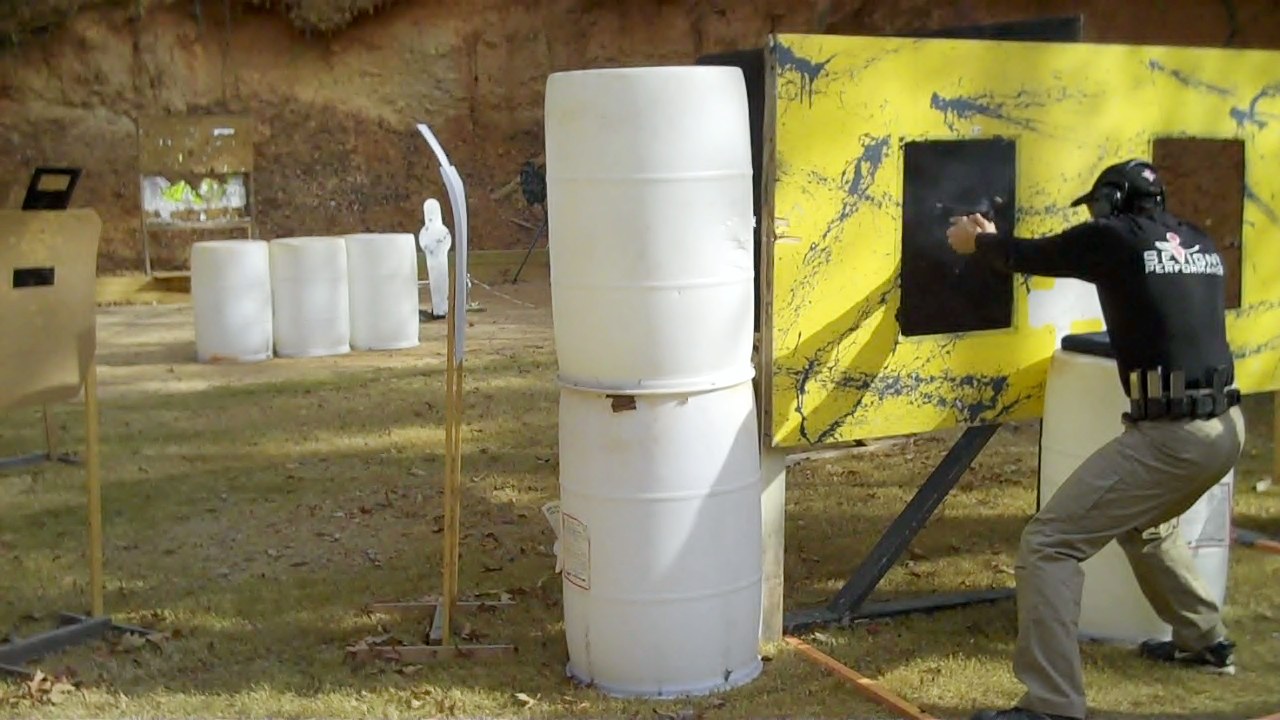
Stage 3 was called Doomed, and now I know why. It’s the one shown in the picture above. There were two swinging targets and a guillotine target. The Guillotine target is covered by a no-shoot at the beginning of the stage, and shooting a popper drops the no-shoot. About 2 seconds later another no-shoot rotates into position blocking this target, so you have a short time to shoot it.
I shot Alpha / Charlie on the guillotine, not bad. But I missed one shot on a 25 yard target, and one shot on one of the swingers.
The best way to shoot swinging targets is to shoot when the target is all the way down on the left or right, as it’s changing directions. In retrospect I should have shot more shots at the swingers.
Here is Dave Sevigny shooting stage 3:
Stage 4, where I started, was called Gotcha, and it was basically targets up the middle of the stage, with lanes on the outside of the stage where the shooter had to be. We shot our way down to the end and then shot three targets over a barrier. For me this was my best stage of the day. No misses, mostly Alphas.
Stage 5 was called Zombiemart. This one started with the gun in a cash register (really a briefcase) and then we engaged three targets straight away, with targets to the left and right.
I’ll come back to Stage 6. . . .
Stage 7 was the Classifier Table for 1, and was a welcome change. Starting with an unloaded gun sitting at a table, we shot three targets, then reloaded and shot them again. Since I finished 6th in Production on this stage, this tells me my shooting was good but I need to work on my movement.
On Stage 6 this was painfully obvious. Here I am shooting Stage 6, Barrel Issues.
Here is Dave Sevigny shooting the same stage.
That was the fastest time of the day. As you can see, there were steel plates, poppers, and a gallows. All the fun a shooter can stand.
In the end, I finished 50th of 67 shooters, and was the highest in the D class. I take what victories I can!
I also took away a lot of things today:
> I need to (obviously) lose some weight, so I can get around quicker. > I need to work on my double taps on close targets. On Stage 6 I shot a measured pair when a double tap would have done better. (Of course, I could also argue that if I shoot worse with double taps, say, Alpha / Charlie versus 2 Alphas, does that get eat up the faster time?) > My magazine changes were decent. > My sight pictures were decent, and I was calling my shots most of the day, even on the stages with lots of movement.
All in all it was the best match I’ve shot in a long time, and the most fun I’ve had in USPSA. Kudos to Peter Oliver, the match director at Cherokee. Peter came in second overall, by the way, which was probably the best he could expect.