When the World Changed – Part 2

Yesterday, I told about how things at work changed on September 11, 2001.

When I got home that day, things changed, too.

We had moved back to the Atlanta area a few months before, and we were renting a friend’s house until we decided where we wanted to buy. We hadn’t personalized this house very much. But when I got home that day, the first thing I did was put up a flag pole on the front porch, and fly an American flag. I left the porch light on to illuminate it at night.

When we moved into our new home a few months later, I installed a spotlight to shine on the flag. It flies 24 hours a day, 7 days a week. I’ve replaced it three times in 10 years, and only one flag has been worn enough to warrant disposal. I’ve kept one flag, and I’ve given the others to the local Boy Scout troop.

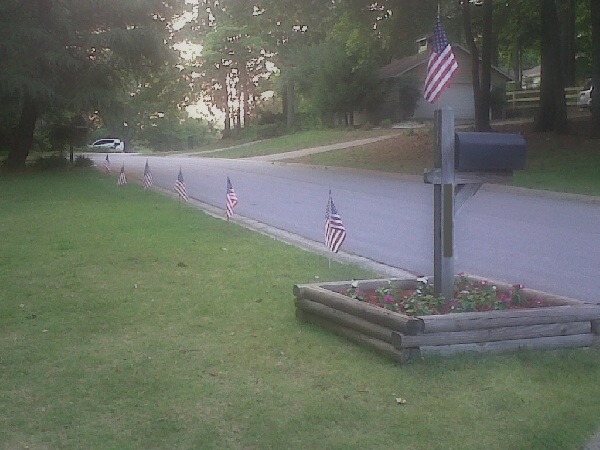
I also fly a flag from my mailbox to honor my brother Michael, who serves in the US Army. I started doing that when he enlisted 19 years ago. These smaller flags only last about 9 months on the mailbox before I have to replace them. I keep the best of the old flags to fly in my yard on national holidays, like in the picture above.

(I don’t know if my brother reads this blog, but I’m going to give away a secret – when my brother retires from the Army in 6 years, I’m going to box up all the old flags I’ve been flying and send them to him. I’ll tell you more about him at a future time.)

Does this mean I’ve become more patriotic since September 11? I don’t think so. I think I’ve stopped taking that patriotism for granted. I’m not a covert patriot now, I am overt.

I’ve also made changes to how I look at personal security. I now carry a gun just about everywhere, not just “when I think I might need it.” Like most people, my concept of “when I might need it” changed on September 11.

Do I worry about terrorist attacks now, after September 11, and Mumbai, and the other attacks since then? I don’t worry about them or change what I do because of them, per se. I know it sounds corny, but if I change how I live my life, then the terrorists have won. And I know that’s not true.

Maybe it’s just being 10 years older. I know I am 10 years wiser.

When the World Changed – Part 1

Photograph by Richard Drew

On September 11, 2001, I was plant manager of a specialty chemical plant in a suburb of Atlanta, Georgia. This plant used railroad car quantities of very hazardous materials, but like most plants in the industry, our safety programs made it a pretty safe place to work, and the record proved it.

That day there was supposed to be a regularly scheduled plant managers’ meeting at the home office, two hours’ drive away. When it was obvious that the planes were part of an attack, I turned around and returned to the plant. We had no idea if this was part of something much larger, and how much of America was targeted, and I needed to be there instead of in a meeting.

The thing I remember most about the drive back to the plant was the lack of police cars. I was able to drive as fast as I needed to, since all the local police were obviously going elsewhere.

That day, I learned the value of knowing the people who worked for me. One of the things I had done when I took the job as plant manager was to read everyone’s personnel files, and I paid particular attention to those with prior military or law enforcement service. So I knew I had several trained former servicemen working that day. One of our plant operators had been an Army Ranger in Desert Storm. We had another operator take his place in operations, and I had him walk the plant perimeter fence, looking for signs of intrusions.

One of my supervisors had been a Navy SEAL in a previous life*, so I asked him if he would man the front gate. Normally, the front gate was open, since there was no way to drive straight through into the plant without someone opening another gate in between. On 9/11 that changed, and that gate has been closed and manned every day since.

He asked me if it was okay for him to move his personal car up by the gate. I knew why he was asking, since I also had gotten to know people well enough to know who kept guns in their cars. Since I did, I didn’t see any problem with others doing so.

I told him to do what he needed to do, and I asked him if he thought he might need an assistant at the gate. “Not if I can get to my car, I won’t.”

Other than the sense of fear, anger, and uncertainty that everyone felt that day, at the plant we had no problems, and we never really had any problems after that. I did hold a quick plant meeting that afternoon before shift change, to remind everyone to keep their minds on their jobs, for safety reasons.

The chemical industry eventually instituted a lot of extra security measures, some of which were needed, and some of which probably were not.

For me, the lesson driven home was to know my people and their backgrounds, and to train everybody in how to protect themselves and the plant. One thing was sure – things would never be the same.

*A lot of people claim to have been a Navy SEAL. One advantage of reading people’s personnel files is it included their form DD214. This guy really had been a SEAL.

Gunsmithing or Something Like It

When I took the Glock Armorer course in 2009, I had the fantasy of using that class to springboard myself into a new and exciting (pronounced “lucrative”) second career, that could perhaps sustain me in my retirement years. When I was was growing up, I would spend my summers at my great uncle’s house in Florida. He was an engineer at Eglin Air Force Base, and he also had a gunsmithing business that he ran on the side, out of a wonderful little shop behind his house. I remember seeing all his tools and the guns his friends would bring him.

So, after all these years, I started thinking about becoming a part time gunsmith myself. However, I quickly learned a few things about gunsmithing.

I don’t have anywhere near the range of experience to make any money be any good at it. True gunsmiths study their craft for years and years, many times as an apprentice under an active gunsmith. If I had started (mumble, mumble, mumble) years ago, I might be there by now. But I did not.

It would be difficult to make any decent money as a gunsmith specializing in Glocks. I recently wrote a blog about the extensive work I have done to my Glocks to make them reliable. Getting someone to pay me to do the same to their Glock is another matter entirely. Yes, there are companies that specialize in aftermarket parts for Glocks, and they are profitable, but this requires volume.

Working on any gun involves calculated risk. After all, you are then asking the owner (me) to shoot the gun, and trust that your work was done correctly and safely. Getting to this level of trust with the gunsmith (again, me) involves years of study.

Having said all that, I have done some work on guns for people, successfully. In truth, most of what I have done should really be described as Armorer work. That is, I’ve replaced parts, cleaned and polished internals, and made some easy modifications. My most requested service is a Glock trigger job, which I have gotten quite good at. I’ve also replaced sights and internal parts.

Now, since Federal law requires that a gunsmith possess a valid Federal Firearms License, or FFL, if they take money for their services and hold guns overnight to do work, I’ve made sure not to take any money for my work, or hold the guns overnight. Lord knows, I don’t want to get in trouble with the ATF.

Mind you, I have done some work that I would consider gunsmith work. I say that because the advice most often posted on the interwebz about the work I needed to have done was “seek out the services of a trusted gunsmith.” And I found that with the right tools, a steady hand, and instructions that came with the part in question, or on the interwebz, I’ve been able to do a decent job.

One example was with my Mosin Nagant. The front barrel band came loose the last time I was shooting, and I found that the wooden handguard had shrunk over time, so that the barrel band holding it on was very loose. Now, the makers of this famous Soviet rifle made sure that the barrel band would not be overtightened or allowed to become too tight as the barrel expanded during use, by including a stop on the band, tow pieces of metal that hit each other and stop you from overtightening. But, this same stop now made it impossible to tighten it enough to hold the handguard in place. So I used a small grinder to remove some material from the stops, until the barrel band just held.

The danger, of course, is that the rifle will expand as it is shot, and the barrel band won’t (not as much, any way) and there’s a chance the wooden handguard would be squeezed in between so hard that it would crack. I will definitely pay close attention to this the next time I shoot.

I’ve also done some work on my SKS, most recently replacing the factory gas tube cover with an aftermarket piece that matched my new stock. This just involved drilling out a pin and reinstalling it with the new piece. A drill press came in handy.

Thinking about it, there’s really not much I wouldn’t at least be willing to try, at least on my own guns. But, my hopes of turning this into a second career have withered in the light of reality.

++++

Just as I was getting ready to post this, I remembered something my grandfather once told me. He was a professional auto mechanic, and his advice was to be able to do all my own work on my own car, but not to do it for a living.

Good advice, even for a gunsmith.

Glock Gen4 Recoil Spring Swap

Glock sent notice to all its active Armorers that they will now swap the recoil spring assembly (RSA) on any Gen4 Glock. I had heard before that this would be done on a case by case basis. Apparently Glock has decided that all Gen4 guns that want one should get them.

Personally, I have not had anyone come to me with RSA problems. On the other hand, you can read about them on just about any shooter forum. I’ve heard they happened mostly with the G17, large frame 9mm. I know shooters with G35s and G19s who told me they don’t have any issues.

If you have a Gen4 gun and you want the RSA swapped out, just contact any certified Glock Armorer and they can do it, but they will need to order the part from Glock so don’t expect While-You-Wait service. On the other hand, you can take your gun to any GSSF match and have it done immediately by the factory Armorers. I only hope they bring enough new parts to the match.

The notice also says “Agencies or Consumer’s wishing to participate in the exchange program at no charge are urged to call 1-877-745-8523 to order their new RSA,” so I assume individuals can contact them if you wish.

I will continue to monitor the situation, as they say, and let you know what I hear.

+++++

Update: to learn more about the Gen4 recoil spring issues, take a look over at pistol-training.com. ToddG has been doing a Gen4 G17 endurance test for quite a while and explains it all.