The Cost Of Competing

Recently Walt at Walt in PA and Ron at When the Balloon Goes Up! posted discussions of the cost of pistol competition.

Here is a chart from Ron, showing the five year cost of competing in IDPA, 6 matches a year.

Courtesy of When The Balloon Goes Up

To me, this chart bursts a few bubbles.  The average shooter (that is, me) frets and worries about choosing the right gun, basing a lot of the decision on the cost of the gun, especially as a newcomer. Yet, as one can obviously see, the relative cost of the gun versus all the other costs – ammo, accessories, entry fees, practice sessions – argues that we should pick our guns based on the best gun for us as shooters, regardless of the price.

That is, of course, a very difficult thing to do. After all, we lay out the money for the gun in one lump, and most of the other money gets spent on an ongoing basis, certainly in sums less than what we laid out for the gun. For me, buying ammo a case of 1000 at a time, I spend $250 or so at a time, and it feels like a lot, even though it’s about half of what I spent on the gun.

++++

Having read this from Ron, I decided to calculate what I spend on my competition over 5 years.

Here it is, for the hardware.

Glock 17 $400
Parts 150
Magazines 60
Belt 50
Holster 60
Mag pouches 40
Hearing pro 30
Eye pro 0
Knee pads 10
Range bag 0
Total hardware $800.00

Some explanation – I bought my Gen2 G17 in 1992. For competition I added a set of Warren/Sevigny sights, a (-) connector, and an extended magazine release. My eye protection was given to me, and I made my range bag out of a bag I got at a trade show.

As for the cost of competing, let’s look at a 5 year cost of shooting GSSF:

GSSF $125
GSSF Match Fees 375
GSSF Ammo 540
Total GSSF $1,040

For 5 years of USPSA:I join on an annual basis, but you could get a 5 year membership for $95. The match fees assume I shoot 3 matches a year. I also assume to shoot 3 boxes of ammo at a match.

USPSA $200
USPSA Match fees 1,200
USPSA Ammo 2,880
Total USPSA $4,280

Again it would be cheaper to join as a five-year member. I assumed an average of one club match a month, although I have access to 3 matches easily. This does not assume any major matches, or overnight travel. I also assumed 4 boxes of ammo per match.

Then, of course, is the cost of practice.  Assuming I shoot 4 boxes of ammo per month in practice, at $12 per box, I would spend $2,880 over 5 years. Add to that the cost of range time. (For me, I shoot at a Georgia Wildlife Management Area range, which costs me $20 per year.)

So, in total, over 5 years, I would spend:

Hardware $800
GSSF 1,040
USPSA 4,280
Practice 2,980
Total $9,100.00

That is a chunk of change, no matter how you do look at it, an average of $1820 per year, or about $150 per month.

++++

But another way to look at it is fixed cost and variable costs.

Fixed $875
Variable 8,235

At the beginning, one would lay out $800 for hardware, plus $35 for GSSF and $40 for USPSA. Then, you could look at it as the balance of $8,235, spread out monthly over 5 years, or $137 per month, or $32 per week.

Now, it doesn’t seem like so much, which is why I suppose I still do it.

What Is It Worth To You?

I found these questions posted by Ben Stoeger in the USPSA section of The Doodie Project:

What do you guys want to get out of this sport and what are you willing to put in to get it?

Wow. This hits to the heart of this blog, and to me this will take a little more thought and answer room than one post on a forum. Look for my thoughts in future posts.

Meanwhile, here is what Ben’s answers were:

I want to have fun, learn, and compete against the best.

I am willing to make shooting the number one thing in my life outside of eating and breathing.

When someone asked about what his wife thought of this, he clarified:

She knows where she stands. I leave my family behind to go and shoot just like pretty much everyone else on this board, the difference is I don’t pretend to put family first.

Interesting.

More to come . . . .

GSSF River Bend Ballistic Challenge V

Photo courtesy of Glocking Tall
On Sunday July 15, 2012, I traveled to the River Bend Gun Club in Dawsonville, Georgia, for the GSSF River Bend Ballistic Challenge V.  
As usual, I shot my Gen2 Glock 17 Bruce, and it performed perfectly, as expected. For those unfamiliar, you can refer to the GSSF course of fire here. 
MATCH PREMLINARIES
The GSSF course of fire consists of ten strings – 4 on Glock the Plates, and 3 each on 5 To Glock and Glock M. So, owning 11 magazines, I am able to pre-load my magazines and not have to do so at the range. That’s a nice thing.
One thing to remember is that we are allowed 11 rounds total per string, so if I load all my magazines with 11, and I don’t shoot the gun dry, I will need to strip one round off the next magazine before using it.
In fact, since 5 To Glock is exactly two shots per target, with no chance of make-ups as there are on the other two stages, I load my magazines 11 – 10 – 9. Then, I have one in the chamber after the first two strings, but the slide is closed. And, the slide locks back empty after the last shot, so showing clear is simple.
Before the match I did my usual pre-match checklist
Life has a way of throwing curve balls, though, and one thing I learned in baseball was never to sit on a pitch, that is, never assume you know what’s coming next.  This came to the forefront with a pre-match malfunction.
For dry firing I almost always install my plastic 5.11 training barrel. However, during the course of practice, the end of the recoil spring must have slipped off the notch in the barrel, because I couldn’t get the slide to slip off as I disassembled it, no matter how hard I tried. I tried everything I knew to get the slide off, to no avail. Finally, I had to resort to cutting the guide rod, and replacing it with a spare.
SHOOTING THE MATCH
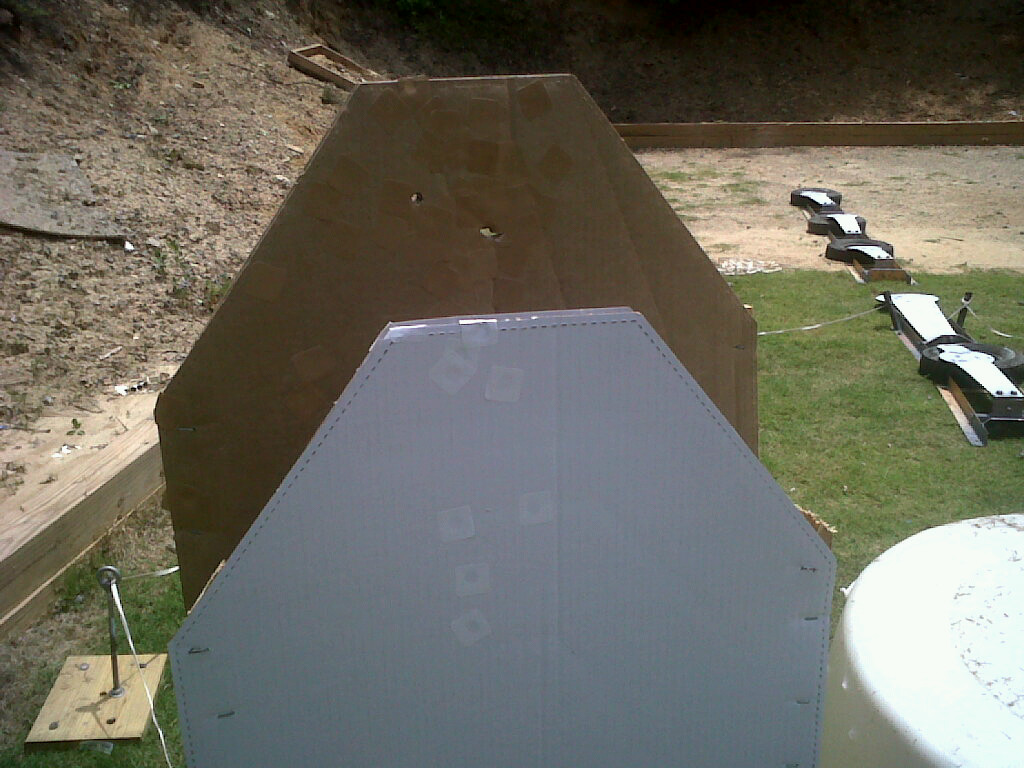
When I arrived, it had been raining, sometimes hard, for about an hour. Footing was still good, but some stages had the cardboard NRA targets covered with plastic to protect them.
I elected to shoot Glock The Plates first, without a warm-up round, since the plates weren’t affected by the rain. Bad idea. I left 4 plates standing my first round, and I could tell from the paint missing from the support that I had been shooting low and a little left, meaning I was jerking the trigger. I know enough from golf not to try and diagnose and fix problems mid match, so I just aimed a little high and right, and I had no misses the rest of the day. My Plates runs were in the mid-7 second range, which was about a second longer than normal, but that was okay.
I had one other close call, when I flinched on one of the long 25 yard shots on 5 To Glock. I called the shot low, and I thought it might be a miss, but it was a D, low and left. Even the RO commented when we were scoring. Some of my other 5 To Glock shots were in the D range, and those 3 second penalties hurt.
Some time while I was waiting for the third stage, Glock M, it stopped raining and the sun came out, all in the space of about 2 minutes. The temperature climbed, but the humidity stayed the same – 100 percent.
All this meant good hydration was essential. I had already drunk about 300 ml of the 1L of sports drink I had brought, and I drank another 500 ml while I waited, and ate a couple of granola bars. Of course, none of this alleviated the temptation to walk across the way to the Holy Smoke barbecue stand operated by a local church. The wind was blowing that tempting smoke our way all day. But I resisted.
I shot the last stage in a decent time, with all Alphas and three Charlies. One thing I did now that the sun was out was step forward a foot or so, so that my fiber optic front sight was fully illuminated by the sun. This helped a lot.
All in all, my overall match score was 188.1, not a good time at all. Four Mikes and a bunch of Deltas, combined with subconsciously slow shooting in the rain, add up.
AFTER THE MATCH
There are usually a decent number of booths at the Dawsonville match, but a lot of them called it quits during the rain, before I arrived. So, I didn’t get to buy any cool Glock items.
I did pay a visit to the factory Armorer, even though Bruce had been given the once over just a couple of months ago to relieve the Gen2 frame. I also told him about my training barrel incident, and he gave me a new recoil spring, making this the third year in a row my recoil spring has been replaced. Everything else was fine, though, as I expected.
I was tweeting after the match, and found a new blog, Glocking Tall(@GlockingTall), whose author was at the match as well. I am looking forward to getting to know him, and I added him to the blog roll today. 
So now we wait for Glock to post the scores. I won’t win a gun for coming in first, but in a few weeks the final scores will be posted, including the random drawings. There’s hope for me yet.

Match Report – Cherokee Gun Club USPSA June 2012

On Saturday June 9, 2012, I shot in the USPSA match at the CherokeeGun Club in Gainesville, Georgia. The day was sunny and warm, never about the mid-80’s. There were 81 shooters total, and 7 stages.


I shot in Squad 7, so I shot the last stage of the day first. However, I’ll describe the match in order.

I also will track some lessons learned with numbers in parentheses (thus) and talk about them in the Debriefing.


STAGE 1


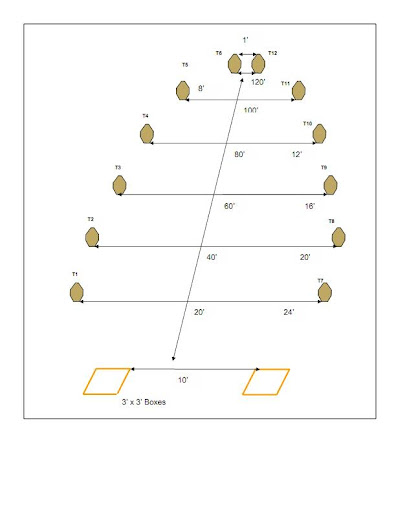
Stage 1 was Georgia State Standards, and, as the name implies, was borrowed from the Georgia State USPSA match. It consisted of twelve USPSA targets arranged in an inverted V shape, with distances ranging from 7 yards out to 40 yards. There was a box opposite each base. The course of fine was, from either box, one shot on the targets on that side of the center line, then moving to the other box and one shot on each target there. For a second string, you started in the second box, shot one per target, then moved to the other box. At this point you shot one per target with the strong hand only.

I started on the right, so I ended up on the right side shooting strong hand only. This was telling, since all three misses I had on this stage were on the farther targets on the right hand side, meaning I likely missed shooting strong hand only. (1)

The RO came to me after the stage and mentioned that I almost broke the 180 degree rule when I was moving from right to left while changing magazines. There’s not a really good way to do that for a right hander, except pay attention and do it right. (2)


STAGE 2


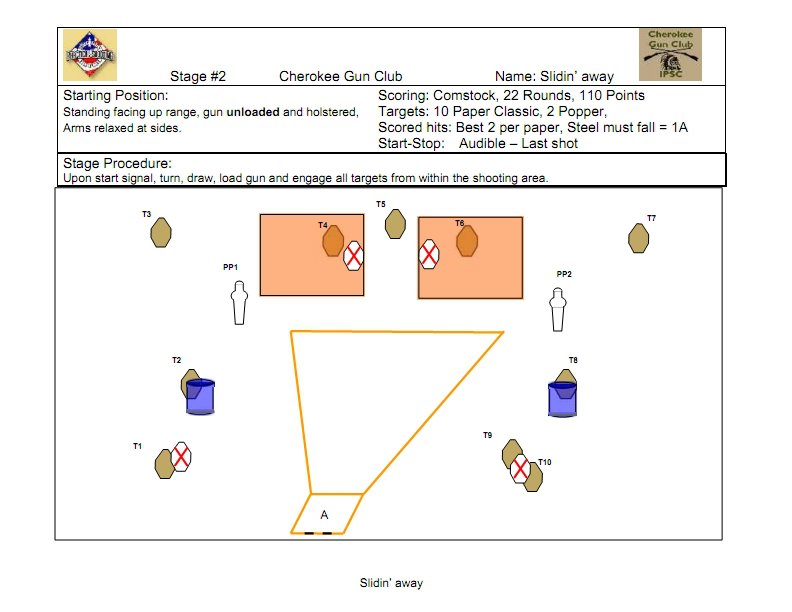
The next stage was called Sliding Away. We shot the two poppers from inside the box, then we could engage the 10 paper targets in any order. This was my best stage of the day. I ran it fairly quickly, and had all A’s and C’s, with no misses. In fact, I finished ninth of 29 in Production on this stage.

My key was making sure I had a good sight picture on the poppers, as well as moving while I shot. It seemed to be a theme of the day that so many shooters stood still while shooting, then ran like hell to the next shooting position. Since I’m not very fast* I can’t rely on running, and learned to shoot while moving.

We also started facing uprange with the gun unloaded and holstered (3), and had to turn, load the gun, and fire. If I had to guess, this stage was designed by someone who open carried in California.


STAGE 3


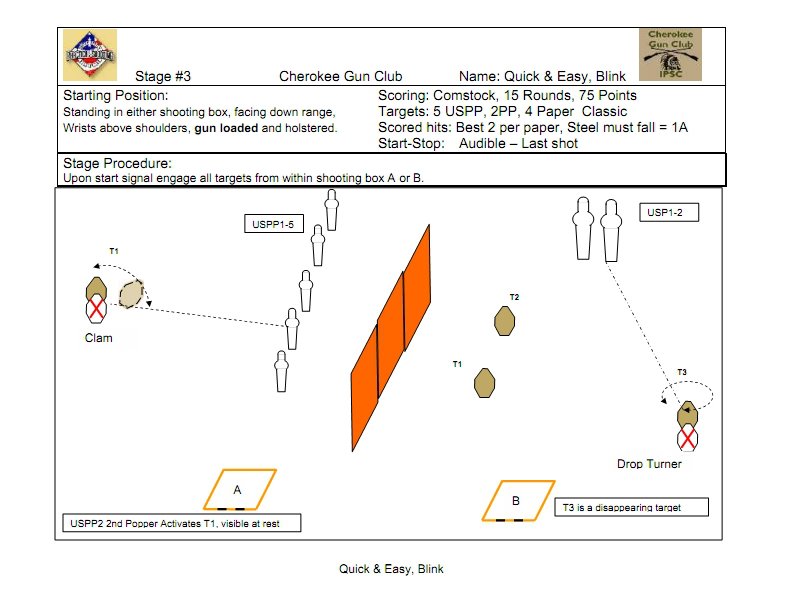
The next stage had a left side and a right side shooting box. From the left you could shoot 5 poppers, one of which engaged a clamshell target. 

A clamshell target is a target that pops up, and then a second later gets covered by a No-Shoot target. This means you normally have to shoot the clamshell as soon as it’s activated, and that’s how the first person through the stage shot it. Soon, though, someone noticed there was a lot of target showing above the No-Shoot, so they decided to leave it till later, and take a head shot on the portion that was exposed. 


This worked just fine, and the rest of the squad shot it that way. I actually tried to shoot the clamshell in the center, but I didn’t double tap it (4), and had to end up settling for A/C, with the A in the middle under the No-Shoot.

I finished 41 out of 81 total on this stage, my best of the day.

Here’s video of Stage 3.


Here’s Dave Sevigny running Stage 3. Dave was in the group behind us.


You would think Dave would win the whole match. Sorry, KC Eusebio beat him.


STAGE 4


Stage 4 was called Dance Down The Middle, and it was made up of single shot paper targets around the perimeter, with a center fault line. All the targets on the left had to be shot from right of the fault line, and vice-versa.

Most people shot it thus: at the sound of the buzzer, they stepped over the line and started shooting at targets, standing still, until they had shot the number they had in mind. Then, they hopped over the line, some changing magazines as needed, and shot the other side.

Then, they ran like hell to the next shooting position, and did the same thing.
The whole time, I’m thinking “Sorry, isn’t this sport called ACTION shooting?”

Here’s how I shot it: At the sound of the buzzer, I moved over the line and shot the first five targets, moving up to where I was opposite the first target. Then, I moved over the line and shot the first five of the other side, while moving down range, keeping myself just behind a 180-degree line to the target. I then continued on thus till I was done.

Shooting on the move is a technique more shooters need to learn, or use. (5)

My Embarrassing Moment of the day came after my first string. As I was moving and changing magazines, the magazine fell out of my hand. Fortunately, this isn’t a penalty, and I kept the presence of mind to keep my muzzle down range and retrieve the magazine (on the run, no less) and get it in the gun.

(This is where I’m glad I don’t have a Hat Cam like Walt.


STAGE 5

Sorry, there wasn’t a diagram of Stage 5.


Stage 5 was called Urine in Your Face, and I have no idea why.

It started with a lone steel target from the starting box, then a series of paper targets and No-Shoots shot from a lane moving down range. Again, most people moved, stopped, and shot several targets, while I kept moving and shot on the move.

But, again the dreaded Mike reared its head, as I tried to double tap the two paper targets close up and to the right, and instead shot Alpha / Mike on each. (4)

Here’s another shooter on Stage 5:


STAGE 6


Stage 6 was a Classifier called Front Sight 2. It was almost like an El Presidente drill, except we ran it in two strings, and we started one run facing uprange with hands raised, and one string facing downrange with hands at our side. Draw and put two on each target.

When I finished shooting, someone behind me called out “sandbagger!” That’s because I had shot 12 alphas with a time of about 8 and a half seconds. But I practice El Presidente, and this was easier, since there was no magazine change.


STAGE 7


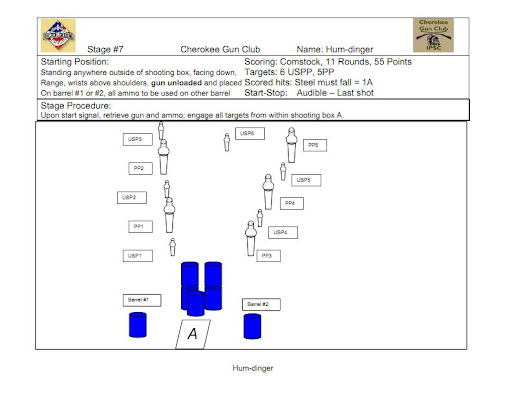
Stage 7 was Humdinger, which was undoubtedly named for the noise it makes. Eleven steel targets, all shot from a shooting box and around some barrels.

This was my first stage of the day, and I hadn’t shot at all before, so I probably shot 25 rounds to take out the 11 targets. My time was over 22 seconds. Instead of spraying and praying, I could have taken a one handed dueling stance and done better. (6)


DEBRIEFING

In retrospect, I didn’t do the worst I could have done, nor did I do the best. In general, the Mikes meant I was shooting too fast. A little slower will means better hits. It’s a tough realization for someone who is competitive and thinks they should be shooting fast. But if I am to get to that point, it will mean – shocker! – PRACTICE!

Here’s what I need to practice:

    1. I need to shoot one handed a lot more. This was evidenced on Stage 1, as well as on the “reverse handed” stage at the Memorial Day shoot at Creekside Firing Range.
    2. I need to practice moving right to left while changing magazines
    3. I need to practice drawing an unloaded gun, loading it, and firing. In case I open carry in California. Or I’m ambushed coming out of a gun show.
    4. I need to work on double taps.
    5. I need to practice shooting on the move. This may require a lot of dry firing or Airsoft work, since there are a limited number of places I can practice this.
    6. Slow down and make hits. My score will go up. I can’t miss fast enough to win.


* I’m told that somewhere there is a baseball scouting report on me that says “he’s short, but he’s slow to make up for it.”