I’m a little behind in my blog reading and podcast listening, but with the warm weather this weekend, I got to do a lot of yard work, and, thanks to noise-cancelling ear buds, catch up some on the podcasts.
In his most recent podcast, Walt White at Walt in PA talked about his first USPSA match of the year, and that led me to the collection of videos and stage debriefings on his blog.
I am a fiend for good descriptions of stages and how they are shot – visualization, planning, and the actual “Red Haze” shooting of the stage, and Walt really delivered. Check out the hat-cam video Walt provides. Coupled with his insightful and no-holds-barred self examination, I found it a really great read.
I am almost convinced that Walt and I are separated at birth. He doesn’t cut himself much slack in reviewing his performance, and neither do I.
On a related note, one of the other podcasts I listened to was Episode 254 of Down Range Radio with Michael Bane. Michael has been competing as long as there have been competitions, and this episode he talked about Winter Range, the big Cowboy Action Shooting match. He didn’t do as well as he thought he should have, or could have, either.
But he talked a lot about how the top shooters are able to shake off a bad stage, and go on to the next stage. Without that ability, they could easily let a poor performance take down their whole match.
I’ve been looking into this concept some, and I plan to write about it some more in the near future. In the meantime, I will take away the good and try to learn from the not-so-good.
About a week ago, I was asked by Walt in PA about the magazine holders I use for USPSA competition. I told him that I have been using the standard Glock Magazine Holder ever since I got into competition, for a number of reasons.
First, it’s what I use for every day carry, if I use a mag holder. Second, it’s lightweight and cheap. So cheap, I’ve never found anything else that meets my needs, for the price.
While my choice of mag holder hasn’t changed, I can’t say the same about my holsters.
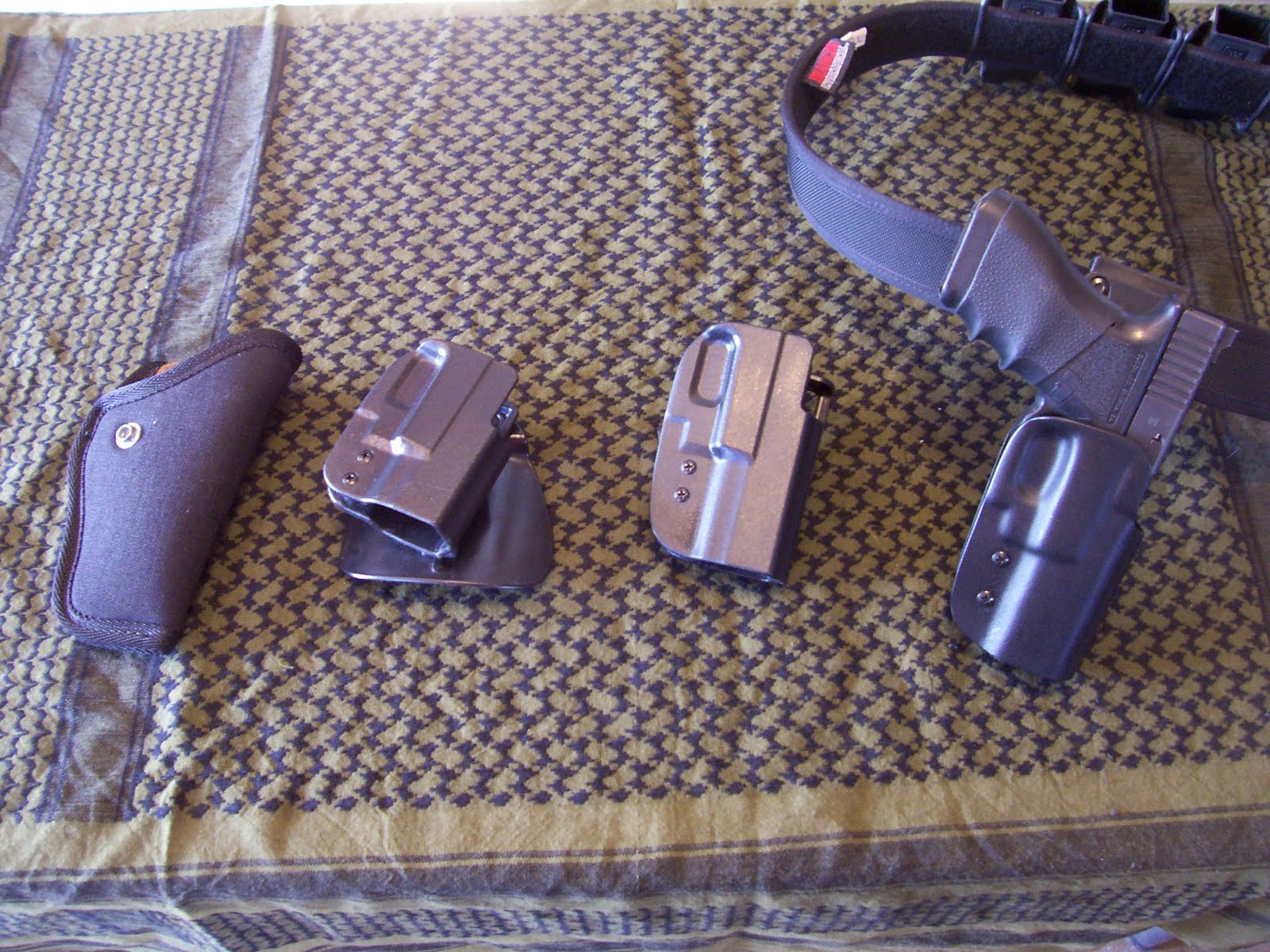
The picture above shows my competitive holster collection, as it has evolved from 1993 to today.
When I bought my first Glock 17 in 1992, I went that same weekend and bought a very inexpensive nylon, one-size-fits-all holster, and I used that holster for club competition for about 3 or 4 years. It’s made by Gould & Goodrich, and I don’t know the model number because that part of the tag is missing now. The inside is a nice suede.
When I took up IDPA in 1995, I bought an Uncle Mike’s Kydex paddle holster. Because I carried my gun at about 4 o’clock at that time, I adjusted it to the maximum forward cant that I could. I still use it for IDPA.
At that time, I used a stiff leather belt, laced through my belt loops, as a gun belt.
Then, in 2002, when I took up USPSA, I changed from a 4 o’clock position to a 3 o’clock position, right on my hip, and I bought an Uncle Mike’s belt slide holster. About that time, I found a Bianchi competition belt on sale, and I started using that. I like the competition belt because it’s a little more rigid than the leather belt, and I can take the belt off and on a lot easier.
In 2005 or so, I started experimenting some with my draw stroke, and I changed my technique a little. Before, I moved my hand below the gun and swept it clear with the fingers, then grabbed the grip as I brought the gun to bear.
However, I found that this technique didn’t yield a consistent grip, so I changed, so that my first movement was to grip the gun with my strong hand, high, with a good shooting grip. Then I would draw the gun, while bringing my support hand in.
I found that the belt holster made the gun ride just a little too high, and someone suggested I try an offset holster, that mounted the gun lower.
Uncle Mike’s belt slide holster, left, versus BladeTech DOH holster, on the right. Note that both belts are at the same level. The gun rides almost 3 inches higher with the belt slide holster.
I ended up buying a BladeTech “DOH” double offset belt holster, that’s adjustable for cant at two points. After some experimenting, I have it set at a neutral position, not canted in any direction. I wear it right behind by the point of my hip bone, per the Production Division rules.
I find that the 3 inch difference between the belt slide holster and the DOH is enough to make my grip a lot more consistent.
Yes, I still have all these holsters, and many more. But that collection is for another day.
In response to the Brady Campaign’s marking of the anniversary of the Tuscon shootings, Joe Huffmann produced this video showing a real solution to the problem.
This past Saturday I shot the regular monthly USPSA match at the Cherokee Gun Club in Gainesville, Georgia.
The weather was perfect for a pistol match, starting in the low 50’s F and ending around 60, with a slight breeze. There were 67 competitors and all classes and divisions were represented except revolvers. And, Dave Sevigny was there, and I got to chat with him for a few minutes.
There was an excellent mix of stages as well, including a couple of simple stages and one of the most complex field courses I have ever had the pleasure of running. More on that later.
I started on Stage 4, but I’ll go through the stages from the beginning. Stage 1 was called Do Your Dance, and it consisted of multiple targets along the edge of the stage, with barrels and a dividing line up the middle of the stage. The Dance came from the requirement that targets on the left side be shot from the right side of the divider, and vice versa, so that the shooter was essentially dancing back and forth down the field. Very interesting. I shot it clean (which for me means no misses, I”ll worry about all Alphas later) but my time was slow. No surprise.
Stage 2 was the Classifier stage Cash ‘n’ Carry, with three targets from engaged from a box, one popper engaged while moving to a second box, and three targets engaged from the second box, only from under a horizontal bar that forced us to kneel or squat. (Given the choice I usually kneel.) I missed two shots on this stage and shot a no-shoot. Not good.
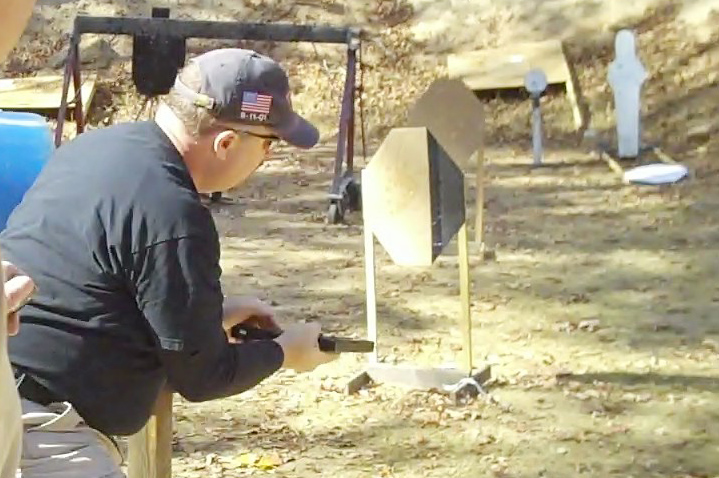
Stage 3 was called Doomed, and now I know why. It’s the one shown in the picture above. There were two swinging targets and a guillotine target. The Guillotine target is covered by a no-shoot at the beginning of the stage, and shooting a popper drops the no-shoot. About 2 seconds later another no-shoot rotates into position blocking this target, so you have a short time to shoot it.
I shot Alpha / Charlie on the guillotine, not bad. But I missed one shot on a 25 yard target, and one shot on one of the swingers.
The best way to shoot swinging targets is to shoot when the target is all the way down on the left or right, as it’s changing directions. In retrospect I should have shot more shots at the swingers.
Here is Dave Sevigny shooting stage 3:
Stage 4, where I started, was called Gotcha, and it was basically targets up the middle of the stage, with lanes on the outside of the stage where the shooter had to be. We shot our way down to the end and then shot three targets over a barrier. For me this was my best stage of the day. No misses, mostly Alphas.
Stage 5 was called Zombiemart. This one started with the gun in a cash register (really a briefcase) and then we engaged three targets straight away, with targets to the left and right.
I’ll come back to Stage 6. . . .
Stage 7 was the Classifier Table for 1, and was a welcome change. Starting with an unloaded gun sitting at a table, we shot three targets, then reloaded and shot them again. Since I finished 6th in Production on this stage, this tells me my shooting was good but I need to work on my movement.
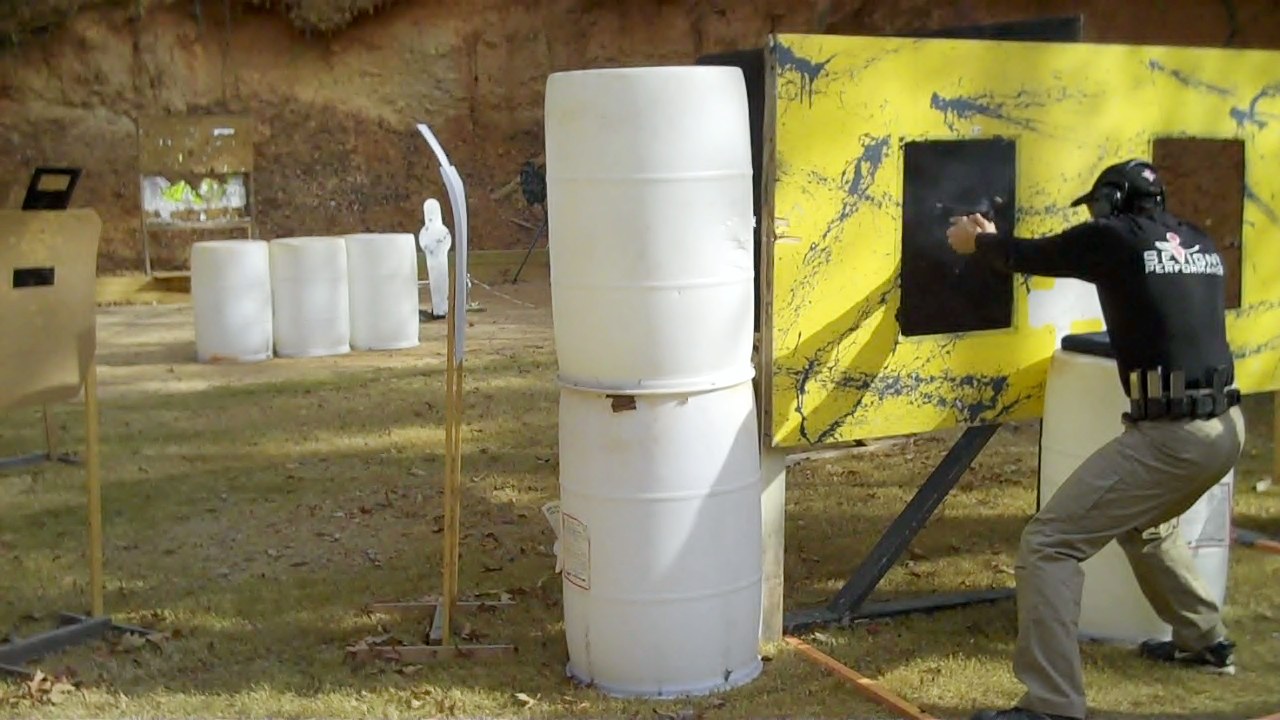
On Stage 6 this was painfully obvious. Here I am shooting Stage 6, Barrel Issues.
Here is Dave Sevigny shooting the same stage.
That was the fastest time of the day. As you can see, there were steel plates, poppers, and a gallows. All the fun a shooter can stand.
In the end, I finished 50th of 67 shooters, and was the highest in the D class. I take what victories I can!
I also took away a lot of things today:
> I need to (obviously) lose some weight, so I can get around quicker. > I need to work on my double taps on close targets. On Stage 6 I shot a measured pair when a double tap would have done better. (Of course, I could also argue that if I shoot worse with double taps, say, Alpha / Charlie versus 2 Alphas, does that get eat up the faster time?) > My magazine changes were decent. > My sight pictures were decent, and I was calling my shots most of the day, even on the stages with lots of movement.
All in all it was the best match I’ve shot in a long time, and the most fun I’ve had in USPSA. Kudos to Peter Oliver, the match director at Cherokee. Peter came in second overall, by the way, which was probably the best he could expect.




 Fill Yer Hands