Be Prepared, Part 11 – Chaos

zombie-hordeSeptember is National Preparedness Month, so I thought I bring you at least one more installment in this popular series, Be Prepared.

As events like the Boston Marathon bombings, September 11, and Hurricane Katrina have shown us, our world can be thrown into Chaos any time. Keeping our families safe is always a priority, and in a time of Chaos, it becomes even more important, as it becomes more difficult.

Of course, the problem with Chaos, as Jurassic Park’s  Dr. Ian Malcolm would tell you, is that anything can, and does, happen. It is, by nature, unpredictable. You cannot predict, with any degree of certainty, what will happen, or how people or systems will react to any given situation.

But that does not mean that we can’t make plans based on scenarios that we think are likely to happen. The best example of this is the reason every car comes with a spare tire and a jack. We can’t predict when or where, or even if, we will have a flat tire, but we can be prepared for it, and train for it by learning how to safely change a tire.

Most readers of this blog have also done that in a more specific way, by deciding that there is a finite probability, as Tom Givens would say, that we will encounter someone who needs to be shot. So, we carry a concealed weapon, we train ourselves in its use, and we prepare to deal with those consequences.

So, make a plan.

When we did our family plan, one thing we saw was that a lot of times we might not have a clear picture of what was happening – there would be Chaos. For us, the best way to mitigate that Chaos was to have everyone in the same place, preferably at home. So, in the event of Chaos, we need to know:

  • How is everybody? Are they injured? Are they threatened, or are they safe? If they are safe, are there threats in the area?
  • Where is everybody? If they aren’t at home, how can we get them home safely? Can they do it alone or do they need assistance?
  • What is the immediate situation, and what is the outlook for the foreseeable future? Do we need to move?

Then the plan becomes taking care of the answers to these questions – getting everyone safely home. In the course of this, here are some of the things our family came up with:

  • Every vehicle has a first aid kit, ponchos, food, and water.
  • My son goes to school with a first aid kid, poncho, food, and water. If has has to, he can walk home 5 miles. He knows the way home cross-country, avoiding main roads.
  • My daughter goes to college in downtown Atlanta, about 30 miles from where we live in the suburbs. One of the things we plan for is the possibility that she might need to evacuate downtown, but that she might be unable to do so safely by herself. As a result, I never leave my car at night without enough gasoline to get downtown and back.
  • I know 4 different ways to her college that don’t involve taking a main highway.
  • In the event of real unrest, communication is essential. For that reason, everyone in my family has a printed list of phone numbers of all the other members, plus others outside our area. We don’t rely on the phone list in our cell phones, since those may be lost, broken, or the batteries may be dead.
  • In real unrest, cell phones will be overloaded, as they were after the Boston Marathon bombing, and making calls will be nearly impossible. However, since the SMS text system uses the cell phone’s carrier signal to broadcast, if you have cell bars, you can almost always send text messages. Our family shares a text messaging plan, and we also know the codes to send emails to text messages. Look that up for your carrier.
  • Because it might not be easy or prudent to send a long text message, we all have a list of codes to use in text messages.
  • Family members outside our area are included in the system. Heaven forbid, “bug out” might get real.
  • In event of real bug out, we have a series of pre-chosen rendezvous points, depending on the direction we choose to go, which would be picked based on the threat and likelihood of threat in the direction we choose. We also have them picked based on how far we need to go.

In the end, you can’t plan for everything, but you can expect the Chaos that will come. Have a plan.

Operation Red Cell

Actual break-in evidence photo from the Queensland Police, Australia. The criminals used the owner's ladder to enter the upstairs.
Actual break-in evidence photo from the Queensland Police, Australia. The criminals used the owner’s ladder to enter the upstairs.

For those who don’t know, the original Red Cell was a project started by Richard Marcinko, founder of Seal Team Six. Basically, the Red Cell’s job was to attack US bases and test their preparation for terrorist attack. He found them wanting, and was court martialed for his efforts.

What I want us to do today is to use this concept against our own homes and businesses. Look at them through the eyes of a criminal. Where can I break in? Where am I vulnerable? Where can I improve?

Of course, we have to be brutally honest with ourselves if we are going to get benefit from this. After all, we would love to think everything is just fine. But the truth is there is room for improvement in everything.

Next, take a look at the situation record what you find. Be thorough. Photographs or sketches can be a great tool, as it will help you see if the changes you’ve made are sufficient.

Then, sit down and assess what you find. Here, you will need to make a judgment call on what level of security you are willing to accept.

Look for places where an intruder can hide from sight. Light them.

Look for doors or windows that can be easily defeated. Fix or replace them.

Finally, commit to a plan and make changes. You don’t have to do them all at once, just prioritize them and make the changes with the biggest return first. If money is no issue, maybe you do them all at once.

I recently did this, and I found some areas that I could improve. One thing to consider is whether you have things lying around that can be used to break in. I found I was just leaning my 24 foot ladder against the fence, where it could be used to access the upstairs. Now, it’s mounted on the fence, and secured by a steel cable bicycle lock.

Now, I have a plan, and I’ve made headway. I’m not done. Heck, I will never be done. But my home is better off today that when I started.

Congrats – You Bought a Gun

DISCLAIMER: I am not an attorney. Nothing in this post is to be construed as legal advice. As always, you should do your own research, and consult an attorney experienced in firearms matters if you have any questions or concerns.

———

When you’ve owned guns for any length of time, you will eventually buy or sell one as a private sale, not through a gun store or other Federal Firearms License holder. I’ve done both, and I thought I would share what I’ve done to document the transaction.

There’s a great post over on Urban Armed that gives a link to bills of sale for private sales of guns. Go take a look, and download a copy for your own use.

(At this point, re-read the Disclaimer above.)

BILLS OF SALE

Every time I transfer a gun to or from someone in a private transaction, I document it with a bill of sale. Even though I live in a state that doesn’t require registration or similar reporting of gun transfers, this will protect me in several ways.

First, should the gun ever be lost or stolen, I will have proof that I owned it, for a police report and insurance claim.

Second, I retain bills of sale for guns I no longer own, forever, so I can prove what happened to them.

In the case of a gift, I still prepare a bill of sale, and write “for just consideration” for the price.

When I buy a gun from someone in a private sale, I bring my own bill of sale, in case the seller doesn’t have one.

When I sell a gun, I prepare two copies of the bill of sale. I also make a photocopy of the buyer’s driver’s licence and Georgia Weapons Licence, as applicable. I won’t sell a gun to someone who doesn’t have a GWL, or who isn’t a family member whose background is well known to me. It’s my way of knowing they are not prohibited from owning a gun.

When I borrow a gun to take to the range, I execute a bill of sale, just like a gift. There are lots of reasons for this – traffic stop, accident, civil emergency, theft, fire – and I need to have proof that I had the gun in my possession. This is the only time I destroy a bill of sale, after I return a gun I borrowed.

INVENTORY

I keep an inventory of the guns I own. I use an Excel spreadsheet, but a printed notebook or piece of paper would work just as well. I keep my inventory backed up on a flash drive, as well as with my normal home computer backup files.

This inventory includes gun make, model, caliber, and serial number, as well as details about when and where I bought it. Using a spreadsheet lets me sort the inventory however I choose.

BACKUP

I keep backups of everything. The original bills of sale are kept in a bag* in my fire safe. PDF copies of the bills of sale are on my flash drive, along with my inventory. That way, if I ever have to evacuate our home, I grab the bag out of the fire safe, and go.


So, Dear Reader, what am I leaving out? What are some best practices I should consider?


* The bag in the safe also contains important family documents like social security cards, home ownership documents, car titles, our marriage certificate, our baptismal certificates, and school records.


Illumination

I’ve recently become aware that I was violating one of Alton Brown’s rules: No Unitaskers. And, I’m happy to say, I have remedied that.

Let me explain.

I’ve carried a flashlight as part of my every day carry for over 20 years. I’m a chemical engineer, and I’ve found them handy more than once, for looking at equipment in buildings or under things. Even in an office setting, you would be surprised how many times you would need to check something plugged into the computer under your desk, or hidden behind the ceiling panels overhead.

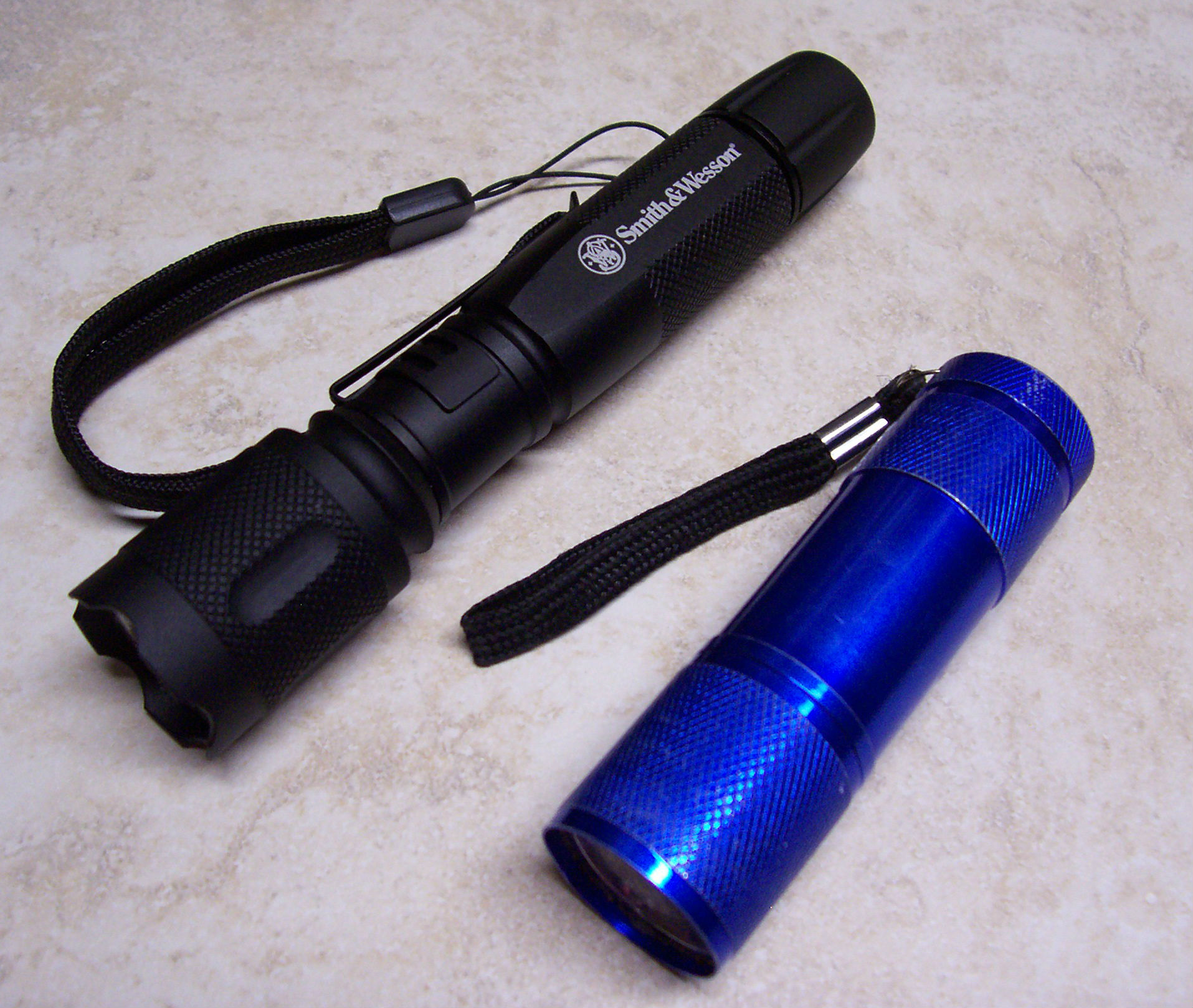
I’ve usually carried a small, cheap flashlight like the blue one on the right in the picture above. I bought that one as part of a “2 for $2.99” pack at the local hardware store. In fact, there are five more just like it in various places around the house.

But, I was reading somewhere after the recent theater shootings in Aurora, Colorado, and the writer reminded us that, even in a Gun-Free Victim Zone, a flashlight with high output can be shined in an attacker’s eyes, temporarily blinding them and allowing us to escape.

I then realized that the flashlight I carried wouldn’t disorient a mouse. It was a unitasker – a device that served only one task. Except for a fire extinguisher, I want no unitaskers.

Now, I admit I have been aware of the vast array of “Tactical” flashlights on the market, but that part of my brain imply ignored them, since, duh, I already had a flashlight. But, after considering the lessons to be learned from the Aurora shooting, I decided to get a new flashlight that could deliver enough light to be a serious defensive tool.

I settled on the flashlight on the left above, the Smith & Wesson branded Galaxy Elite model. It delivers 120 lumens from a CREE LED bulb, uses AA batteries, and has a twist-on, or momentary push button control. I used it in the dark back yard last night, and the difference between it and the old light was astonishing.

I know there are several brands of tactical flashlight out there, and I’m sure I will stir up the usual discussion. I wish I could say I researched the subject exhaustively, but in truth I bought the flashlight that gave me the most lumens for the  best price, with a design I thought fit how I carry.

++++

So, now, what other unitaskers am I harboring . . . . . ?