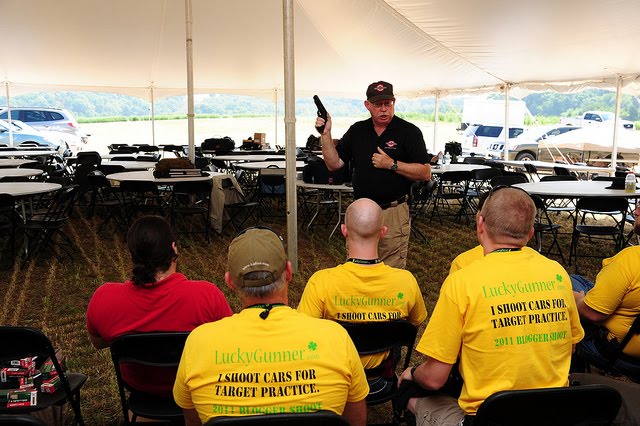
Thoughts on Training

Photo by Oleg Volk courtesy of LuckyGunner.com

Last Sunday, as part of the Blogger Shoot, I got to participate in some defensive handgun training with Tom Givens of Rangemaster. I briefly covered the training in yesterday’s post, but I’ve thought about the training since then, and I wanted to share some additional thoughts.

While I am fairly new to handgun training, I am no stranger to training in general. I have a degree in chemical engineering, and I’ve attended training seminars and classes on everything from hazardous waste regulations, to how to get more out of Microsoft Excel, to how to deal with the media during a crisis.

One of the things I learned a long time ago is that, unlike college courses, for short seminars and classes, a student can probably expect to take away one really usable point per day. While you might remember more, if you can take one point to heart and make it part of your daily routine, you’re doing well.

Now, I usually try to relax my brain when I take classes, since I never know ahead of time what that one take away point will be. Inevitably, too, there will be a lot of material that is familiar, and I want to avoid letting my mind wander, so I will try to pay attention to the teacher regardless.

Sunday, I almost forgot all that.

Tom started the class with a presentation of the Four Rules of Gun Safety made familiar by Lt. Col. Jeff Cooper. These are well know. Heck, I’ve blogged about them, and about how we should make “Never try to catch a dropped gun” into Rule 5. So, in my mind, when Tom was talking, I was thinking about my blog post. Dumb.

You know what? Later, on the range, Tom told everyone never to try to catch a dropped gun. No, he didn’t make it Rule 5. He just said Don’t Do It.

Later, when we actually got to shooting, he talked about the concept of Follow Through. I had heard others talk about Follow Through before, but I had never been trained about it, but here it was – Follow Through is to complete the shot so that you are ready for another shot if needed. That means taking another sight picture, and having the trigger ready by only releasing it back to reset.

At that point, my mind wandered to a GSSF match at Fort Benning some years back, when an Army Marksmanship Unit RO asked me after one stage, “Do you mind if I give you a tip?” Heck, who turns down tips from the AMU? He then told me that I was taking my finger off the trigger between shots, and instead, I should only release it back until I felt it click, when the internals reset. He even cycled the empty gun for me so I could feel the difference.

Back to the training Sunday, and Sean Sorrentino of An NC Gun Blog and I are cycling each other’s gun so we can feel it reset. But my mind is at Fort Benning. And Sean is no AMU sergeant.

Then we start to shoot. Draw to ready, up, sight picture while taking up the trigger slack, squeeze a shot, follow through, take another sight picture, and let the trigger reset.

Only, after 3 or 4 rounds like this, I become aware that I AM LETTING MY FINGER LEAVE THE TRIGGER AFTER I SHOOT! Since we are only taking one shot, my mind thinks it’s over, and lets reset go out the window. How dumb.

Then, it’s Sean’s turn to shoot, and I’m watching, and he’s letting his trigger go to reset. After one shot.

So when it’s my turn, I concentrate, and let the trigger go to reset, and I put the sights back on the target. At the time, it’s no big deal.

Then comes multiple shots. First, one per second, then two per second, the four per second. I have to admit, in the past my groups have gotten very wide at this point. I’m talking about “Mike” wide. But, since I’m now following up the way I’ve been taught, my shots are still tight. In the end, my target has “one ragged hole.”

So, it turns out, Follow Up was my take away. And, I learned something about myself, that even an old skill can become a take away, if I’ve not used that old skill.

EPILOGUE

Monday, I shot a pistol steel challenge match at Creekside Firing Range in Taylorsville, GA. This was not your typical steel challenge match.

One stage involved taking 3 poppers from behind the left side of a barricade, the switching to the other side of the barricade and taking 3 more poppers, then hitting the stop plate. Sounds simple enough. Only the front popper on the right, it turns out if you watched the shooters, is set an a little bit of an angle, so that it takes multiple 9mm rounds striking it at the top to take it down. I watched one shooter in the squad ahead of us shoot this popper 9 times before it fell.

When my time to shoot came, I made my plan. I would start out on the multiple hit popper, then move on. I drew and aimed at the top center of the popper, and shot, and followed up. In four shots the popper was down, and I went on. Honestly, I don’t think I could have made that shot a week before. All because I followed through.

Thank you, Tom Givens.

Match Prep

I have a match to shoot this weekend, and it got me to thinking about my preparations. Since my goal in 2011 is to improve as many aspects of my competition as I can, I thought I would begin at the beginning.

Assuming I have done the work in practice, there is still a lot of things I do to get ready. Before now, I just did them, but now I have my checklist.

Since it’s already starting to get warm, I have been drinking water all day today, to get my body ready.

Here’s what I will do tonight:

> Detail strip my Glock 17 (Bruce) and inspect all parts

> Change the factory connector for the (-) connector. (Bruce does double duty as a home defense gun and my competition gun. I keep the factory trigger connector in for home defense, so the trigger pull matches my other Glocks. Changing the connector to a (-) connector lowers the trigger pull about a pound.)

> Brush out but don’t clean unless it is very dirty

> Clean the fiber optic front sight with water only

> Lubricate the gun, using grease on the rails and connector

> Re-assemble the gun and dry fire it and practice drawing. Fix any problems

> Check mags – for damage, springs, followers

> Check holster and mag pouches – make sure that everything is adjusted correctly

> Load all my magazines to 10 rounds

> Make up some sports drink in plastic bottles, and put one bottle in the freezer

> Check my hearing protection and eye protection

> Make sure I have a clean towel in my shooting bag

> Make sure my knee pads, hat, and spent shell bag are in my shooting bag

Finally, make sure I have directions to the range, since there are about half a dozen ranges in the Atlanta area with USPSA or GSSF matches.

Tomorrow is a Steel Challenge match at Creekside Firing Range. I will try to live tweet it at @FillYerHands, so “stay tuned.”

Practice for Competition, Part 3 – USPSA

Photo by P. Erhardt, courtesy of USPSA

Last time I talked about how to practice for GSSF competition. Today I’m covering how to practice for a USPSA match.

There are some differences between GSSF and USPSA that add to what we need to practice. However, everything we did to get ready for GSSF will apply to USPSA. Here are the extra things we need to practice, in what I see as the order of their importance to our success in the sport:

* In USPSA the shooter reloads when the ammo runs out, or as the course of fire dictates. In GSSF there are no reloads.
* In USPSA the shooter moves between targets. In GSSF the shooter is stationary.
* In USPSA the shooter starts each stage from a draw, or with the gun on a table or other surface. GSSF starts from low ready
* In USPSA each stage is different. GSSF uses the same three stages for just about all matches.

RELOADS

To me, one of the biggest things I can do for USPSA matches is practice reloads until they are smooth and almost reflexive. The difference between a good reload and a bad reload can be a few seconds. A terrible reload – dropping the magazine, for instance – can add not just time, but can also be a big demoralizer.

So, with an unloaded gun and unloaded magazines, put one magazine in your gun, and the rest in the mag pouches on your gun belt. Then, practice reloads. From a shooting position, first bring the gun up to eye level, and in a little. Drop the mag from the gun, and at the same time, grab a mag from your belt and bring it up to the gun, and insert it smoothly.

Repeat these as many times as you need until you are comfortable. I find that 10 or 15 minutes is about right for me.

Variation: start with the slide locked back to simulate an empty gun reload, and at the end of the reload, drop the slide. For me, the best way I have found is to start the gun back to the shooting position, grab the top of the slide with my off hand, and push with the gun hand while pushing the slide back with the off hand. Yes, there are other ways, and I leave it to the reader to find the way that works best for you. I admit, I’ve changed the way I release a locked slide several times in my life, so I can’t tell you any one way is best.

One piece of advice – make sure your gun is in great working order before you go to a match. In one USPSA match I watched a Master class shooter spend several stages watching the magazine drop out of his 1911 every time he fired a shot. It turns out he had changed the magazine catch spring in his gun the night before, trying to fine tune his gun. He had even practiced reloads, and was confident it would work. But, he didn’t factor in the shock of recoil. He finally had to curl his off hand under the grip just to complete the match.

MOVING BETWEEN TARGETS

Sorry, but the best way to practice this by doing wind sprints, almost like in football practice. Good general physical condition is the best way to be prepared for moving, and I don’t pretend to be any expert here. I generally limber up (remember Rule 3 from Zombieland) and then spend ten or fifteen minutes dashing around the back yard. I usually do this without my gun, but I think the neighbors wouldn’t mind either way.

Be sure to practice starts and stops, and work on controlling your breathing during the stops so you don’t upset your target picture.

DRAWING

Don’t over-do the drawing practice. After all, we only draw once in each stage. It’s like golfers I know who spend their whole practice session hitting drivers, when they are only going to use the driver 14 times in a round of golf, versus maybe 40 or 50 putts. So, still put your time in practice starting from low ready, as we did practicing for GSSF. That’s because every time you move from one target to another with your gun lowered, your next shot is from low ready. This is going to happen a lot more in every stage.

To practice drawing, start with an unloaded gun, and start slow and smooth. Bring the gun up into your sight, then push toward the target,as we did when starting from low ready, so you avoid the oscillation when the sights are on target. Work up to full speed over 2 or 3 minutes, then draw for 3 to 5 minutes more.

PUT IT TOGETHER

Now, use your imagination. This can be done inside or outside. First, use some painters tape to tape some of the 1/3 size USPSA targets from GlockFAQ to walls or trees. (Or, since it works for Navy SEALs, use 3×5 index cards.) Then, start with the gun in your holster with an empty magazine, and run a stage. Go from target to target, counting shots, and changing magazines as you go. Be sure to keep your muzzle down range and your finger off the trigger as you move. When your stage is through, unload and show clear, reholster, then pick up your mags, and do it again.

I would love to hear your USPSA practice regimen!

Preparedness Tested

Sunday evening, my wife and I were watching a movie on TV. I was making my usual observations about gun handling. Kudos to the sound people for not inserting some kind of cocking or safety clicking noise when Gerard Butler drew his Glock, since they don’t have external safeties, and don’t need to be cocked. Gerard Butler’s trigger discipline left a lot to be desired, though, especially since he was supposed to be playing an ex-cop.

Then I decided to check my Twitter feed, and my threat level went from Yellow to Orange about as quickly as it takes you to read this. My timeline was full of people telling me to switch to CNN, because President Obama was going to announce that Osama bin Laden had been killed. You all probably saw the same thing I did, as we waited an hour for the President to confirm.

About five minutes into the wait my daughter texted us from her dorm room. After a couple of exchanges, my wife asked her if she was all right, using a specific series of words, and my daughter responded she was okay, using her affirmative code word.

Each member of my family has a specific question that the others may ask, and we have a positive code word to show that we are okay and not being coerced, and we have a negative code work. The negative code word is actually a positive word that can be used without anyone else being alerted, but it tells the others that they are being help against their will or being forced to do something they wouldn’t otherwise do.

Am I paranoid to do this? I don’t think so. The world is a dangerous place, and our lives take us places where we might not always have family members available for support. If we get the chance to communicate, a call for help might just make things worse.

My wife told me later that as soon as I put down my Blackberry and changed to CNN, she thought from the look on my face that there might be something going on that would require me to drive to my daughter’s dorm and bring her home. Yes, there are scenarios where that is my plan. That’s why I keep my car gassed and my things ready. I pray I won’t ever have to do it.

But we have a plan, and sometimes it gets tested.