Why Wyatt Earp Is My Hero

Wyatt Earp at 75 c
Wyatt Earp at age 75.

Like a lot of people, I became acquainted with Wyatt Earp through the movie Tombstone. Now, I know it’s not the most accurate, historically, but I will say that Kurt Russell’s portrayal captivated me. Anyone who follows me on Twitter knows that.

Since watching the movie I have learned a lot more about Earp. One of the things that I noted was that he survived quite a few gun fights, and survived to quite an old age. My take is that this was due in no small part to his shooting style, which was not the norm of the day, from what I gather. The impression I get is that the average shooter was more “spray and pray,” while Earp was in the Hickock mold of “slow and steady.”

This post is about how I moved from “spray and pray” to “slow and steady.” Thank you, Mr. Earp.

+++++

I have been competing in pistol matches for about 20 years now. When I first started competing, I admit, I got into some bad habits. I found that, because of the way scoring was done, and the people I was shooting against, that my shooting speed determined how well I did, more than accuracy. So, I shot fast, and didn’t worry so much about score.

I won some matches.

Don’t get me wrong, I was never fast. But I was faster than those I shot against, who had come up in the Bullseye school, so they pretty much stood in one place, shot targets, then moved to another place. I, on the other hand, learned to shoot on the move, which really improved my times, and thus not my final scores. And I learned to reload on the move.

Over the years, as I look back, I see that I adopted the “spray and pray” style. I went just about as fast as I could, and as long as I didn’t miss too many targets (and my standard for “too many” was very loose) I felt I was doing okay. Yes, I saw that my scores were getting worse, and my classifications were getting lower. But I was ingrained in my style.

Now, time and age have taken toll, and my lumbering has been reduced even more. At last, due in part to writing this blog, and having it in my face, I decided to try to improve. I had to find a way to shoot better.

I finally realized that I could not miss fast enough to win. I had to do something.

I decided to adopt Wyatt Earp’s style, and shoot for accuracy, and not for speed. And the journey began.

+++++

So, how do I improve my score? After all, scores in just about all the shooting sports are measured in time units. Meaning, in the end, my score is a time. So, telling myself that I was going to improve my scores, no matter the time, was somewhat confusing on a lot of levels.

But, how are the targets themselves scored? Let’s look.

NRA D1 with GSSF scoringHere is the GSSF target, the standard NRA D-1. Note that if you shoot outside the A or B ring, you have penalty time added to your score. Shooting C’s is no big deal, but a miss can ruin your day.

The same thing applies to USPSA
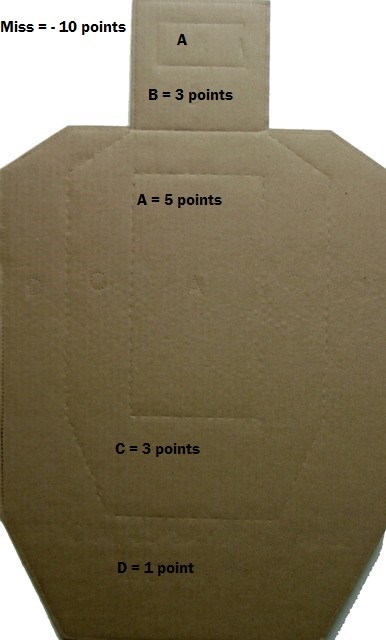
USPSA Target with scoringOn USPSA you get points for hits in A, B, C, and D areas, and that is divided by your time. Note that the penalty for a miss is twice the maximum points on the target, or minus 10 points.

So, what I found is that poor shooting – D ring or worse, misses – killed my scores, no matter how well I shot.

I could therefore improve my score – my shooting time – by hitting the center of the target.

Duh.

+++++

So, I changed my style. It took practice, and it wasn’t over night. I had to get used to aiming and getting a good sight picture before releasing the shot. For a lot of people this is no issue, but for me, it took some learning.

You see, part of what happened as I grew older, shooting for speed without much care for accuracy, was that my eyes were getting older, to the point where I could not focus on the front sight. Now, to a “spray and pray” shooter that didn’t matter much, as I was shooting as soon as I had any sight picture at all. This led to a lot of misses.

But a couple of years ago I decided to change that, by getting some contact lenses that let me see the front sight. Now, I had to learn how to shoot again, the right way, and it has taken me a little while to learn how to get a good sight picture before releasing the shot.

It has taken a lot of dry firing to teach myself to do that. A lot. And a lot of slow fire practice. And a lot of slow transitions.

The results have been impressive, to me any way. The first milestone came this spring when I shot my first clean match – one with no misses at all. Then came a match this summer where I actually shot a perfect stage – I knocked down four steel targets with one shot each, and shot all the paper targets in the Alpha zone. I was almost giddy.

Yes, there are those who will point to all Alphas and say that I am not shooting fast enough. Right now, that’s okay. I will learn to speed up, but not right away.

I still shoot on the move, and my scores are showing the improvement. I suspect that my Classifier scores will help me move up to C class in the next revision.

Since then, I have repeated the No Mikes performance in each match, most recently in the GSSF Glock Annual Shoot at Conyers, GA, last month. This GSSF match turned out to be the best GSSF performance of my life. I’ve been shooting GSSF for 18 years, and this was the best.

So now, I think of Wyatt, and I “take my time” and shoot for score.

+++++

Now, to lose weight, and get faster. Who knows where I can head next.
Are You Ready?

SAMSUNG
“If you are finished, unload and show clear . . . “

I’ve shot in USPSA since 2008, and I finally got around to taking the Level 1 Range Officer course last month. I sincerely regret the delay.

As a bit of background, the National Range Officer Institute or NROI is part of USPSA, and administers the Range Officer functions for the sport worldwide. They write the rules, and give training around the world on how to run matches safely.

In all the years I’ve been competing, I have to confess, I have never run a competitor through a stage as the main RO, the one with the timer. I’ve not been certified so I’ve never felt qualified, even though I feel I know what to do.

Part of the problem was the USPSA didn’t put on many training classes in our area. But when I heard about this one, I signed up as quickly as I could.

Thus began the journey . . . .

DAY 1

SAMSUNG

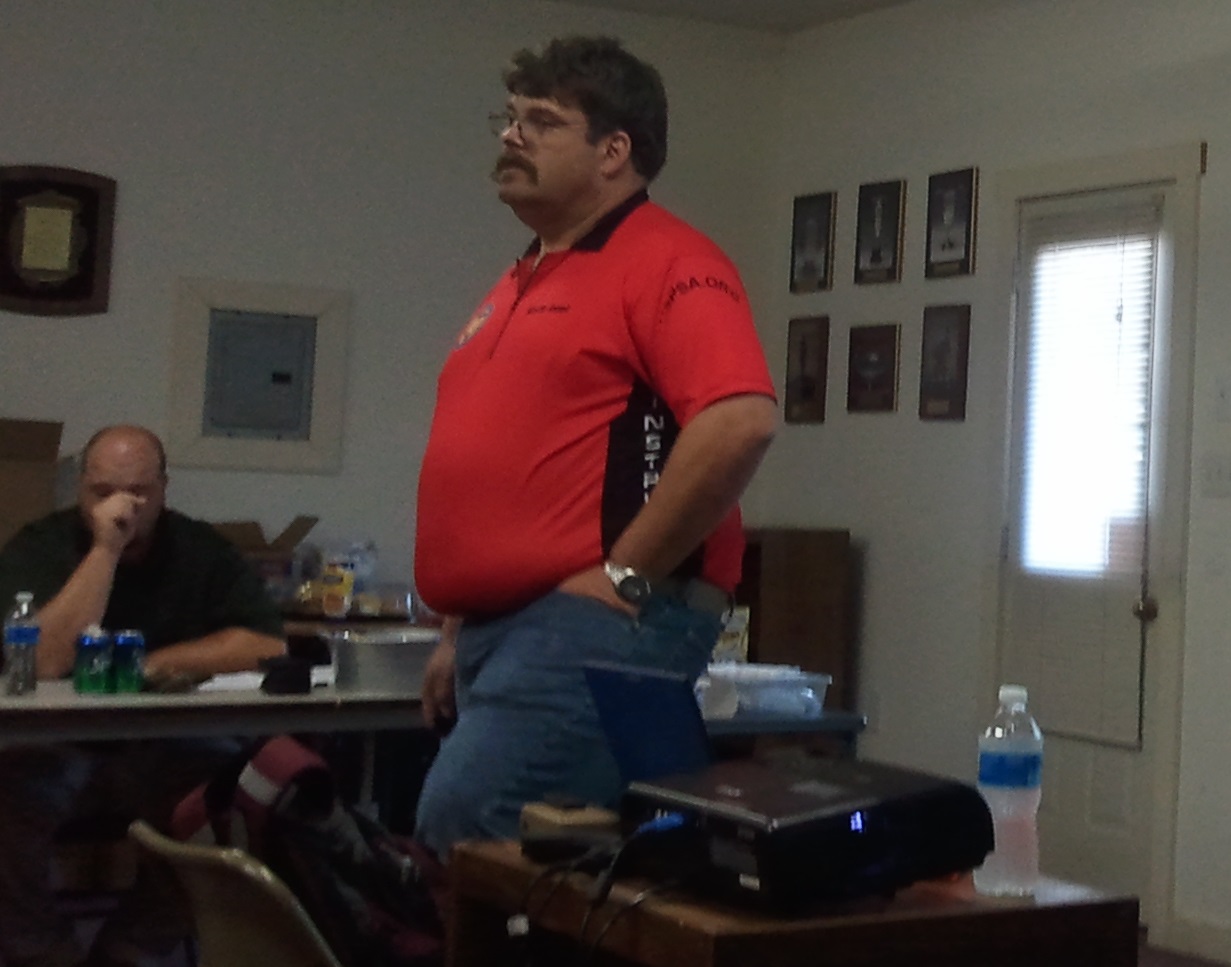
The class instructor was Kevin Imel, a veteran RO and Instructor from Washington state. His teaching style was very easy going, and it was obvious he had been there and done that.

The class is divided into two days, a classroom day devoted to the Rules, and a range day where we got to see the Rules in action, and show that we knew what we were doing.

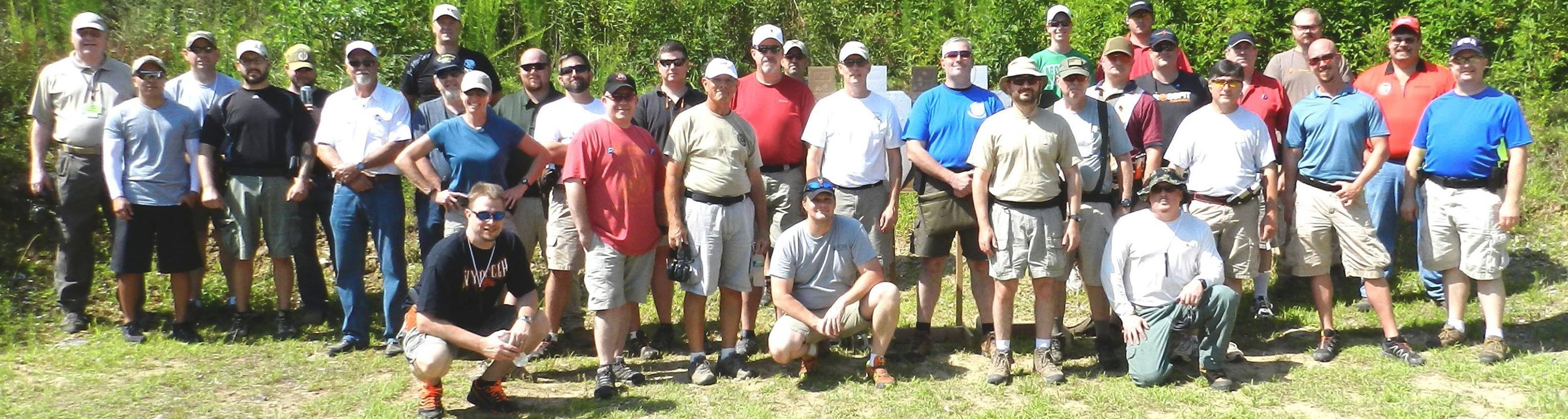
There were 30 people in our class, and as we introduced ourselves, I found that most of us had been shooting USPSA less than 5 years. Skills ranged from D Class shooters like me, up to World Champions. Seriously.

We were all asked why we were taking the class, and most of us responded like me: to learn more about the sport, and to give back by refereeing and making the sport safer. The best answer, though, came from the aforementioned World Champion, KC Eusebio, who said he was taking the class so he could DQ people.

Kevin then went through the Rules, from front to back. I have to admit, I had a passing knowledge of them coming in, but not very thorough. Kevin fixed that.

We covered all the Rules, along with examples of the usual kinds of things ROs come across. There was a lot of lively back and forth with the class, and a lot of “what if” and “there was this one time.” But in all, I really got a lot out of the day.

DAY 2

SAMSUNG

I won’t say that Day 2 was more interesting than Day 1, but, after all, USPSA is about shooting, and on Day 2, we shot.

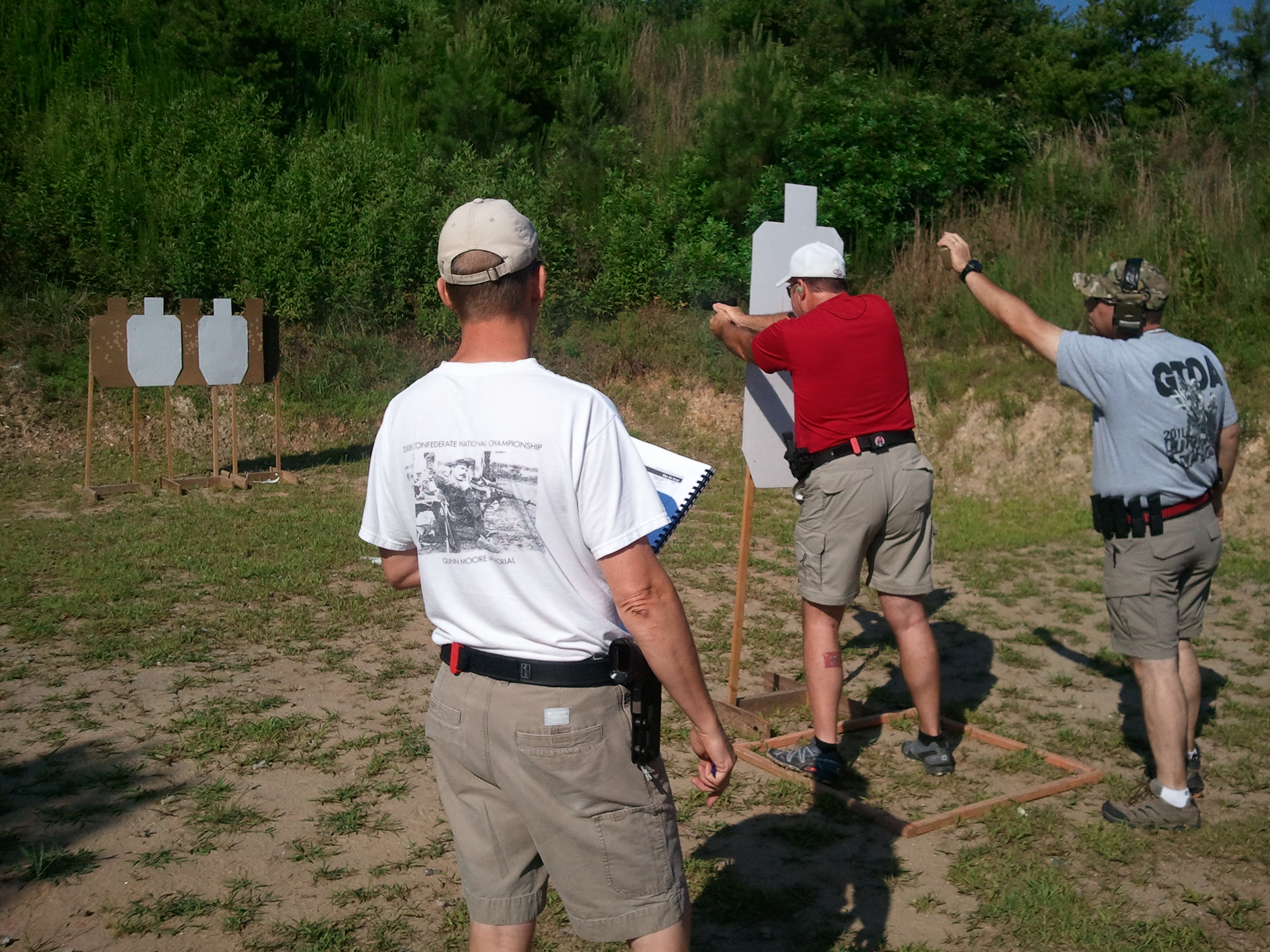
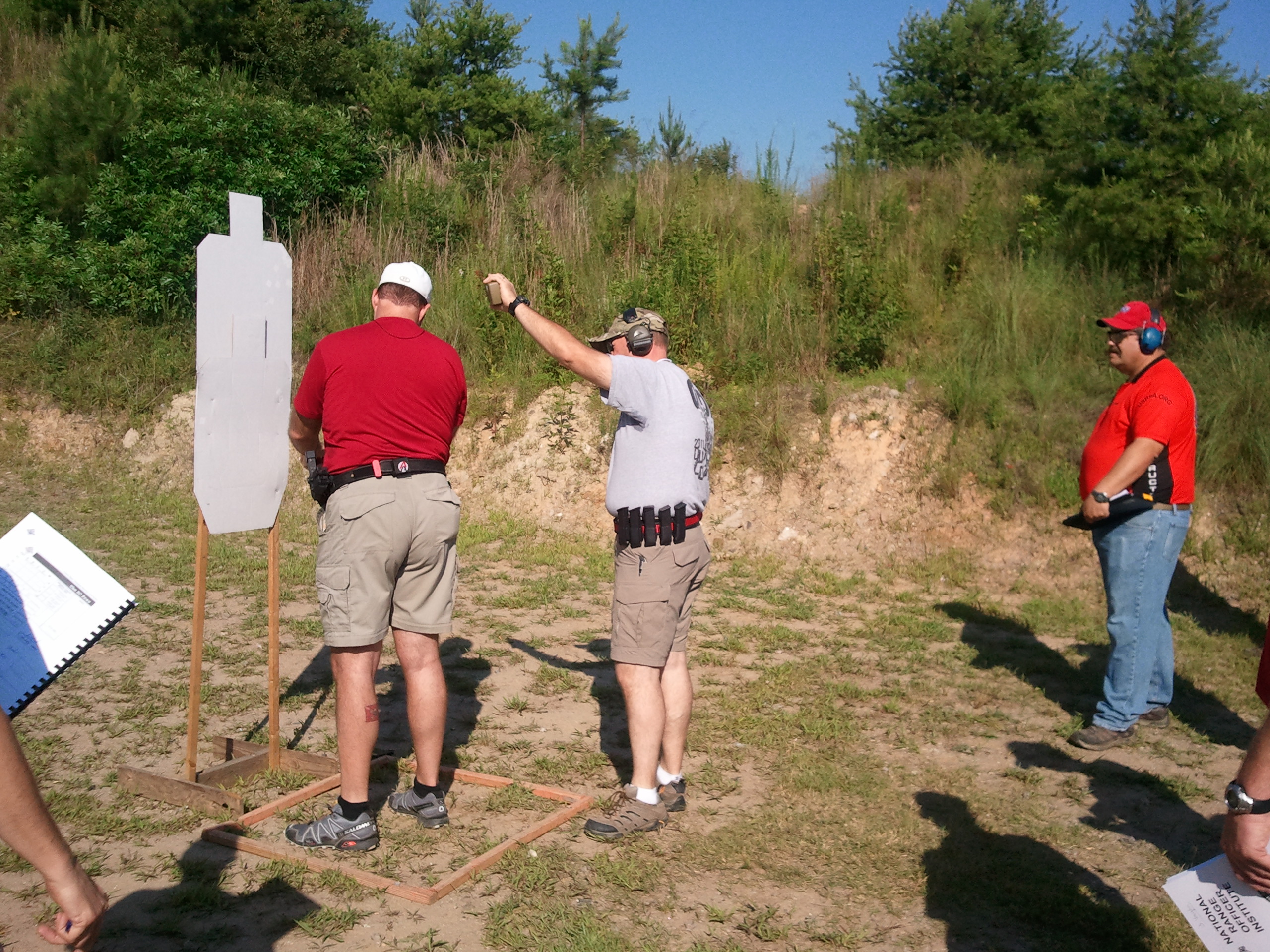
First, though, we set up the stage according to the diagram and written stage briefing. This is where you find out there is more to the setting up of a stage than it seems. To someone like me, who pretty much shows up and shoots (yes, I do help break down afterward), there was a lot more precision involved in how the targets are aligned and set. I admit, it took us a couple of goes at it to get the stage set, but soon, we were ready to shoot.

There are 2 tests involved to receive RO certification, a written rules test and a shooting test. The shooting test actually has 3 parts. In the first, you are the shooter. You shoot the stage safely and according to the rules, and the RO instructions.

The second part involves you acting as the main RO, the one with the timer. This is the one who calls out the stage commands, and a lot of us, having shot in other sports, were a little confused on some of the commands. But, we all eventually got them right.

The main RO is also the one who scores each target, and, as it turns out, there were wonderful examples of difficult calls all day. But again, we all learned how to do it.

The third part involves running the clipboard, and I have to admit, I never gave this role much serious thought in the past. In truth, this person has RO authority, and is the one who is supposed to look downrange and be sure each target is engaged.

In all, I made it through fine.

One note – KC Eusebio ran a really good shooter when it was his time to be the main RO. The shooter finished the stage with no penalties and no safety infractions.

But KC disqualified him anyway. After all, it was why he came to the class.

Oh, and he autographed that shooter’s book.

DAY 3

The last part of the class involved completing a written test over the rules. Each question required not only an answer, but we had to list the Rule number(s) that supported our answers.

I finally sent my test off to Kevin, knowing I had aced it.

Of course, I didn’t. But I did pass – so, but the tenth of next month, the USPSA will have at least one more Certified Range Officer, and, I suspect, 30 in all.

RO Class RBGC 2013

Match Report – USPSA River Bend Gun Club April 2013

I’m sorry this post is so late!

A couple of weeks ago I shot the regular monthly USPSA match at River Bend Gun Club.

It was my first match in some time, and I tried to concentrate a couple ofstrategies.

STRATEGY: ACCURACY OVER SPEED.

In my younger days I shot for a couple of years in a non-affiliated club, where the scoring was score divided by time. I found I could shoot fast enough to win with poor shot placement. Plus, with my eyesight, I was never able to see a sharp front sight, so I never developed good sight discpline, and I developed some poor habits as a result. In USPSA and IDPA, this plan doesn’t work.

Another thing I learned is to use all the resources available to me when preparing for a stage. This was brought to light on the first stage I shot:

SAMSUNG

Do you see it? I didn’t either. Here it is:

SAMSUNG

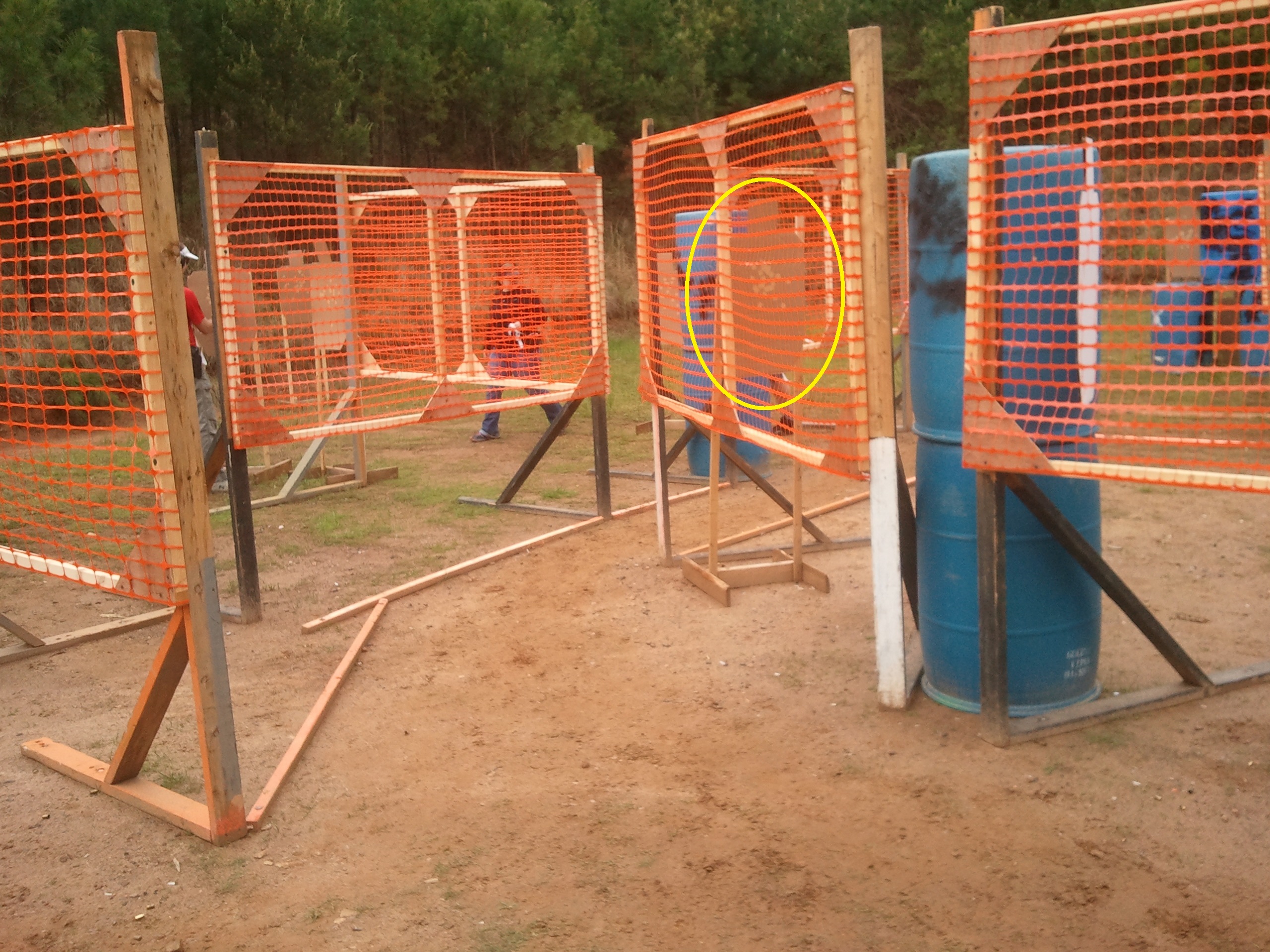
From this direction, it’s hard to see, but there is a paper target behind the barrier that is visible if we move to the left. When I first walked through this stage without reading the course description or looking at the diagram I thought that target was a no-shoot that was in place to keep me from shooting a close target to the right.

But later, walking through after pasting targets for another shooter, I noticed this view:

SAMSUNG

where it is obvious that this target is an active one that I needed to shoot.

The moral: Look at the stage drawing, read the description, and pay attention.

Wow, there it is.

RBGC 4 13 Stage 1

It’s a good thing I wasn’t the first shooter on this stage or would have had two Mikes and a Failure To Engage.

In any case, the strategy of accuracy over speed, and I did something I had never done in all my days of shooting USPSA – I shot a stage clean. All Alphas, and two steel on two shots. Yes, I shot about 10 seconds slower than the match winner, but I’ll take it.

STRATEGY: STICK WITH MY GAME

Sometimes I let other people’s way of shooting a stage influence how I do it. But I find I shoot better if I stick to my game.

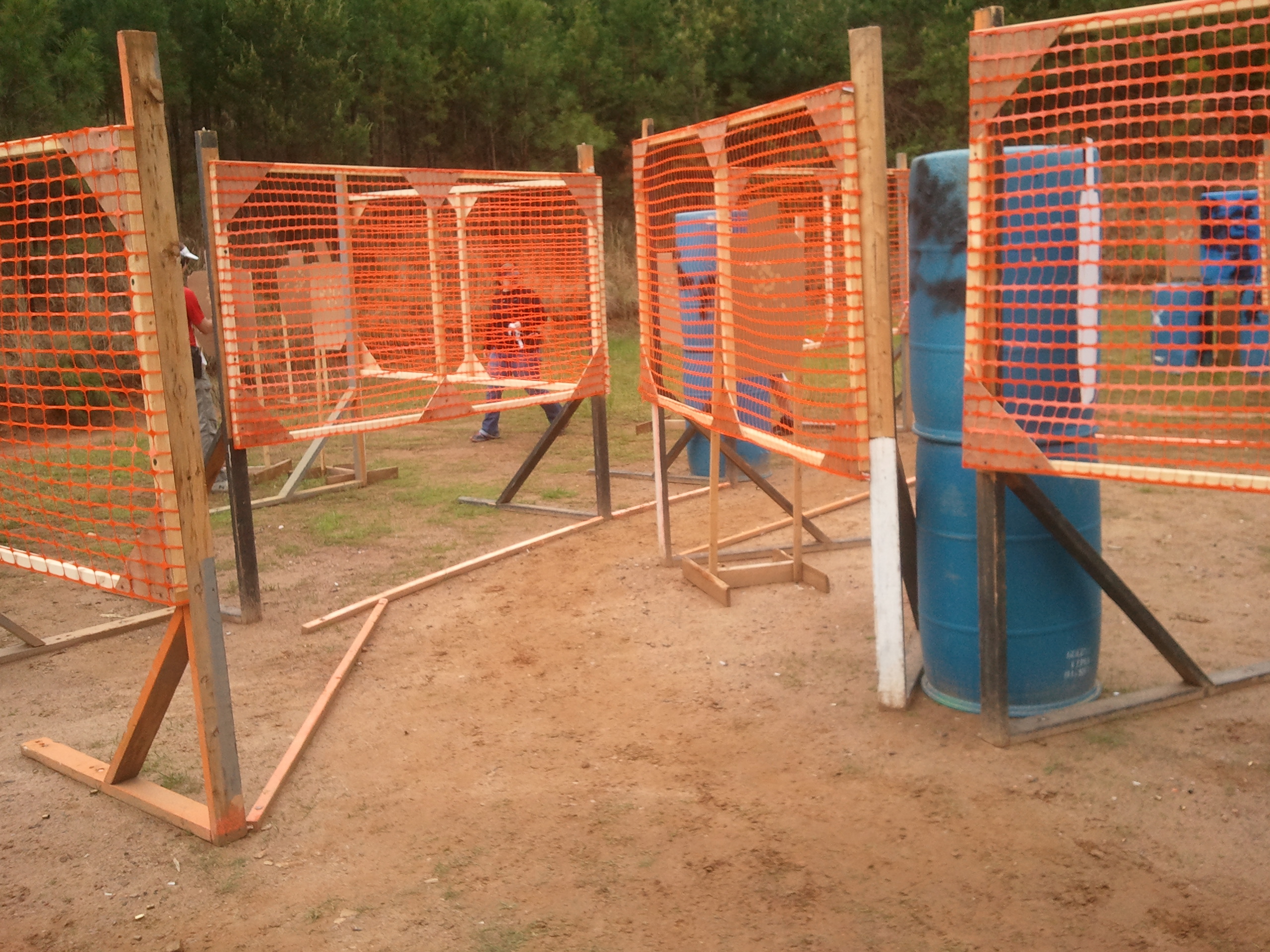
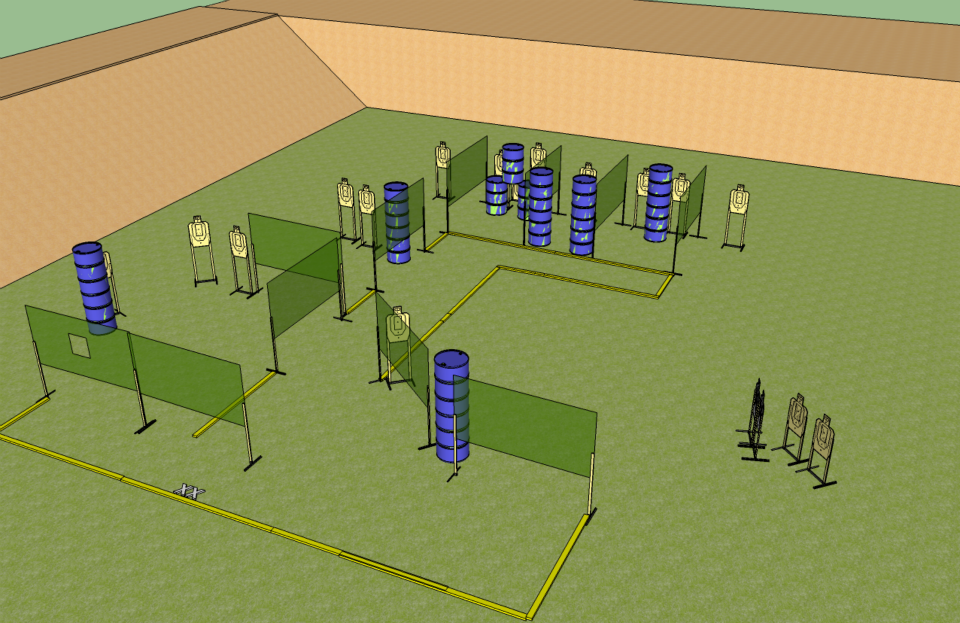
An example came in this stage, which consisted of four paper targets on the left, mirrored with these on the right, and a Texas star in the middle.

RBGC 4 13 Stage 3

Most people in Production shot it this way:

  • Two shots on 3 targets on the left, around the barricade, then a mag change (6 shots).
  • Through the center window, shoot the paper targets, then the Texas star. That’s 9 shots of they are perfect. Change mags.
  • Then repeat the first string on the right targets.

SAMSUNG

For me, though, I know I have had a bad time with Texas stars, historically, and I don’t want to end up with a mag change from slide lock, shooting through the center window.

So, here’s how I shot it.

  • From around the left barricade, shoot the four paper targets. Yes, it means I had to lean out to get the last target, but I can make that shot easily. Change mags.
  • Then, go to the right of the barricade and repeat on the four targets there, and change mags.
  • Then, through the center window, shoot the Texas star with a full mag plus one.

Again, staying with my strategy paid off. Not only did I shoot the Texas star with a full gun, my accuracy over speed strategy meant I shot the Texas star in 6 shots, which gave me the 8th best score of everybody.

All in all, I thought I shot well for my first match of the year. The one down spot for me was on the classifier. Since classifiers are the means by which USPSA shooters are sorted by class (hence the name), it stands to reason that I need to shoot better on them to move up.  What killed me was a miserable performance in weak handed shooting. There were five targets, and we shot three strings of one shot per target. The first string was freestyle, the second was strong hand only, and the last was weak hand only.

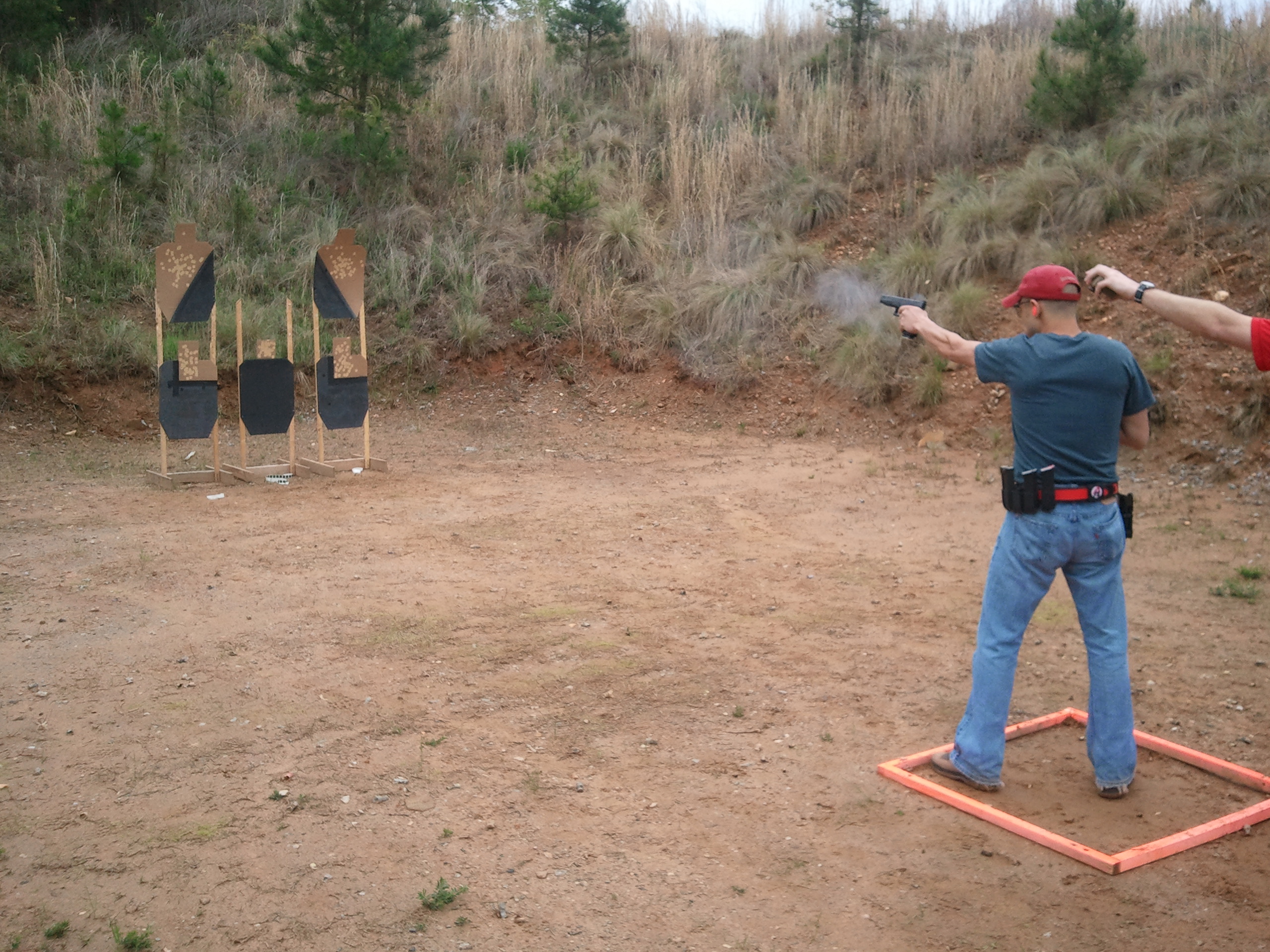
No, this isn't me. I suck at weak hand shooting. Time to fix that.
No, this isn’t me. I suck at weak hand shooting. Time to fix that.

+++++

On a related note, I found this video on line from Randy Gamble, who shot in my squad. Enjoy.

Getting Serious

Let’s face it, none of us is getting any younger. Without details, let me say that if I were a pro golfer I would be on the Senior circuit. So the time has come for me to decide – am I going to move forward, or continue where I am and accept a gradual decline into the sunset?

I’m moving forward.

Fortunately, I have some experience to draw on in my quest for improvement.

Once upon a time, when Old Tom Morris was a kid, a friend gave me an old golf bag and set of irons. I went and played, and I was hooked.

In the next three years, I went from nothing to a 14 handicap. How? Immersion, practice and dedication.

I got involved. At first I traveled around our area, playing public courses, but soon I joined a club. I took lessons, bought good equipment, and practiced, practiced, practiced. And my scores got better. I learned new techniques. What was difficult before got easier.

Then I learned how to build golf clubs from parts. I also fitted clubs for others, and I still play with wedges and a putter that I built. Now, this is one area where my shooting has already paralleled my golf, because I am a Certified Glock Armorer, and I am well into learning how my other guns work and are put together,

What was the theme that tied all these improvements together?

Investment

There are several things I can invest in for my shooting future. First, I have always shot matches as a guest of the club where I was. This also means, when I want to practice, I have to go pay a daily fee at a range. So, I plan to join a club, so I can practice more, and have access to lessons and instruction. I am now looking at my options and hope to report something soon.

Next would be to invest my time in practice. I’ve written about this here before, but I am going to establish a real regimen, and stick to it.

Next would be in equipment. Fortunately, my equipment isn’t an issue right now. Yes, there are better guns out there, but, to borrow an analogy from my golf game, by the time a $1,000 driver would do my game any good, I wouldn’t have to buy them because a sponsor would give them to me. It’s the same here. I’m not limited by my gun, and by the time I shoot better than my gun, Glock or Smith or somebody will offer to give me one, provided I don’t remain anonymous.

Next would be involvement, and I’ve already taken some steps in this direction, by sending in my application and money to take an RO training class here in the Atlanta area this summer. Frankly, I think I am long overdue. In golf, I found that knowing the rules backward and forward helped my game immensely. I know it will here too.

I will invest in some coaching, too. There are a number of good shooters around here who teach.

So, look for future posts on my practice regimen and other plans.