Lessons Learned and Re-learned

Courtesy of Warren Tactical

Writing this blog has forced me to look at my shooting techniques in black and white terms. One thing I am confronting is the lack of actual training I have gotten, and how my shooting has suffered as a result. It’s one thing to read in a forum or see on TV how something should be done, and another thing altogether to realize I am not doing it that way.

For 18 plus years I was a self taught shooter. I taught myself a lot of things that I’ve found out not to be the best way. Notice I don’t say these techniques are “wrong,” because I managed to shoot decently. But, I know now I would have shot a lot better if I had done things the other way. That’s the reason for my post the other day about bullet orientation in my magazine pouch. If there’s really a better way I want to use it.

Today I’m writing about the biggest mistake I made, and how I fixed it. And boy, has it made a difference.

Drum roll.

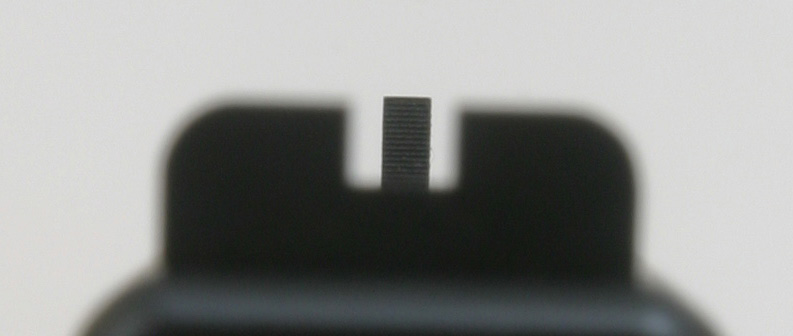
Until recently, I didn’t really look at the front sight.

I started out focusing on the target, and the gun’s sights would be blurry at best. Because I was shooting competitions where the targets were at 3 to 15 yards, it’s how I did it, and I got away with it. My shots were mostly As and Bs on an IPSC target, with Cs on the far targets. Sometimes I would have complete misses, and I was at a loss to tell you why.

Yes, I always heard teachers say “focus on the front sight,” but I didn’t think I needed to do anything different.

Then, about two years ago, I was watching the Pro Tip on an episode of American Shooter. KC Esubio was talking about calling your shots. To me this was a foreign idea at best, but he was using a helmet camera that actually focused on the front sight. I could see the rear sight alignment great, and the target was somewhat fuzzy, just like I had heard it described.

Then he shot a string of fire and told us to call his shots. I was surprised – I could tell exactly where the sights were aligned when the front sight lifted. I called his shots.

So I thought, maybe I should start focusing on the front sight, and maybe I could call my own shots, and figure out why I was missing targets.

There was a problem, though. Thanks to presbyopia, “old eyes” for you young whipper snappers, I physically couldn’t focus on the front sight. I wear contact lenses that give me good vision at normal distances, but I’ve had to wear reading glasses for the last 12 years or so. Even with my glasses, I couldn’t make something that close come into sharp focus.

So I got an idea. The next time I went for my annual eye exam, I asked the optometrist to help me out. He isn’t a shooter, but he understood what I wanted. He ended up giving me a sample contact for my right (dominant) eye that corrects it to 20/20 at arm’s length. Suddenly, my fingernail was in focus at arm’s length. The rest was up to me.

It was harder than I thought to train myself to look at the front sight. But to make it easier, I changed my sights on my competition pistol to a set of Sevigny competition sights with a fiber optic front sight. The difference has been amazing.

The first competition I shot with the contact in was the GSSF Annual Shoot, and it was my best GSSF match ever. Before this, my personal best was four misses in a match. This time I had only one miss, and I even called that one when it happened, and I knew I had jerked the trigger when it happened.

This contact has lasted me over a year, since I only wear it for about 6 hours at a time a few times a month. And, at my annual visit this year, my optometrist gave me another sample that I can use when this one wears out.

So, what’s next in my rebuilding of my technique?
Three Months Already?

Order this shirt here at Despair.com

Hard to believe that three months ago today I got a wild hair and clicked on the “Create Your Own Time Sink” button.

Thank you to everyone who reads this blog. I’ve gotten to meet a lot of good people, and I’ve learned a lot, mostly about how much I have to learn.

Summer Thoughts

Summer is the time of the year I like most. Many people say “I can always put on more coats in the winter.” Not me, I can never get warm enough. I prefer to feel the sweat roll down my . . . neck. I like it hot.

Summer is the height of competition season, and on this Solstice I’m struck by how little I have competed so far this year. I have two favorite USPSA clubs here in the Atlanta area that I shoot at, one the second Saturday, and one the third Sunday, and I’ve had other family commitments so far this summer. I’ve shot two Steel matches, at that’s it. Yes, I spent Memorial Day at the LuckyGunner Blogger Shoot, but that doesn’t count.

In July, I have a Steel match, a USPSA match, and a GSSF match in successive weekends. Then, Gaston Glock’s birthday on the 19th. It should be a good month.

So, okay already. Stop my bitchin’. Load some magazines, get my practice in, and hit the road. I have no one to blame but me.

Be Prepared Part 6 – A Yellow Day

This weekend my wife and I had a few more discussions about family safety and preparedness. It started with another robbery in the news, where some people were mugged, and despite giving the robbers what they wanted, were shot and killed. Our take was that there was really no excuse for two people together to be surprised by a robber, if they were paying attention to their surroundings. That got us to talking about awareness.

There are a lot of ways to describe our levels of awareness, and maybe the best was put forth by Lt. Colonel Jeff Cooper in his book Principles of Personal Defense. My wife is not a reader of the good Lt. Colonel Cooper, so I talked a little about his color code. For those who might have missed this or forgotten, Cooper summarized those this way:

White – Unaware and unprepared.

Yellow – Relaxed but alert of your surroundings, and prepared to defend yourself if necessary. You see people and things coming in and out of your area, and you assess them for threat, almost subconsciously.

Orange – Something is not quite right and has your attention. It may be time to take furtive evasive action or other action.

Red – In an active fight. It’s time to either get away, or defend yourself if needed.

She seemed to really take to our discussion, so we talked about how we can work as a team when we’re out, watching out for each other. She immediately noted that we would be in Yellow all the time, but if one of us sensed something, we needed to be able to tell the other without alerting the threat. After some talk, we decided our code for that would be to pointedly use the word “orange,” as in “I feel orange right now, three o’clock.”

We’d had the Condition Red talk before, without using that phrase, and she has always known that if I ever had to draw my gun, it would not be to threaten, it would be because, as Tom Givens put it, there was somebody there who needed to be shot. That would be her cue to move with the kids as fast as she could away from me and away from the threat, since I then became the number one target for whoever we were confronting.

Later, we went out for a little shopping, and we talked about this again in the car. The telling time happened when we stopped to use an ATM in a part of town we don’t normally frequent. As we pulled up I talked about what I was going to do, and she agreed to watch out for anyone approaching the car.

My ATM routine is simple. Pull up as close to the ATM as I can so I don’t have to open the door. Keep the doors locked. Keep the car in gear. Don’t keep my arm hanging out of the car while I wait. As money, card, and receipt come out of the car, I shuffle them into my other hand and into the car. As soon as the ATM is done, I pull away, and I put the money and card away when I stop later.

We finished our shopping and got home with no incidents.

Now, I admit, we used to go our way in condition white, or as we also call it, Fat, Dumb, and Happy. So, did our awareness spoil the time together? Not at all. In fact, we probably felt better because we knew we were watching out for each other, even more than before.

It was a yellow day.