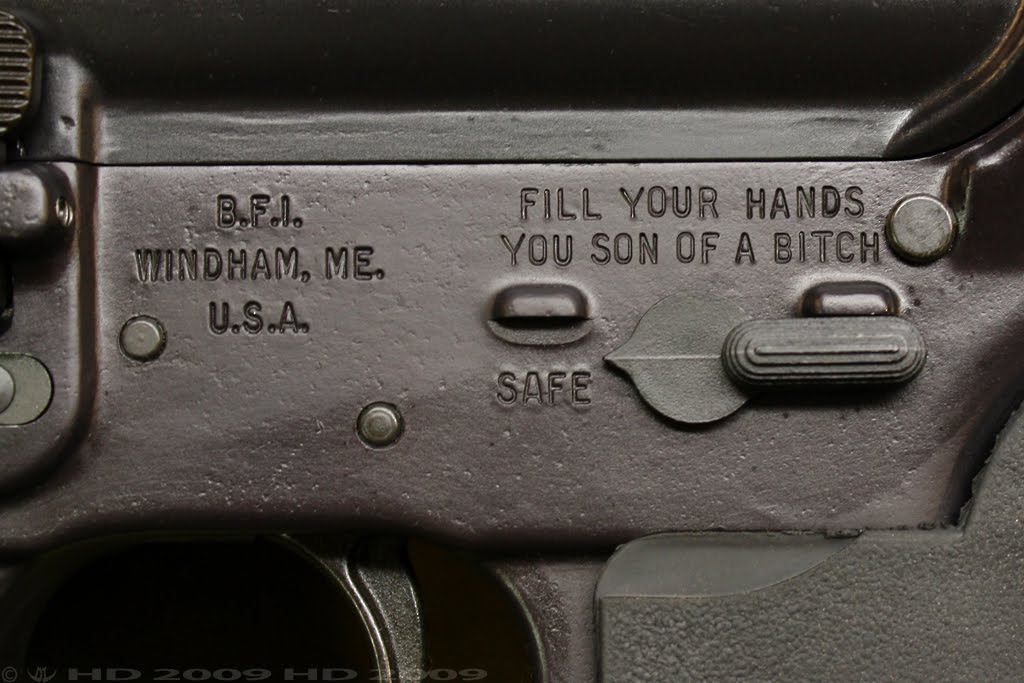
Epic Selector Win

I came across this while I was doing a search for new Twitter avatars.

It came from the Flickr account of Mike Fett.

Okay, he admits it’s shooped, but if someone can make a real AR lower like this, with the second word spelled “YER,” please email me.

Seriously.

Photo courtesy of Mike Fett.

Gun Control by Executive Order

Nothing to see here. Step around.

In the last few days there has been a lot of blog and Twitter chatter about President Obama issuing new Executive Orders instituting new “gun safety rules,” or as it is known in the Real World, gun control.

I have some strong feelings about this issue, and I’ve tweeted about them, but 140 characters doesn’t do it justice, so here goes.

The whole idea of legislating new gun control by Executive Order is a steaming pile of BS. Don’t be distracted. Just walk around it.

The whole issue is a smokescreen to distract attention from the ongoing Fast and Furious / Project Gunrunner scandal, which is probably going to take down the Attorney General, if not others in the administration.

Why do I think this is meaningless? Consider:

First, as far as I can find, there was only one story reporting this prospect. A Google search I did failed to find any other stories corroborating this report. All the other stories quoted the original story. (And all the gun forum posts quoting this one story didn’t help the search any.) The only deviation was a story in March suggesting this was in the works, but again, no follow up other than quotes of this one story.

Second, as I said about the Fast and Furious investigation, the current Congress is sufficiently pro-Second Amendment that any attempt by the Administration to circumvent not only US law but the Constitution itself would be met and fought.

Third, Executive Orders do not have the force of law, in the absence of other legislation directing the President to take action. Executive Orders are almost always used to carry out things that are already written into law, but are in the form of a direction to the President and the Executive branch to carry out. They are also used to organize the Executive branch by establishing working groups and positions that don’t need Congressional approval.

An Executive Order that created a new regulation out of thin air*, would certainly by unconstitutional and would be fought almost immediately, both by the Congress, and by organizations like the Second Amendment Foundation and the NRA. In addition, trying to change the terms of an existing law would be unconstitutional, and would be blocked.

One example that’s been given of the latter is that a “paper trail” would be kept of NICS background checks done from firearms purchases. The problem is, the NICS law as written specifically states that records of the NICS check will only be kept for 90 days, then destroyed. So, any attempt to change this by Executive Order would be fought as aggressively as it was in 2009 when attempts were made to change the law to allow longer retention.

So personally, I would ignore it. Molon labe.

Here’s the kicker though.

Obama knows all this. He is just trying to distract us and make us commit limited resources to a fruitless fight against nothing. Then he and his gun control cronies can point to us reactionary, trigger happy, gun nut zealots, and make some headlines in the Washington Post about us all being right wing nut cases. And then the whole thing will disappear overnight, like Congressman Weiner.

I, for one, refuse to listen any more. I am concentrating my attention on the many more real threats to our rights. There are certainly enough.

* Yes, an Executive Order was used to establish the Japanese Internment Camps during World War II, which was not previously authorized by law, and which was almost certainly unconstitutional. However, even a casual study of history shows that the climate in the nation at that time prevented anyone from seriously disputing FDR’s authority to do so, and the Congress at the time lacked the courage to question it as well. Fortunately, that condition does not exist today.

Getting Used to New Magazines

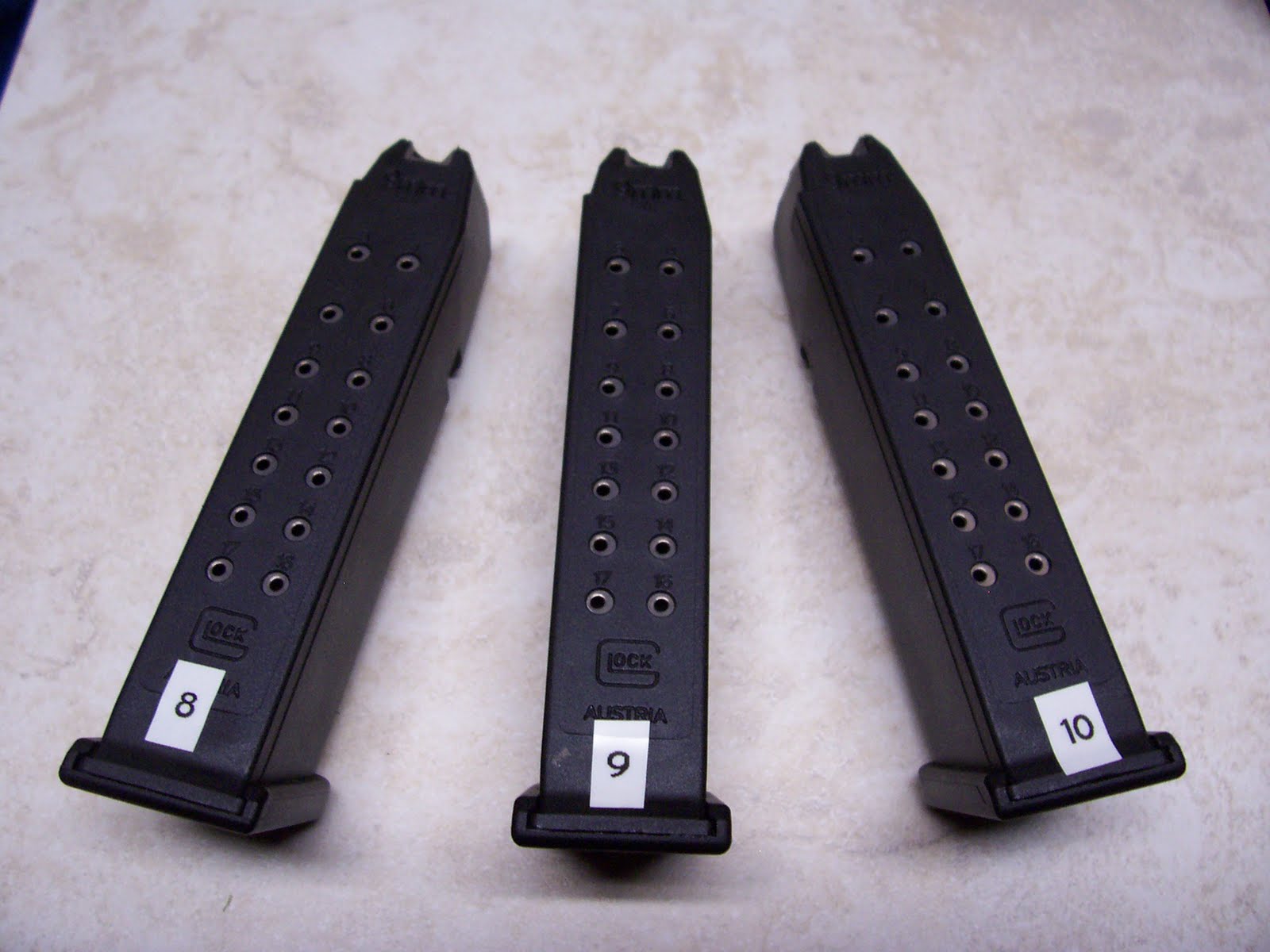
This past weekend I was practicing magazine changes with my new Glock magazines. These FML mags will replace my old NFML mags. For now, only Magazine 2 has been completely retired, and Mags 1 and 3 will continue to be used.

Since most of the magazine changes I do are during competition, and I almost always compete with Bruce, the G17, with magazines that have “plus 2” extenders, I didn’t anticipate how much the lack of the extenders would affect how the magazine changes felt. Granted, I did have a preview of this during my last training session, Memorial Day weekend, using the Duke, my G21SF, but that experience was limited.

What the lack of the extenders means is that it feels to me like I have to push the magazines in farther than I used to. I didn’t think an inch or so would make that much difference, and it doesn’t really, when I’m using the full size guns, the G17 and G21, as long as I push until they stop and click in place.

But when I did a few practice runs with Liberty, my G19, which does not have extenders on its magazines either, I found that the shorter grip of the gun meant my the heel of my left hand, pushing the mag in, impacted the heel of my strong hand, which really felt awkward. This means there’s a chance I won’t fully seat a mag so that it latches, and I will end up dropping the full mag on my foot as soon as I return the gun to the shooting position.

I know where this heads. First it means I need a lot more practice time with the new magazines, and with my other guns. I’m going to have to practice until seating the magazine is a sure thing, no matter which gun I’m using. A few 10 minute practice sessions each night will go a long way to that.

Second, it means I probably need to budget for a lot more extenders. Eleven of them, at $9 each. Ouch. And no, the extenders from the NFML mags will not work on FML mags – I tried them when I first bought mags 4, 5, and 6, and got a rain of cartridges in return as the extender popped off.

Of course, the up side is that I will also gain 2 more rounds per magazine. You never know when that will come in handy.

It’s always something.

Glock Sport Shooting Foundation

I am surprised when I talk with fellow Glock owners who are unaware of the Glock Sport Shooting Foundation, or GSSF. I then realized I hadn’t done a full post explaining what this organization was or how to join. Let’s correct that today.

The GSSF is owned and operated by Glock, Inc., out of their US headquarters in Smyrna, Georgia. They organize and run about 36 matches a year, all over the country, with the much appreciated assistance of a lot of people at local host ranges. The schedule can be found at the GSSF website, www.gssfonline.com. Joining GSSF is just $35 for the first year, and $25 to renew, plus $25 per match for each pistol you compete with. (More on that later.)

But the bounty comes with the prize packages. In addition to awarding Glock pistols for winners, and cash for other high finishers, they also award a lot of cash, complementary membership renewals, and free pistols at random to competitors. In the 15 years I’ve been competing, I have only won a prize once for my finish – I won $100 for taking second in my class. But I’ve also won $100 once, $50 twice, two annual renewals, and – YES – a brand new Glock of my choice. (That’s where Libert, my G19, came from!)

GSSF is open to any Glock shooter, regardless of age or experience. There are different classifications for shooters, ranging from Amateur Civilian (which would include most of us), to Guardian (for police and military) to Master (for those who are ranked Master or Grand Master in other groups). All you need is a Glock pistol and at least 4 magazines, plus 104 rounds of ammo. And, if you have more than one pistol, you can enter more than one classification, which increases your chances of winning a random prize.

Admittedly, GSSF seems like a rather low-intensity competition, when compared with USPSA or IDPA. There are no reloads or movement during the stages, and the stages start at low ready, rather than being drawn from a holster. This is perfect for the new shooter, but don’t think it makes matches a cake walk for experienced shooters. This just shifts the emphasis from transitions to accuracy.

To level the playing field, and to account for the restrictive gun laws in some states, all magazines start with 10 rounds, and you are allowed one in the chamber. There is an exception for the Glock 36, which only holds 6 rounds to start, in a class called Heavy Metal, and if you shoot another .45ACP or 10mm Glock, you can enter that class as well, and self limit your magazines to 6 shots each, plus one in the chamber.

Scoring is based on time, with penalties assessed for errant shots or misses. The match uses three kinds of targets – the NRA D-1 target, also called the Tombstone; steel pepper poppers; and 6 inch steel plates.

For the metal targets, scoring is easy. If you knock the popper or the plate down, there is no penalty. If you leave one standing, you add 10 seconds. Ouch.

For the Tombstone targets, all shots in the A or B area incur no penalty. Shots in the C area add 0.5 econds for each, and shots in the D area count for 3 extra seconds each. Complete misses add 10 seconds. Ouch.

Every match I’ve been to has included the same 3 stages, and they are run just about the same everywhere. I tried to find some good examples of these stages, but the best ones are actually on the GSSF website itself, which I liked above.

5 to Glock:

This stage is five Tombstone targets, spaced from 5 yards out to 25 yards. Sometimes these are in a straight diagonal, and sometimes they are staggered. The point here is to test transitions from target to target, and to test your ability to make the longer shots as well as the close shots.

This stage is shot three times. At the end of the stage, all three times are added up, and each target is assessed. There should be 6 shots on each target, and penalties are added accordingly.

Glock M

The stage is named for its similarity to the letter M. From left to right, there is a Tombstone target at 7 yards, a Tombstone at 15 yards, 3 pepper poppers at 11 yards, then another 15 yard Tombstone, and a 7 yard Tombstone. This stage is also shot three times, with only one popper being shot on each run through.

Here’s where a little strategy comes in. I generally shoot all the Tombstone targets, left to right, 2 each, then shoot the pepper popper. This means I’ve shot 8 shots, leaving me three shots to knock the popper down. If I leave a popper standing, then it’s my fault, but I’ve never left a popper standing.

Glock the Plates

This is the simplest stage of all – just 6, 6 inch steel plates, at 11 yards. Knock them all down in the shortest time. This stage is shot four times.

But, as is often the case, the simplest stage is not necessarily the easiest. I have probably left more plates standing in my GSSF career than any other. For me, this stage embodies all the fundamentals of good shooting – sight picture, trigger control, and follow-through. When I get all these where they should be, and my shot cadence is right, I clean this stage. My technique is to shoot each plate in order, whether I hit it or not, then come back and take the ones I miss.

GSSF can be an excellent entry into competitive pistol shooting, and it is also a great complement to other shooting games for more experienced shooters. If you own a Glock, give them a look. For that matter, sign up, and come shoot with me next Saturday, July 16, at the Riverbend Gun Club in Canton, Georgia.