What a Day

On June 14, 1775, the Continental Congress adopted a resolution creating the Continental Army. This was a significant move in the formation of the United States, as it sought to unify the military forces of the 13 colonies under one command – General George Washington – in its fight against the British.

Before this, since the battles of Lexington and Concord on April 19, the Revolution had relied almost entirely on the efforts of local militia, groups of men who fought for their freedom with their own guns and their own resources. While these men were not part of the Continental Army, they were an effective force, and continued to be a vital part of the Revolution, even after the formation of the Army. But now, with a central command, there was the beginnings of a national armed force.

Later, after the Revolution was won, and the Constitution established, Congress sought to make right an oversight. It adopted the first set of ten amendments, known collectively as the Bill of Rights. One of those, the Second Amendment, recognized the part the militias played in the Revolution, when it said that the militia was “necessary to the security of a free state,” and it enumerated the “right of the people to keep and bear arms shall not be infringed.”

So, how did we get to the “well regulated militia = National Guard” idea? This misunderstanding rises from the fact that most people don’t use the word “regulated” the way our founding fathers did. They used it in the same way we use it when speaking with a gunsmith about a double barreled shotgun or a double rifle. In that sense, to regulate these guns means to adjust them so that both barrels shoot to hit the same target point. A well regulated militia is then a group of citizens who are proficient in arms, and can all shoot well enough to hit the same targets.

Today’s “well regulated militia” means that we citizens, men and women, must be prepared to protect our homeland, the same way the militia did in 1775. We need to practice so we can all hit the same target point if the time comes. While fewer of us may come to shooting from a military background, this doesn’t excuse us from that responsibility, nor preclude us from that right.

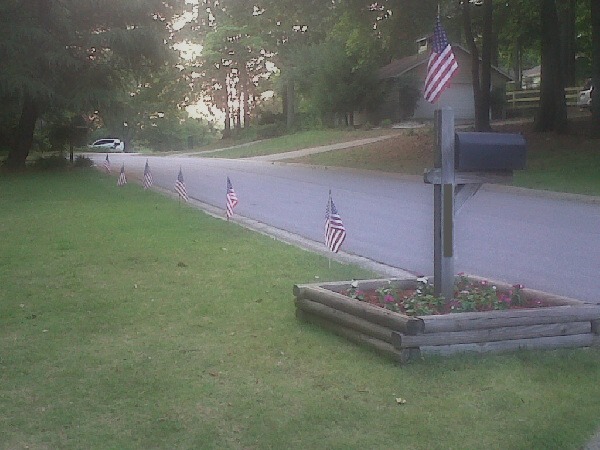
Interestingly, exactly two years after the establishment of the Continental Army in 1775, the Congress adopted the familiar Stars and Stripes as the national flag of the United States.

While you celebrate Flag Day today, remember our army as well, and the well regulated militia that stands behind them.

Ammo Review – USA Ammo 9mm 115gr FMJ

UPDATE NOVEMBER 2, 2012:

Based on feedback I’ve received since I’ve written this review, I can no longer recommend USA Ammo as a source.

  • Ammo quality has deteriorated seriously in the time since this review was written.
  • Delivery is now obviously not a priority for the company, and attempts to contact them for comment have gone unanswered.

For more information see this post, The Decline and Fall of USA Ammo:

In June 2011, on the advice of a fellow shooter, I bought 500 rounds of 115 grain FMJ 9mm ammo from USA Ammo. At the time I was very impressed by the delivery and performance of the ammo, and I gave it 4 eye patches.

Later in 2011, they ran a special on GearHog, and a lot of people bought a lot of good ammo. Still, I was pleased.

Then something terrible happened.

From what I can tell from posts on other sites, the company wasn’t able to keep up with ammo production to fill the GearHog orders, and they started having problems shipping orders on time. Customer service suffered at that time, too. Calls to the company went unanswered, messages were unreturned, and emails seemed like they were going to a black hole.

The appearance of the loaded ammo changed was well. In the first batches of ammo I had gotten, the bullets were shinty and unblemished. Later batches had bullets that were full of small dents and dings, which seemed to indicate to me that the bullets had been in storage or shipment for a long time.

Comments to my previous posts show a trend in the downward performance of the ammo, mostly in fulfillment of the orders. And a cursory Google search shows similar disappointing reports.

Based on these, I can no longer recommend USA Ammo.

I will continue to follow their progress and update as I see it.


++++

ORIGINAL REVIEW:

On the advice of a shooting acquaintance, I recently bought 1,000 rounds of 115 grain 9mm JHP ammunition from USA Ammo. This weekend, I did an inventory, and it turns out I’ve shot just about half of it, so I thought I would review the ammo for others.

Having never done an ammo review before, I read a few, and decided on a format. I will give you my impressions in 4 areas: price and availability, cleanliness, operation, and accuracy. I will rate each area with an appropriate unit of measure, the Rooster Eye Patch.

USA Ammo loads their own ammo, and sells both new ammo, and reloaded ammo made from once-fired brass. Both are very economical – the new ammo is currently $9.45 for a box of 50, and the reloaded ammo is $1 a box cheaper. Shipping on a 1,000 round order was around $17. The ammo was available and shipped as ordered.

When I opened the first box, my first impression was very positive. The ammo comes 50 rounds to a box, loose in the box, which at first threw me a little, because the photos on the USA Ammo website showed them in a tray. But after some thought, I guess it doesn’t really matter to me. For one thing, it makes the boxes a little smaller without a tray.

I was also taken by how bright and shiny the rounds were. Loading magazines didn’t leave my thumbs black, either, a nice change. This carried over to the end of the shoot, too, as my Glock 17 and Glock 19 appeared above average in cleanliness after shooting. Shooting at an indoor range, there were no black deposits on the flat surfaces on unused targets.

How to measure accuracy? Now, I am not a bullseye competitor, and I don’t have a Ransom rest. My most stringent accuracy requirements are being able to make a shot into the USPSA A zone. As an engineer, I also know that of all the factors acting to make a shot go out of that zone, bullet accuracy is way down on the list. In other words, most ammo is going to be a lot more accurate that I am.

Having said that, I decided I needed an accuracy test for this to be a respectable review, so I devised the Zombie Accuracy Test. Every shooter needs to be able to make a reliable zombie headshot. So, using the zombie head target from Zombie Squad, I shot a full magazine – 19 rounds – from 7 yards, as fast as I could accurately shoot, about 3 shots per second. A passing score is to get all the shots in the head. USA Ammo 9mm 115gr FMJ passes the Zombie Test.

I also used this ammo in two Pistol Steel Challenge matches, and had no complaints. I had zero failures of any kind during the first 500 rounds. There were no mis-loaded rounds, dented cases, or other defects.

So, I give USA Ammo’s new 115 grain JHP 9mm a Rooster rating of 4 Eye Patches.

Disclosure – I bought all the ammo used in this test, and performed all the testing myself. There has been no influence or contact in any way from USA Ammo.

"Tell Me Your Story" – Gun Culture 2.0 Revealed

Some of the people I had the great fortune of meeting at the LuckyGunner.com Blogger Shoot a coupe of weeks ago was Jennifer, who writes the blog In Jennifer’s Head, and her husband Evyl Robot Michael.

Yesterday, Jennifer asked in her blog for her readers to tell us her story – how did we get into the gun world? This prompted over 50 stories of how they started shooting. I even posted a link to my story, my first real blog post 3 months ago.

Many people who posted linked to their own blogs, and their comments sections had people posting how they got started. I didn’t count them all but there’s a lot.

One of the things that I noticed was a lot of the posts, maybe a third, represented what is becoming know as Gun Culture 2.0. I first heard this phrase used by Michael Bane, and it means those whose entry into shooting deviates from the traditional, established route of gun ownership. Traditionally people were around shooting all their life. Shooting was passed down from parents and grandparents, or perhaps learned in Scouts or 4H. There are also those who took up shooting in the military.

Gun Culture 2.0 are those like me who took up shooting because of a concern for personal protection. I even noted that several people mentioned Hurricane Katrina as a driving force in their decision. It was not a family tradition, and in some cases, people bought their first gun despite a family tradition of anti-gun attitudes.

Welcome to the fold, fellow members of Gun Culture 2.0. I look forward to meeting you!

The Next Big Scare

Here is the subject of the next Scare Email that is going to show up in your inbox soon: another proposed UN small arms treaty. According to Larry Bell writing in an Op/Ed for Forbes Magazine, this treaty would

1. Enact tougher licensing requirements, creating additional bureaucratic red tape for legal firearms ownership.

2. Confiscate and destroy all “unauthorized” civilian firearms (exempting those owned by our government of course).

3. Ban the trade, sale and private ownership of all semi-automatic weapons (any that have magazines even though they still operate in the same one trigger pull – one single “bang” manner as revolvers, a simple fact the ant-gun media never seem to grasp).

4. Create an international gun registry, clearly setting the stage for full-scale gun confiscation.

5. In short, overriding our national sovereignty, and in the process, providing license for the federal government to assert preemptive powers over state regulatory powers guaranteed by the Tenth Amendment in addition to our Second Amendment rights.

Obviously these terms an unacceptable. Does such a treaty present a threat to our Second Amendment freedoms here in the United States? In my opinion, yes, and no.

Any research will show that the issue of whether treaties trump the US Constitution is divided. Personally, I believe they do not. However, I choose not to have to rely on some future Supreme Court to decide the issue, when to me, the best course of action is to prevent ratification of the treaty by the Senate, and, if possible, its presentation to the Senate in the first place.

Treaties are presented by the President to the Congress, and ratified by two thirds of the Senate. The current Senate is unlikely to vote for such a treaty. Despite the vocal exceptions like Schumer and Feinstein, the majority of the Senate remains pro-Second Amendment. This is logical, because the majority of the American people are pro-Second Amendment, outside of the areas represented by the obvious anti-freedom members.

It is up to us to contact our Senators and make sure they understand what is happening, and we let them know where we stand. I know that both of my Senators in Georgia, Johnny Isakson and Saxby Chambliss, are staunchly pro-Second Amendment, but I am writing them about this any way.

Despite the fact that the House of Representatives does not vote on treaty ratification, they almost certainly will have their say. I also plan to write my Congressman, Dr. Phil Gingrey. I will report the responses of my representatives here as they arrive.

Of course, the President presents any treaty to the Senate for ratification, so the opportunity is there to affect this, provided the treaty can be delayed until after the next inauguration in January 2013. The need to elect a President that reflects the love of freedom shared by the rest of the country could not be greater.

I believe if we act now and maintain contact with our Senators on this issue, we can hold off this threat. But it won’t be the last. That’s okay. This is part of the “eternal vigilence” that is required of us.