The Safety Rules in Depth – Part 3

Rule 2: Never let the muzzle cover anything which you are not willing to destroy.

If there was a single gun rule that, when violated, resulted in the most damage, injury, and death, it would have to be Rule 2.

After all, the direction a gun is pointed determines where the bullet goes when the gun fires. While Rules 1 and 3 are devoted to preventing the gun from going off unintentionally, with Rule 2, it doesn’t matter whether the gun is fired intentionally or unintentionally (or, as the anti-gun crowd believe, it goes off by itself). This Rule must be followed, or bad things happen.

Rule 1 is a philosophical rule. It takes a change in the shooter’s thinking to make it work. You need to have a change in your attitude, so that you always treat the gun as if it were always loaded, even if it isn’t. Which it is – see Rule 1.

Rule 2 is a concrete rule. It doesn’t matter how you think about the Rule, what your attitude is. The gun is pointing where the gun is pointing, regardless of how you think about it.

In my experience, Rule 2 is the most violated of all the safety rules. The main reason for this is ignorance and inexperience. New shooters may be used to playing with a toy gun, or not having a gun around at all.

And then there are the thousands of very bad examples on TV and in movies.

Wow. Not only did Vincent violate Rule 2, he violated Rule 3. Bad things happened. Sorry, Marvin.

Almost as bad are the hundreds of images where an actor points the gun in the air as they move around. No one tells viewers that this isn’t for good safety practice, this is so the gun is in the shot with the actor’s face.

This Rule takes concentration. Nothing about Rule 2 can be left to attitude or thinking or philosophy. You must be aware where your gun is pointed at all times, or bad things can happen.

So, what works when teaching Rule 2? Zealous enforcement and repetition. When you find someone waving a gun around, call them on it. Whether you are polite about it or not depends on the situation and the violator, I suppose, but you should be firm and unequivocal in any case. In my family, we are all allowed to call “MUZZLE!” and push the gun downrange or toward the ground if it’s safe to do so.

A search of most gun forums will also find many accounts of violation of this rule at gun ranges, gun shows, and gun stores. When a polite but firm reminder not to point the gun at something they aren’t willing to destroy goes unheeded, the only recourse then is to leave. I know I’ve done it.

+++

Rule 2 is the failsafe of the gun rules. Follow it – make sure the gun isn’t pointed at anything you aren’t willing to destroy – and even if someone violates the other rules, you will be safe.

Got It On Camera

My Quest for C Class

Note: I thought about delaying this post until I found some good video editing software that I like, so I could illustrate my points. But I think the points need to be made. When I finally settle on editing software I will post a follow-up.

When I first took up golf, one of the best tools I found to help my swing was to watch myself on video. While most people have no problem pointing out my faults, I tend to politely dismiss their help. But, on video, the good parts and bad parts of my swing stand out clearly, without comment or advice. The camera doesn’t lie, and it isn’t trying to get in my head and mess me up to make that $5 Nassau.

This past weekend I was using some software to capture individual frames of my shooting videos as photos. In the process, I got to look at my shooting stance, grip, and follow through in slow motion, and I found out that video works the same way with my shooting as it did for golf.

When I shot video of my golf, I would tape my practice sessions as well as my play, so I could compare what I did when I concentrated on it, versus what I did when I wasn’t concentrating as much as relying on muscle memory and training.

For my shooting, I reviewed match footage, but I don’t have video of any practice sessions. I am focusing on the match, and on making good shots, not on the mechanics. So, what I am seeing on video is my ingrained habits, my training.

Here’s what I found out:

> My draw is smooth, and it does what I think I have been practicing for it to do. The gun comes out and up smoothly, and I press straight out while the support hand takes a grip. It also goes straight to the target, without any oscillation at the top. That’s good.

> I control recoil a lot better than I think I do. From the beginning of my shooting career, I’ve always thought that I did a poor job of recoil control, almost like I was shooting one of those .500 Magnums you see on Youtube. It turns out, however, that my muzzle rise is actually on par with some of the best shooters I’ve seen. It goes up just a little and settles right down. This proves that not only do I have a bad image of myself as a shooter, I’m also focused well on the target such that muzzle flip isn’t even noticeable. That’s good.

> I do a decent job of positioning my body as I shoot. But, as I suspected, I move a lot like a sea lion. That will improve as I lose weight. I full imagine to be moving like a penguin in no time.

> On close up targets, I lack the confidence to make double taps. I will instead take two measured shots. It’s not that I can’t do double taps, so it has to be confidence. That should come with practice.

> I do a decent job keeping the muzzle down range when I move. I’ve never been warned or DQ’ed by a Range Officer, so that confirms it.

> I need to pay a little more attention to my trigger finger when I draw or move. I have been warned about this, so this is something to pay attention to and practice.

> Compared to someone like Dave Sevigny, my magazine changes look like I’m trying to force a live snake into a coke bottle. I think I can make this better by practicing. But it’s not because of the direction the bullets face in my magazine pouch. (Yes, I had someone point this out to me, again.)

> My Glock 17 Bruce runs flawlessly in every video I’ve shot. This jives with the fact that I’ve never had a malfunction of any kind in a match. In fact, apart from a broken extractor and a couple of limp-wristing incidents with my son, Bruce has had exactly 2 failures to extract in the 19 years I’ve had him.

At my next match, I’m going to try to get video of me on every stage. By then I will have some better editing video, and I’ll make another report showing what I’ve found.

I’m also planning a range trip on a week day in a couple of weeks. If the range is clear enough, I will get some video of some standard drills like El Presidente and the Mozambique. I can then compare my results to those I find on line.

Be Prepared, Part 9 – Stay Prepared

So, three years ago you did your part and put together a set of emergency supplies that you could carry in your car. Then comes the big snow, and you’re stuck. So, you get out the bag, and you find those batteries are dead, and the emergency food is gone, because your kids snacked on it a few times without telling you. Bummer.

A few months ago I wrote about my Get Home Bag that I carry with me in the car. Like just about everything in life, even a Get Home Bag takes maintenance. So, with winter approaching, I took some time to unpack the bag and make sure the perishable items were fresh.

You can see the contents of my bag above. I listed them in the previous post, and all was there except the granola bars, which I had commandeered for the most recent USPSA match.

I ended up replacing the water bottles, but everything else was good. I also shook out the blanket and bedroll and re-folded them, and I will wash and dry the towel, too.

I also checked out the compass (it was fine), and tried the lighter (it lit fine). Another change I made was replacing the two AA batteries with three AAA batteries, since I changed my every day carry flashlight to one that takes AAA.

For sure, repacking it all was a pain. I should have taken some pictures of what went where. But, in the end, it all went back.

You put good effort into planning. Take a few minutes now, and periodically, to make sure your work wasn’t in vain.

Where Were You?

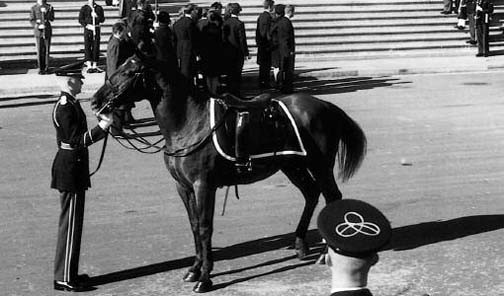
US Army Photograph

When I was a very young boy, we lived a couple of blocks from my grandparents, and my parents would take advantage of that as often as they could. For sure, this meant that I spent Sunday mornings with my Grandmother, while my folks went to church. I liked that a lot, since I was the only grandchild, and I was treated well, as you would expect.

I remember I really enjoyed watching cartoons on Sunday mornings, Popeye in particular, the old Max Fleischer classics, in black and white. At least, I remember them in black and white, probably because the TV was black and white.

One Sunday morning, my routine changed. Instead of my cartoons, there was something else on TV. In fact, it was on all 3 channels.

There was some kind of military parade going on, but there was no music. Everyone was quiet.

I distinctly remember one big black horse with no rider. Boots were in his stirrups, and they were in backward.

I didn’t know why my cartoons weren’t on. My Grandmother came in, and she looked at the TV, and started to cry. This made me cry, too.

++++

This is my earliest memory. It was Sunday, November 24, 1963, and an honor guard was moving the body of President John F. Kennedy from the White House to the US Capitol, to lie in state, following his assassination on November 22. I was 2 years and 8 months old.

For years, I thought this memory was of President Kennedy’s funeral, of the procession from the Capitol to Arlington National Cemetery. Then, in 1983, to mark the 20th anniversary of the events, MSNBC replayed the NBC coverage of the assassination and funeral, exact 20 years from the moment it occurred.

There, on the 24th, as the TV showed the President being moved to the Capitol, I saw the military escort, and the big black horse with the boots backward in the stirrups. I then realized it wasn’t the funeral I remembered, but the moving of the President to the Capitol.

I remember, in 1983, being 22 years and 8 months old, still being moved to tears by the sight of the horse, by the memories.

Every generation shares a “where where you” moment. For this one, it’s the September 11 attacks. For others, it’s the Challenger explosion, or Pearl Harbor. This is one of mine.