Podcast of the Week – The RoadGunner

The Un-Named Trucker (r) and some other up and coming gun guy.
Photo courtesy of the Un-Named Trucker

Okay, I admit I am probably the last gun guy in America to discover the RoadGunner Podcast. But I’m here now, and that’s what counts.

Over the last year my gun podcast repertoire has expanded to cover the 30 plus mile commute that I face twice a day. I have gotten to where I listen to music maybe two or three afternoons, but beyond that my drive is taken up.

I started hearing about this new podcast called the RoadGunner, hosted by an over the road trucker. Okay. I’ve known a few over the road truckers in my time, so in my mind, this was a wonderful podcast full of stories of duck hunting and hog hunting and deer hunting and squirrel hunting and coyote hunting. I am not a hunter. So I held off.

Man, was I wrong.

After the Gun Dudes hosted Mas Ayoob’s MAG40 class out in Utah, they started talking about what a good guy this new podcaster was. He goes by the name The Un-Named Trucker, because he’s a trucker and he prefers to remain unnamed. He drives an over the road big rig, for a company whose policies prevent him from carrying a firearm for protection. I understand completely.

The man has a gift for talking about guns and shooting and self defense, as well as just about every other topic. This is understandable, since a trucker’s life is spent behind the wheel, and he has ample time to work out not only the solutions to all the world’s problems, but effective and memorable ways to express them. He records his show while driving through the lower 47 states of America. He doesn’t visit New Jersey.

From his first show, this podcast has not failed to entertain and inform. Since he visits so many places, he’s become an expert of sorts in the gun laws of the various states and locales. He knows where all the good gun ranges are, and, like any trucker, he knows where the best food is, so he includes a food review of some kind in every episode.

He is also a very good interviewer, and he uses that skill in a lot of the episodes. His interviews are very conversational, and I imagine this flows well from a trucker’s natural skills – someone who spends almost all his day in the cab of a truck would probably be a very good conversationalist once he got to talk to someone in person.

Since I am late to the party, I am going back and listening to the old shows. The RoadGunner Podcast is published every weekend (again, this makes sense, since this is when a trucker is home the most) so I can fit it into my schedule any day. This is definitely a welcome addition to my weekly rota.

The RoadGunner podcast is a member of the Gun Rights Radio Network, and is available for subscription on iTunes.

A New Blog – Sorta

Back before September 11, JP and I got a wild idea one evening, to flaunt our American liberties in the face of America’s Islamist enemies, in order to show that we have not been dissuaded by anything they could put together. The result was a blog called Bacon and Boomsticks.

While I did post a few examples, I have to admit that I wasn’t able to give this site the marketing effort needed for it to really take off.

I haven’t talked a lot about it here, but one of the things I love as much as shooting is cooking. Now, a lot of bloggers combine their loves into one record, and that’s okay.

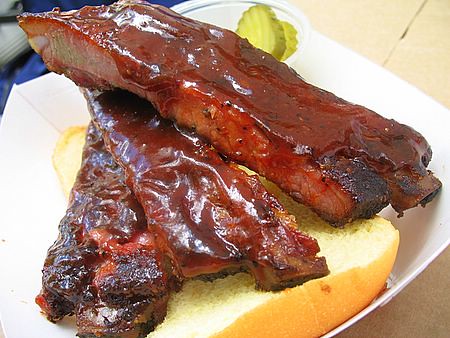
So, today I am announcing that Bacon and Boomsticks (B&B) will become a blog devoted to barbecue, grilling, and other forms of cooking. I also plan to review barbecue joints, beers, and other refreshments. Yes, if I go to a barbecue, then there will be guns, since the folks I hang with bring their guns, and you’ll see them there.

I can’t say how often I will post. When I find something interesting, you’ll see it there. I can’t say whether there will be many cross-posts, but I will be sure to provide a link here so you can catch up.

If you enjoy burned meat, chili, and beer as much as I do, then we’re both in for a treat.

A New Blog – Balloon Goes Up

I noted a tremor in the force, and found a neat new blog, Balloon Goes Up. I was especially impressed with his post on his Get Home Bag. In it he relates an interesting rule of thumb called the 10 C’s of Survivability. I need to review my plans against them.

This reminds me that it’s getting close to winter, and it’s time to review, refresh, and renew my Get Home Bag. It also occurs to me that I should take pictures of the stuff that goes in my bag.

The Safety Rules In Depth – Part 1

I’ve recently been thinking about the Rules of Gun Safety. As I see them, they are:

0. Always wear eye protection, and hearing protection where warranted.

1. All guns are always loaded.

2. Never let the muzzle cover anything which you are not willing to destroy.

3. Keep your finger OFF the trigger until your sights are on the target.

4. Always be sure of your target and what’s behind it.

5. Never try to catch a dropped gun.

As I’ve said before, these are the classic rules (1 through 4) as developed by Lt. Col. Jeff Cooper, plus a couple that I emphasize as well.

I have a 14 year old son who is learning to shoot, and he has various friends who join us. Since we live about an hour from the range, every shooting session starts with a discussion of the rules. I’ve found that some points resonate well with these guys, so I wanted to share what we’ve talked about.

+++++

Rule 0: Eyes and Ears.

Or, Always wear eye protection, and hearing protection where warranted.

[My version of this rule says “hearing protection where warranted” because Rule 0 also applies to Airsoft guns, BB guns, and other non-gunpowder guns. I require my son and his friends to always wear shooting glasses during their maneuvers.]

TEENAGER VERSION

Protecting your sight and your hearing should be a no-brainer. You want to spend the rest of your life enjoying the world, and all the sights and sounds it has to offer. Think of life without music or television. Bleak, isn’t it?

But a lot of people see movies and TV and soldiers and think they can get away with not wearing protection when shooting.

The problem is, when you shoot a gun without eye and ear protection, you are damaging your hearing every time, and you could damage your sight, if you get hit by a stray shell or ricochet. Hearing damage and sight damage are not reversible. Once you lose hearing, it’s gone. The cilia in your ears, the little hairs that transmit the sound, don’t grow back. And once you damage your eyes, chances are the damage is irreparable.

So, everybody put these on, keep them on, and don’t give me any more lip.

+++++

GROWN-UP VERSION

[WARNING: Engineering content.]

EYES

The regulations and standards for protective eyewear are found in ANSI Standard Z87.1. Now, this standard covers eye protection for just about every exposure, not just impact, and it’s quite involved.

But you should always use eyewear that’s stamped somewhere with “Z87.1.” This means it meets the impact standards at least.

Regular glasses generally don’t meet this standard, because of the lack of impact resistance, and the lack of side shields. If you wear prescription glasses it may be worth it for you to get a pair of Z87.1 standard shooting glasses.

Off the shelf sunglasses fare even worse. May of them don’t offer even basic impact protection.

Shooters’ eye protection comes in all shapes and sizes and colors. Pick the one you like, and buy 2 or 3 pairs. Different colors help make targets easier to see in different light conditions. The most common are gray for sunny conditions, yellow or amber for low light, and vermillion, which enhances a beige or orange target.

EARS

The intensity of a noise, that is, how loud it is, is expressed in units of decibels, or dB. Hearing protection is rated by a Noise Reduction Rating, or NRR, which is also stated in dB. This is pretty much the measure of how much the ear protection reduces the noise level for the wearer.

Generally, noise about 85 dB is considered dangerous, since it can cause permanent damage. Noise over 140 dB is usually painful, and gunfire can range from 120 to 160 dB depending on the caliber and the surroundings of the shooter.

The NRR of hearing protection is measured by the manufacturer using a continuous noise, so its applicability to the sharp pressure wave of a gunshot isn’t exact. However, most experts recommend using ear plugs or ear muffs with a NRR of 19 or higher when shooting.

Obviously, the higher the better. Ear plugs can work, if you use them right. Foam ear plugs need to be inserted all the way into the ear canal, almost flush with the ear opening. Roll them up, and insert them before they expand, by reaching behind your head and pulling your ear back, and inserting the plug with the other hand.

If you can see foam ear plugs sticking out of your ears, you don’t have them in right.

Earmuffs are easier to use, but they can be hot, and they’re bulkier. The choice is yours.

Personally, I wear foam earplugs with a NRR of 21, inserted correctly, during any time I’m at the range. Then, when it’s my turn to shoot, I put on some earmuffs with a NRR of 25. This prevents me from having an involuntary startle reflex when I shoot.

+++++

Don’t overlook eyes and ears around the home, too. Wear eye protection when you cut the grass or use hand tools. Wear hearing protection when you use power tools or lawn tools.

I even bought a set of ear buds for my iPod that fit into the ear canal, and provide a NRR of 22. Very nice when I’m cutting the grass, or on the airplane.

+++++

Finally, here’s a good video that explains it all, from our friends at MidwayUSA.


Video courtesy of MidwayUSA