In the course of seeing how bad the video quality was from the Memorial Day Steel Match, compared to the HD video I shot earlier, I edited my Match Checklist this morning to add my HD camera. I use this checklist to remind me of what I need to do, and I typically start it a few days before the match.
I thought I would share it with you. Here’s the checklist. Feel free to copy it for your own use.
As I’ve related before, on Memorial Day the Creekside Firing Range in Cartersville, Georgia, hosts an annual Memorial Day Fundraiser. Consisting of a pistol match, and auction, and a tactical rifle match, all proceeds from the match this year went to the widow and two children of a soldier from the Chattanooga, Tennessee area, who was killed in Afghanistan this past year.
I shot in the morning Steel Challenge match, which attracted about 40 competitors. I didn’t stay around this year for the auction or the rifle match, mostly because I don’t own an AR-15 – yet. (More on this later.)
The shooters were split into two sqauds, and we shot 5 stages.
STAGE 1
Stage 1 was simple enough. The shooter started out seated at a table, with the gun loaded and lying on the table facing downrange. At the buzzer, we engaged five 4-inch targets at 20 yards, then moved to the second shooting area, where we engaged another five 4-inch targets at 20 yards.
Sounds simple, yes. Easy, no.
Four inch targets are small, very small at 20 yards. That’s the X ring on a NRA D1 target, or half the center “-0” ring on the IDPA target.
Couple that with being the first stage of the day, and it wasn’t pretty. I shot it in 32 seconds, and I was in the upper half of results if I had to guess. I bet I took 25 rounds.
STAGE 2
Stage 2 was just Stage 1, reversed. Start standing, shoot with the opposite hand, and progress to the seated position.
Okay, I had practiced drawing with my right hand and moving the gun to the left hand, and I had done some dry firing left handed, but not enough. As I tweeted at the time, I found out that, shooting left handed, I flinch in a way totally different from how I flinch right handed.
All stages carried a 90 second par time, and I ran out of time on this one, with only 4 targets knocked down. Since each target missed added 10 seconds, my score was 140 seconds. Yuck.
The best way I can describe my performance on this stage is to compare it with a drunk Kid Shelleen in the movie Cat Ballou. Only, I wasn’t drunk.
STAGE 3
Stage 3, for me, was a lot easier. From left to right there were two full size pepper poppers, then five groups of two smaller poppers, set in front of each other. The shooters were allowed to move along a fault line, set 20 yards from the targets, that ran the length of the targets. Some shooters moved along the line, Sundance style, while I prefered to stand and deliver.
I shot the stage in under 20 seconds, using fifteen shots. Now we’re talking.
One observation was that I was actually able to call my shots on this stage. Rather than wait until I saw the target fall, I knew when I broke the shot that my sights were aligned, so I trusted that the shot was made. I even knew when I had made the three misses.
STAGE 4
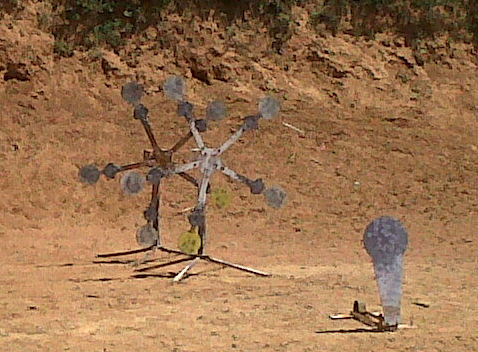
Stage 4 is shown above, from a little left of the shooting area. It consisted of two Texas Stars and a popper. One plate on each Star was painted yellow, and the rules specified that these two plates had to be shot first, or there was a 10 second penalty. The problem was, the yellow plate on the back Star was in line with one of the plates on the front Star, so that you had to hit the yellow plate on the front Star first, and when the front Star started spinning, you had a shot at the back Star’s yellow plate.
Once the two yellow plates were down, you could then engage any plates you wanted, in any order. Of course, with a Texas Star, that’s is about a hundred times easier said than done.
I managed to clean the stage in under 70 seconds, although I did knock off a non-yellow plate from the front Star before I hit the yellow plate on the back Star, so I incurred a ten second penalty.
STAGE5
Stage 5 was a mix of twelve targets, 4 inch plates and poppers, all at about 15 yards. I kept things simple and engaged them left to right. Shot it clean, with a decent time, again calling my shots. On this one, I asked a fellow competitor to take some video.
Sorry for the crappy video quality, I left the HD camera at home. I’ve got to add that one to my checklist.
In all, I enjoyed the match, even if I didn’t shoot as well as I could on the first two stages. I like shooting steel matches because the feedback is definite, and the scoring is simple.
As soon as I know where I placed I will let you know.
Competition is good. It helps you practice your gun handling skills, and it exposes you to a stressful environment which at least simulates a real world encounter. In the world of pistol competition, there always seems to be a lot of discussion about which pistol sport is more “defensive based” and more “real world” – USPSA or IDPA.
IDPA is the International Defensive Pistol Association, and it was founded in 1996, as a response by some who felt that IPSC competitions were getting too far from the intended purpose. Namely, the founders didn’t like the IPSC trend toward “race guns,” or guns purpose built for competition, and felt that there should be a sport that required the use of normal carry guns, with stages based on more real world scenarios.
The object of practical pistol skill is not to win trophies, but rather to stop fights. Muzzle brakes and reduced loads are backward steps and not to be regarded as progress. When we see the terms “race gun” and “carry gun” as representing two different instruments, we learn that some people at least have lost sight of the object of the exercise.
This comes from none other than the founder of IPSC and its first president, Jeff Cooper.
Interestingly, he goes on.
It is important not to become dogmatic about this.
Whoa. Dogmatic doesn’t even touch some of the “discussion” I hear.
He concludes:
If there is a better way or a better weapon, let’s have it. But I have not seen this developing in pistolcraft, at least not recently. Those of us who have studied the matter deeply understood this a good many years ago. We will change when we are shown why we should, but not until then.
In this light, the recent trend in USPSA toward the Production division is certainly welcome.
So, if you’re serious about shooting, you should be competing, both to build defensive skills, and to do so in a stressful environment. It seems clear that it doesn’t matter which sport you choose, as long as you keep your goals in mind. The rules may be different, but the goal should be the same.
If we get away from the original intent, however, we risk making it into something it isn’t suited to be, and something it wasn’t meant to be.
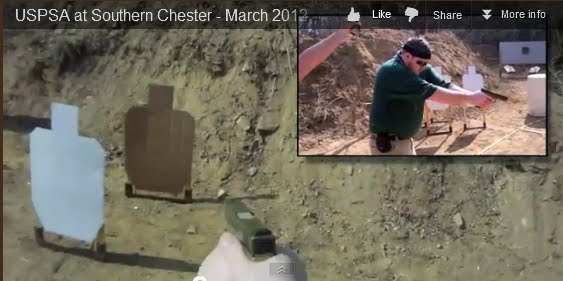
Walt White at Walt in PA has posted another match report from his recent USPSA match. Check it out.
As I read Walt’s description of his first stage, Stage 4, I began to see a neat demonstration of a curious phenomenon: how time slows down when we’re “in the zone.”
To see what I mean, read Walt’s description of this malfunction he ran into:
It was at this point that I ran into trouble. My slide was locked back but my magazine wouldn’t drop free after pressing the magazine release button. I gave the gun a little shake to try and free the magazine but was unsuccessful. Being the first time I had ever encountered this problem, I acted on instinct. I mashed down on the slide release lever and the slide snapped forward. A press on the magazine release lever sent the empty magazine falling to the ground. I re-inserted a new magazine and racked the slide.
With a round in the chamber and the slide in battery, the gun appeared ready to rock. I raised the gun and fired two last shots on the one remaining target.
As I read this, and imagined it in my mind, I thought it might take him 5 or 6 seconds to clear the problem.
Watch the video though:
You can see that it takes Walt 3 seconds, from 0:29 to 0:32, to clear and bring the gun back up. I think the fact that he was able to describe dropping the slide and trying to drop the magazine shows that he could and think about and clearly see all the details of what was happening.
All this happens because, when we are “in the zone,” or under stress, the body is filled with the “fight or flight” response, and flooded with adrenaline. Our brains speed up, and perception of time is altered. Lots of people have reported this, and I once experienced it during an auto crash.






 Fill Yer Hands