Gun Review – Glock 17

This is the first in a series of reviews of guns I own, have owned, or have shot enough to be sure of what I’m writing. Like everything here, this is based on my experience and research. Your mileage may vary.

The Glock 17 is the full size 9mm version of the famous Glock handgun, first introduced to the US market in 1986.

I bought Bruce, my Gen 2 Glock 17, in late 1992, from a pawn shop in a small town in Alabama. According to a serial number search I did through Glockmeister, it was made in March 1990. I don’t know anything more about it except the shop owner told me it was used.

I’ve written about it in the past, so I won’t go into a lot except to say that, because of the ease of maintenance and exceptional customer service, the only original parts left are the polymer frame, the slide, and the barrel. Over the years, through the graces of the Glock Sport Shooting Foundation, everything else has been replaced.

The performance of this pistol has been almost flawless. I estimate I’ve shot about 10,000 rounds through over the years, and in that time I have had exactly six failures, all of which were failures to extract. Three were due to a chipped extractor, which I was unaware of, thanks to a reluctance on my part to own up to the toll the ravages of time have taken on my close-in vision. Two were due to limp wristing (1 by me and 1 by my son), a failure of the shooter to support the gun to allow the cycling slide to completely extract the spent shell.

The remaining failure was caused by me shooting the pistol without a magazine in place, to see what it did. Now I know.

I have never had any light strikes on primers, no double feeds. In fact, for years, since I had no malfunctions of any kind, the only instruction I got on clearing malfunctions was watching fellow IDPA and USPSA competitors.

The only magazine problems I’ve had were from the older, non-fully metal lined magazines, which were since redesigned. I’ve replaced all those magazines.

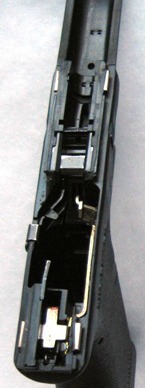
As a Generation 2 frame, the gun has two pins (versus the 3 pins of later guns) and no finger grooves. Since about a year after I bought it, I’ve had a Hogue slip on grip installed. I did this more to provide repeatable indexing of my shooting hand, than as a grip aid. In fact, I find that the finger grooves on my Gen 3 Glock 19 are too close together, thanks to my unique hands – short, fat fingers, with a wide hand. (I also wear 4E shoes.) I also found that the Glock 26 I once owned was too small for my wide hands, even with an extended base plate installed on the magazines.

++++

In truth, there are four parts that I have replaced voluntarily, and not because they failed. I have installed Warren/Sevigny sights, an extended magazine release, an extended slide stop, and the (-) trigger connector, which some people call the 3.5 pound trigger connector.

Sights

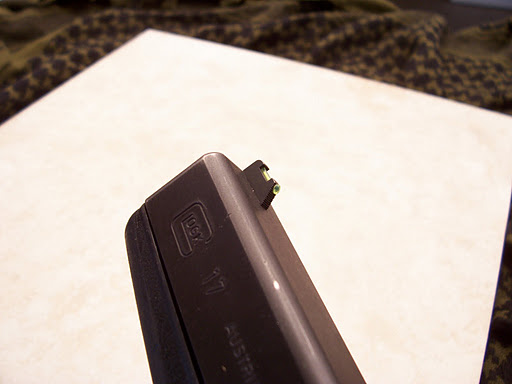
About three years ago I installed Warren/Sevigny Competition Sights with the fiber optic front sights. For about 2 years I had the red fiber in the front sight, and then I changed it to the green, admittedly on a whim. I find now that I prefer the green.

I also like these sights a lot better than the Glock factory sights, especially the fiber optic front sight. They make the front sight really stand out, and they’ve made a big difference in my sight picture.

Extended Magazine Release

The first modification I ever did to the pistol was to install an extended magazine release, to compensate for my short thumbs. In fact, what I did was have a Glock Factory Armorer install the magazine release from a Glock 21, at the first GSSF match I ever shot, at Dallas in 1995. (That way it was factory installed and the gun qualified for Stock Service Pistol in IDPA. You see what I did there.)

Extended Magazine Catch

About that time, I also installed an extended magazine catch. This was during the time when I released the slide from slide lock with my strong hand thumb, as opposed to using the method I use now, of grasping the top of the slide with my support hand and releasing it that way. As such, since I don’t (and never will) have a grip plug installed, this now qualifies as The Most Useless Modification I’ve Ever Made.

Minus Connector

The purpose of the (-) connector is to reduce the trigger pull of the pistol from the approximately 5.5 pounds, to something less. I’ve never measured the trigger pull of my pistol, but I can say it definitely lowers the pull weight. Some Glock Factory Armorers call it the 2kg connector, and 2kg is about 4.5 pounds, so I will go with that if I have to.

I only install the (-) connector on the pistol for competition or for practice, and never when I plan to carry the gun or have it available for home defense.

++++

A few years after I bought the gun, I bought a video Armorer’s Course, on VHS no less. (That should give you an idea of how long ago this was.) It contained a good bit on detail stripping and cleaning and lubricating of the Glock, but the host said that about the only modification he made was to polish the barrel feed ramp. I gave that a try, and was content with it.

Until I discovered the famed $0.25 Trigger Job, so named because the cotton swabs and polishing compound required to accomplish it cost about a quarter.

Basically, what this involves is polishing all the metal parts of the Glock trigger system that contact each other, so that they are smooth, and slide easily past each other. The original method calls for cotton swabs; I used a polishing wheel on my Dremel tool. Much faster.

I’ve done this on all my Glocks now, and I would not own a Glock that I didn’t do this to. In fact, when I bought my Glock 21 a few years ago, I let my son dry fire it before I did the trigger work, and compare that to my Glock 17, and even he could tell the difference.

++++

The accuracy of my Glock 17 has never been an issue. I figure it is more accurate than I am capable of shooting. No, it will very likely not shoot one ragged hole at 50 yards. But it will put all its shots in the A zone of a USPSA target at 25 yards, and it will put all its shots in the center of mass of an armed attacker, as long as I hold the sights there while I smoothly press the trigger. And that’s all I require it to do.

++++

In the areas of reliability, durability, affordability, shootability, and customer support, the Gen 2 Glock 17 exceeds my expectations. I would recommend this gun, as well as the later Gen 3 and Gen 4 models, to shooters of all experience levels, for competition, recreation, or self-defense shooting.

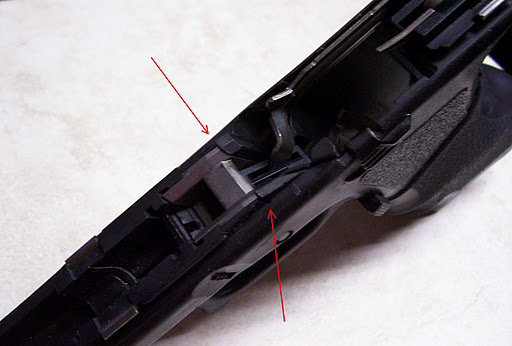
Upside, Downside

Part of the benefits of being a member of the GSSF and attending matches is the factory armorers are there. They will check out your Glocks and replace any parts that are worn. Now, even though I’m a trained and certified Armorer, I like to have my guns looked over at least once a year by the pros. An upside is that the factory guys are not very reluctant to change parts, so your Glocks always stay factory fresh.

So, after checking out all three Glocks, the only thing they did was replace the trigger bar on my G17. I had noticed some scratches on the top of the cross piece, and I guess he thought it was enough to warrant replacement. Better safe than sorry, I suppose.

Then, when time came to put the slide back together, I noticed he also replaced the rear cover plate. I think it was because he had misplaced the original. I was sad. This was an original piece from 1992. Now I am left with the frame, the slide, and the barrel.

Now, as a downside, this meant that part of my cleaning routine on Sunday was a 5 cent trigger job, just an abbreviated version of the 25 cent trigger job. All I had to do was polish the new trigger bar.

I dry fired a bunch since then and I can’t tell much difference. That’s an upside.

Glock Annual Shoot 2011

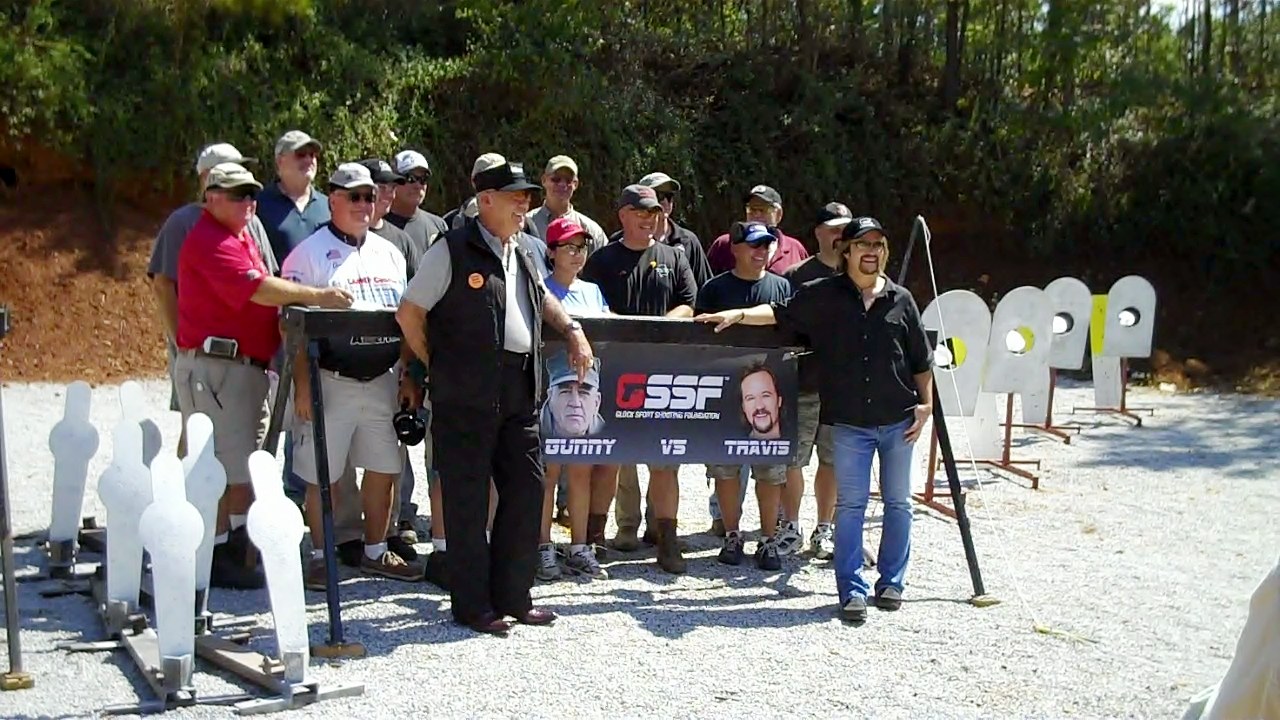
R. Lee Ermey and Travis Tritt pose with the GSSF MatchMeisters prior to the Gunny Challenge. Note the orange “Guns Save Lives” button from GeorgiaCarry.org that the Gunny is wearing.

This past weekend the Glock Annual Shoot XVIII was held at the South River Gun Club in Conyers, Georgia. This is the culminating match for the Glock Sports Shooting Foundation, or GSSF, and, as in previous years, it certainly lived up to its billing.

The match consisted of the normal GSSF match I’ve written about before, plus the Gunny Challenge VII. The Gunny Challenge, named for Glock’s celebrity spokesman R. Lee Ermey, is a special match pitting the winners of GSSF matches around the country against each other, vying for a first prize of $5,000.

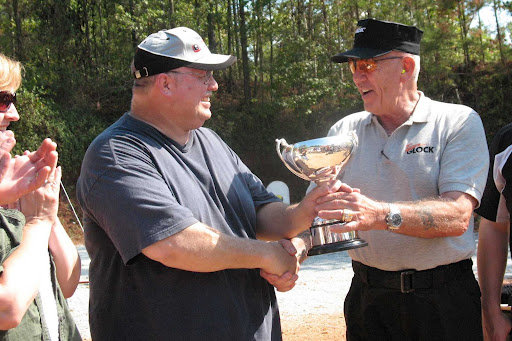
The Gunny Challenge was won, for the second year in a row, by Butch Barton. Bryan Dover took second, followed by 2009’s winner Dennis Kirchoff, and David Knight in 4th.

Here’s the finals, from my Youtube channel:

Here’s Butch receiving the Gunny Trophy:

After the Gunny Challenge came a special head to head match between the Gunny and country music star Travis Tritt. Gunny won, 5 – 0.

The Gunny squeezes of a shot from the Gen4 G35, with GSSF Director Chris Edwards acting as RO.

Of course, all this was a side show to the real attraction, the Glock Annual Shoot. This event has grown just about every year, and this year there were 1,025 entries in the various categories. This made it the largest action pistol match in history, breaking the old record of 744 entries, set last year by the Glock Annual Shoot XVII.

Fortunately, there weren’t 1,025 people there, since the rules allow shooters to enter multiple categories. But it was definitely a crowded venue.

I shot on Saturday, arriving at the range about 10:30 AM. Already, the bays were crowded, so once I signed in and received my stickers, I signed up for what looked like the 3 least crowded bays. Not that it mattered – I still had to wait about an hour at each one.

My shooting was okay. I shot Glock the Plates first, leaving no plates, with times in the mid 7’s. Not really fast, but I was determined not to leave any plates. Missed plates carry a 10 second penalty.

Glock M

My second stage was Glock M, and I shot it with times in the 8’s. Again I had no misses, and was only 4 shots down, meaning I had only 4 shots out of the A-B main scoring range. All those shots were on the farther targets, which I should have taken as foreshadowing.

By then, the Gunny Challenge was getting close, so I had lunch and watched the match. I also shot video of the Gunny Challenge, and I’ve posted the finals on my Youtube channel, along with video of two of the stages, Glock M and Glock the Plates. No, those are not me shooting. Next year I’ll bring a tripod.

After the Gunny Challenge, I took advantage of the lull in the action and shot the 5 to Glock as soon as I could. I shot in the 7’s, but I missed 4 targets, all on the farthest one. Looking back, I realize I should have gone to a safe area and dry fired a little while to get back the trigger feel.

All in all my score, with penalties, was 160 and change, which is a little worse than I shot at Dawsonville earlier in the year. Oh, well.

+++

One thing was missing from this year’s Glock Annual Shoot – the Glock shooting team. Usually, they have been on hand with product demonstrations, autographs, and just plain shooting fun. But with the recent departure of Dave Sevigny, the remaining Team members Randi Rogers and Tori Nonaka were not in attendance. Hopefully next year we will see them again, maybe with a new team member.

Because of the GSSF rules which award random prizes based on the number of entries, there will be 41 Glocks awarded. Maybe I’ll win one – I did in 2009, that’s where Liberty, my G19, came from!

One more thing – I heard that the last 26 entries had to have their paperwork filled out buy hand, because the staff found out their software didn’t support over 999 entries. I’m sure they’ll have that software problem worked out by next year. But it’s a nice problem to have.

Shooter Ready?

I’ve been spending the week preparing for the biggest GSSF match of the year, the Glock Annual Shoot at the South River Gun Club in Conyers, Georgia, this weekend. My prep has been a little more focused this year.

I did a deep clean of my G17 last weekend, and cleaned and inspected all my magazines. I have enough magazines to shoot the whole match without reloading now, so that will make my day easier.

I have been doing the Wall Drill for ten minutes every evening, and I can only trust that this has helped. It sure seems like the front sight is a lot more stable than when I started.

Yesterday, I went to the range at lunch, and shot my 100 round GSSF practice routine:

Using a 1/3 scale NRA D-1 target from GlockFAQ:

From the ready position, I come up and shoot one round into the A or B ring. Repeat for a 16 round magazine.

From ready, come up and shoot 2 rounds into the A or B ring. Do this for 2 16 round magazines.

From ready, come up and shoot 2 rounds into the A or B ring, then transition to a second target and shoot 2 rounds. Repeat 3 times.

From ready, shoot 2, transition, shoot 2, and continue to transition until the magazine is empty.

I was careful to use good form with follow-up, as I learned at my training with Tom Givens.

I also shot my Buck Mark a bunch. The work I did last weekend paid off. I kept the targets, but the first photos I took didn’t come out well. From 7 yards, shooting 1 round a second, I was able to shoot a ragged hole. At 10 yeards, I shot 20 rounds as fast as I could, and all 20 were in a 3 inch circle.

I also had zero failures to extract, which had been a source of annoyance for us at the range the last time we went. Part of the work I had done involved removing the extractor, cleaning it well, and polishing it with the Dremel buffing wheel.

On thing I noticed was the Browning extractor had sharp edges all around, unlike the factory Ruger extractor on my 10/22. I assume Browning’s manufacturing process involves cutting instead of stamping. In any case, the extractor was very nice, especially once I smoothed it up with the buffer.

I plan to shoot Saturday at Conyers, in the morning. If any of you plan to be there, email me and we’ll get together.

Otherwise, look for some video on my Youtube channel, probably Sunday evening.