Knife Review – Victorinox Swiss Army

I’ve carried a knife of some sort just about every day since I was 10 years old. I’ve been carrying a Swiss Army Tinker from Victorinox for about 20 years. Before that, I carried a Boy Scout model Swiss Army knife since about the 7th grade, until I lost it when my canoe capsized when I was on a camping trip in Ohio when I was in college.

This year for Christmas, I presented the Dauphin with his first pocket knife, a Swiss Army Climber model. He was very pleased.

Here are our knives, side by side, with mine on the left and the new one on the right:

Since it had been about 20 years since I looked the Swiss Army line, I was also pleased with the changes Victorinox has made.

First, as the photo shows, mine is shinier than his, because his side panels are a matte texture, versus the old slick plastic. This makes the knife much easier to grip when wet. I tested it and I like it.

Second, there are a few more blades on the Climber versus my Tinker model. The scissors are much welcome. My wife carries a small Classic Swiss Army, and she tells me she uses the scissors at least once a week.

The Climber also has a hook and a corkscrew, but is lacking the Philips head screwdriver.

My impressions of the Climber are very positive, by itself, and compared to my Tinker. Opening is smooth, the blades are all solid and sharp, and the miscellaneous tools are easy to open and use.

I’m still pleased with my 20 year old Tinker, too. Although one panel is a little loose, the grip is still comfortable and usable. The blades have kept their edge, although I dress them regularly.

In all, this new knife should serve my son well for the rest of his life, provided he doesn’t put it in the pocket of an unsecured sweatshirt on any canoe trips.

++++

A note of thanks is due here to Sheriff Jim Wilson. Some time back he and I swapped some tweets about pocket knives, and about how I had resisted giving my son a knife, for fear that he would accidentally take it to school, and in today’s Zero Tolerance world, be expelled when it was discovered.

Sheriff Jim responded simply that this might also be a way to teach responsibility.

Later, he wrote in his blog

I especially like to see a kid with a good pocket knife. It’s usually an indication that someone trusts him. And it is tangible proof that he is growing up and that the day when he will have his very own .22 rifle is not all that far off. Kids need that sort of trust and responsibility.

I think he was right. Thank you, Sheriff.

Holster Review – Don Hume H715-M IWB

Once upon a time, when I carried my Glock 17 inside the waistband, I used a cheap, non-branded split leather holster, that I bought for $4 at a big box sporting goods store while my wife was next door buying throw pillows.

I didn’t carry my G17 inside my pants very often. It was painful after just a short while carrying. The back of the slide dug in, and the extended magazine release, which wasn’t covered by the holster, pinched my skin whenever I moved.

A few years later I got a smaller Glock 19, and it was a little better to carry than the G17 with this holster, but not much.

+++++

Then, a couple of years ago, I was on a business trip in the Dallas/Ft. Worth area, and I had an extra hour before I needed to be back at the airport for my flight, so I dropped by Cheaper Than Dirt. (Actually, I made my flight plans with a trip to Cheaper Than Dirt in mind.)

I had never given much thought to a leather IWB holster, but there on the Don Hume wall was a great looking little number for the G19, priced at $22. I decided to give it a try, and I’m glad I did.

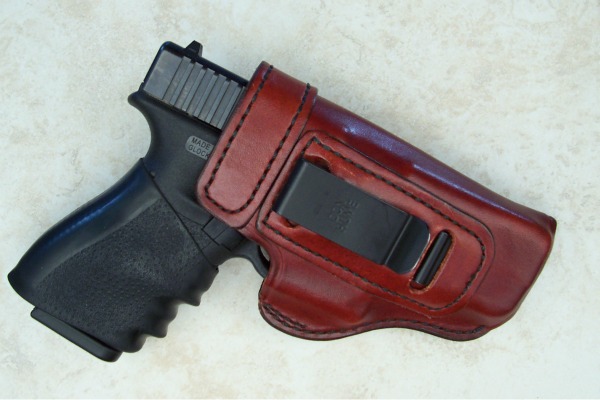
The holster fit is just right. I use “just right” on purpose. Leather holsters are fit to the gun they hold, and not all of them are done well. For instance, I have one holster with a fit that looks really great, so that the outside of the holster looks just like my gun. But, it is fit so tight to the ejection port that the leather has been cut by the trailing edge of the ejection port by the repeated action of holstering and drawing my gun.

On the Don Hume, the interior of the holster is shaped to the G19 just enough to hold the gun in place. Retention is excellent, while the draw is smooth, with no hesitation or hold up.

Coverage of the gun is excellent as well. The trigger and trigger guard are completely covered, and the barrel doesn’t extend past the end of the holster at all.

The holster rides higher on my pants than the old one did, and at first, I didn’t like that. The difference isn’t much – the Don Hume rides at about the trigger, and the old holster rode at the magazine release – but after some practice, I find that I can draw my gun a lot easier with more of the gun elevated.

The problem I had with the magazine release pinching into my skin is solved in this holster. While the mag release isn’t covered, the holster material is thicker than the length of the release, so that it does’t even reach my skin.

The top of the holster is reinforced, so that the holster is held open while it is in place in my belt, even with the gun removed. As a test, I’ve carried the holster empty for several hours, and the holster never collapsed. re-holstering is smooth.

The leather finish is excellent, without blemishes or streaking. The belt clip is just right, too, and holds on to my 1-1/2 inch belt without slipping off, yet isn’t too stiff that I can”t easily remove it with my thumb.

+++++

Based on two years of using it at least 4 times a week, I can enthusiastically recommend the Don Hume H715M holster for the Glock 19.

The next time business takes me to Fort Worth, I’ll probably pick one up for my G21.

Gun Review – Glock 17

This is the first in a series of reviews of guns I own, have owned, or have shot enough to be sure of what I’m writing. Like everything here, this is based on my experience and research. Your mileage may vary.

The Glock 17 is the full size 9mm version of the famous Glock handgun, first introduced to the US market in 1986.

I bought Bruce, my Gen 2 Glock 17, in late 1992, from a pawn shop in a small town in Alabama. According to a serial number search I did through Glockmeister, it was made in March 1990. I don’t know anything more about it except the shop owner told me it was used.

I’ve written about it in the past, so I won’t go into a lot except to say that, because of the ease of maintenance and exceptional customer service, the only original parts left are the polymer frame, the slide, and the barrel. Over the years, through the graces of the Glock Sport Shooting Foundation, everything else has been replaced.

The performance of this pistol has been almost flawless. I estimate I’ve shot about 10,000 rounds through over the years, and in that time I have had exactly six failures, all of which were failures to extract. Three were due to a chipped extractor, which I was unaware of, thanks to a reluctance on my part to own up to the toll the ravages of time have taken on my close-in vision. Two were due to limp wristing (1 by me and 1 by my son), a failure of the shooter to support the gun to allow the cycling slide to completely extract the spent shell.

The remaining failure was caused by me shooting the pistol without a magazine in place, to see what it did. Now I know.

I have never had any light strikes on primers, no double feeds. In fact, for years, since I had no malfunctions of any kind, the only instruction I got on clearing malfunctions was watching fellow IDPA and USPSA competitors.

The only magazine problems I’ve had were from the older, non-fully metal lined magazines, which were since redesigned. I’ve replaced all those magazines.

As a Generation 2 frame, the gun has two pins (versus the 3 pins of later guns) and no finger grooves. Since about a year after I bought it, I’ve had a Hogue slip on grip installed. I did this more to provide repeatable indexing of my shooting hand, than as a grip aid. In fact, I find that the finger grooves on my Gen 3 Glock 19 are too close together, thanks to my unique hands – short, fat fingers, with a wide hand. (I also wear 4E shoes.) I also found that the Glock 26 I once owned was too small for my wide hands, even with an extended base plate installed on the magazines.

++++

In truth, there are four parts that I have replaced voluntarily, and not because they failed. I have installed Warren/Sevigny sights, an extended magazine release, an extended slide stop, and the (-) trigger connector, which some people call the 3.5 pound trigger connector.

Sights

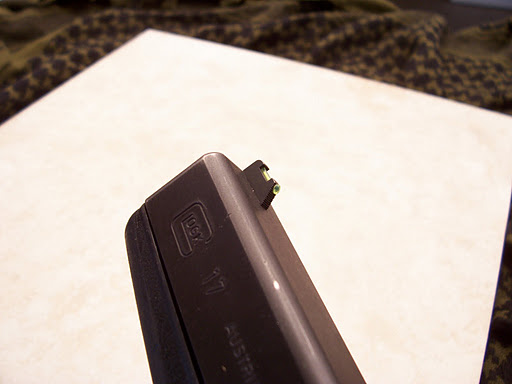
About three years ago I installed Warren/Sevigny Competition Sights with the fiber optic front sights. For about 2 years I had the red fiber in the front sight, and then I changed it to the green, admittedly on a whim. I find now that I prefer the green.

I also like these sights a lot better than the Glock factory sights, especially the fiber optic front sight. They make the front sight really stand out, and they’ve made a big difference in my sight picture.

Extended Magazine Release

The first modification I ever did to the pistol was to install an extended magazine release, to compensate for my short thumbs. In fact, what I did was have a Glock Factory Armorer install the magazine release from a Glock 21, at the first GSSF match I ever shot, at Dallas in 1995. (That way it was factory installed and the gun qualified for Stock Service Pistol in IDPA. You see what I did there.)

Extended Magazine Catch

About that time, I also installed an extended magazine catch. This was during the time when I released the slide from slide lock with my strong hand thumb, as opposed to using the method I use now, of grasping the top of the slide with my support hand and releasing it that way. As such, since I don’t (and never will) have a grip plug installed, this now qualifies as The Most Useless Modification I’ve Ever Made.

Minus Connector

The purpose of the (-) connector is to reduce the trigger pull of the pistol from the approximately 5.5 pounds, to something less. I’ve never measured the trigger pull of my pistol, but I can say it definitely lowers the pull weight. Some Glock Factory Armorers call it the 2kg connector, and 2kg is about 4.5 pounds, so I will go with that if I have to.

I only install the (-) connector on the pistol for competition or for practice, and never when I plan to carry the gun or have it available for home defense.

++++

A few years after I bought the gun, I bought a video Armorer’s Course, on VHS no less. (That should give you an idea of how long ago this was.) It contained a good bit on detail stripping and cleaning and lubricating of the Glock, but the host said that about the only modification he made was to polish the barrel feed ramp. I gave that a try, and was content with it.

Until I discovered the famed $0.25 Trigger Job, so named because the cotton swabs and polishing compound required to accomplish it cost about a quarter.

Basically, what this involves is polishing all the metal parts of the Glock trigger system that contact each other, so that they are smooth, and slide easily past each other. The original method calls for cotton swabs; I used a polishing wheel on my Dremel tool. Much faster.

I’ve done this on all my Glocks now, and I would not own a Glock that I didn’t do this to. In fact, when I bought my Glock 21 a few years ago, I let my son dry fire it before I did the trigger work, and compare that to my Glock 17, and even he could tell the difference.

++++

The accuracy of my Glock 17 has never been an issue. I figure it is more accurate than I am capable of shooting. No, it will very likely not shoot one ragged hole at 50 yards. But it will put all its shots in the A zone of a USPSA target at 25 yards, and it will put all its shots in the center of mass of an armed attacker, as long as I hold the sights there while I smoothly press the trigger. And that’s all I require it to do.

++++

In the areas of reliability, durability, affordability, shootability, and customer support, the Gen 2 Glock 17 exceeds my expectations. I would recommend this gun, as well as the later Gen 3 and Gen 4 models, to shooters of all experience levels, for competition, recreation, or self-defense shooting.

I Humbly Yield the Floor

A gun is a tool, Marian; no better or no worse than any other tool: an axe, a shovel or anything. A gun is as good or as bad as the man using it. Remember that.

Shane (1953)

Every death at the barrel of a gun is a tragedy. Whether an innocent victim is killed by a criminal, or that criminal is stopped by a law abiding citizen, or a group of gang bangers end up shooting each other, the resulting death could have been avoided, if one goes back far enough in the process.

One of the chief failings of the anti-gun crowd is their refusal to assign responsibility in this tragedy to those who are to blame. They choose to believe that, somehow, the gun – the tool – was at fault, and if all guns were eliminated, then the tragedies would cease.

Make no mistake, they will speak of “easy guns” or “illegal guns” or “assault weapons with high capacity clips and a shoulder thing that goes up,” but what they really mean is all guns. Even the recent history of gun control in countries like England and Australia shows that.

Every time I read an anti-gun diatribe, I am tempted to write about it, and cite the truth – that the vast majority of gun deaths are due to criminals. You don’t know how many draft posts I have saved, that are in this vein.

I forget exactly what I was reading today, but it was the same tired claim that “gun violence” could somehow be solved by more gun regulation. All I know is it got me to sounding and acting like Lewis Black – cussing and jabbing my fingers at the screen.

Fortunately, the next blog I read calmed me down. And for that reason, in matters related to who and what is to blame for “gun violence,” I humbly yield the floor to Sean Sorrentino.

Many gun bloggers, like myself, choose to remain somewhat anonymous. For me, it’s because my side passion might interfere in other areas of my business life, where, frankly, it should have no bearing at all.

When you meet Sean, though, he will be wearing a badge in the shape of the state of North Carolina, that says his name, and under that, An NC Gun Blog.

Sean deals frequently with legislators, anti-gunners, and pro-gun people alike, and, as he told me, he wants them to know where he stands.

I salute Sean not only for his forthrightness, but for his blog. The subject of his blog, more often than not, is to show you who the perpetrators of gun crime in North Carolina are, and what they have been up to all their life.

Sean tells you about the criminals and their records in a very civil manner. He doesn’t name names, he doesn’t throw stones. He just shows you the truth.

As a quasi-aside, Sean doesn’t just write about guns, he shoots very well, too. He was my training partner in Knoxville earlier in the year.

So, in lieu of ranting, in the future, I will just point to An NC Gun Blog. Sean says it better than I can.