My Shotgun, Reborn

One spring day, not long after I had bought my first gun, I was at work, talking with a truck driver, while he was waiting for his trailer to be loaded. The conversation turned to guns. After all, it was spring, we were men, we were in Alabama, and I was a Gun Newbie. After a while, the truck driver mentioned that he happened to have a used shotgun for sale. Would I like to see it?

Sure.

It was a very nice pump shotgun, a 12 gauge. The wood was in good shape, and while some of the bluing on the barrel was worn, there was no corrosion. And the pump action was as smooth as glass. It had only one minor defect – a former owner had written his name on the barrel with a power inscribing tool.

I say it was a defect, but in fact, it was a blessing, because the person whose name was on the shotgun barrel happened to be the plant chief operator, and he was on shift that day. So I went and asked Lee about the shotgun. He told me of the large number of whitetail deer who were prancing in the fields of heaven because of that gun.

Was it worth $100?

Lee said he thought so, because that’s what he had sold it to the truck driver for, 3 years before.

So, at lunch, I went and cashed a check (these were the days before the ATM, friends) and the shotgun was mine. And I named it Lee.

Now, I had no idea what brand of shotgun it really was, and neither did Lee. The brand name on the gun is Revelation, sold by Western Auto. I tried taking it apart, but knowing nothing about shotguns, I didn’t get far.

The next day, my copy of American Rifleman arrived, and the monthly section on gun schematics and disassembly instructions featured the Mossberg 500 12 gauge shotgun. Everything looked the same as mine, and it came apart and went back together just like in the magazine. So, Lee was really a Mossberg 500. Thank you, Lord.

+++++++

A couple of years later, after I had moved away, I went back to my old plant for a visit, and Lee (the operator) asked about the shotgun. He then told me that he had been approached by the truck driver, to try to sell him the gun back, and he had steered him to me.

Again, thank you, Lord.

+++++++

Fast forward a number of years, and a lot of trap shooting, later. Now, the bluing on Lee had gotten a little more worn, so I decided I would like to re-blue it. I bought a re-bluing kit at the gun store, read the instructions, and completely de-blued the whole gun. I sanded all the pits and corrosion out, and – no offense – I used my Dremel to erase Lee’s name. Sorry, man.

Then I decided to search the Internet for info on how to re-blue guns, and I was confronted by tales of woe. It turns out that the Mossberg 500 has an aluminum receiver, which doesn’t take bluing well. So I decided I needed a little more experience in gun finishing before I gave it a try.

Fast forward a little more. Okay, probably 5 years more. The shotgun sat unfinished, all that time, while I periodically thought about refinishing, and stopped, because it made my head hurt. To assuage your fears, the barrel and steel parts were well oiled, and stored in a firearms sock in my safe. The small parts were stored in a plastic shoe box.

At last, thanks in part to the false sense of optimism this blog has given me, I decided to finally refinish Lee.

After a bunch of Internet research I decided to use Duracoat firearm finish, and a Hogue rubber overmolded polymer stock, to make Lee look like his Glock brethren.

++++++

The refinishing process began with the fitting of all the parts onto the new polymer stock, to be sure I didn’t need to do any gunsmithing to make it fit.
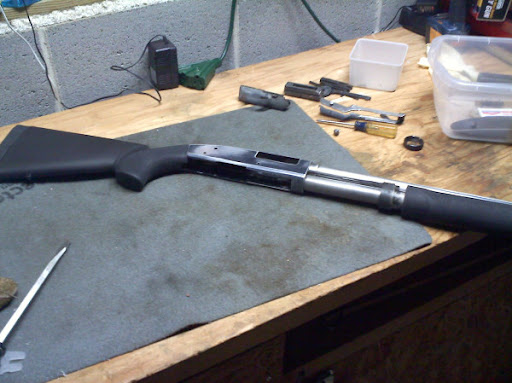
Everything fit perfectly.

I then laid all the parts out to get ready. In addition to the Duracoat with sprayer that I bought, I also bought painters tape. I also remembered back when I was researching bluing, and they told me to fill in all the holes in the receiver with Silly Putty, so the finish wouldn’t get in the holes, and make them smaller.

I also got some 600 grit sandpaper for the final sanding, and some nitrile gloves to protect my hands.
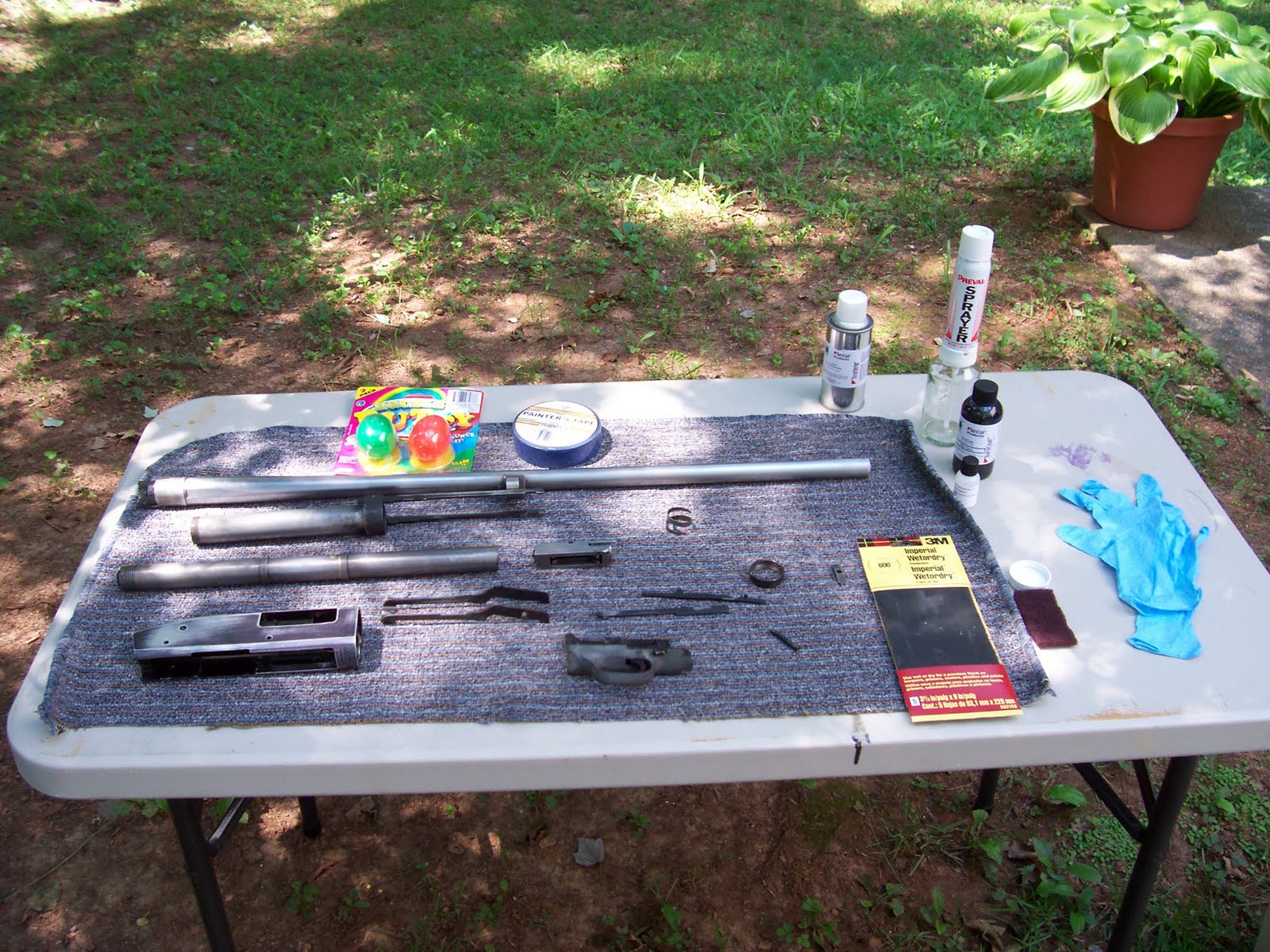
I then went over all the metal parts with the 600 grit sandpaper, per the Duracoat instructions.

Here’s the trigger group taped off below the parts that will show in the final gun assembly:

I filled in all the holes with Silly Putty, and taped all the threads and other parts that I didn’t want to spray. I then sprayed the whole gun with the degreaser spray provided in the kit.

Here’s the receiver, hanging and ready to spray.

I then mixed the paint and the hardener in the glass sprayer bottle, and shook it all for the time they told me to. Spraying with a smooth even motion, I laid down the first coat:
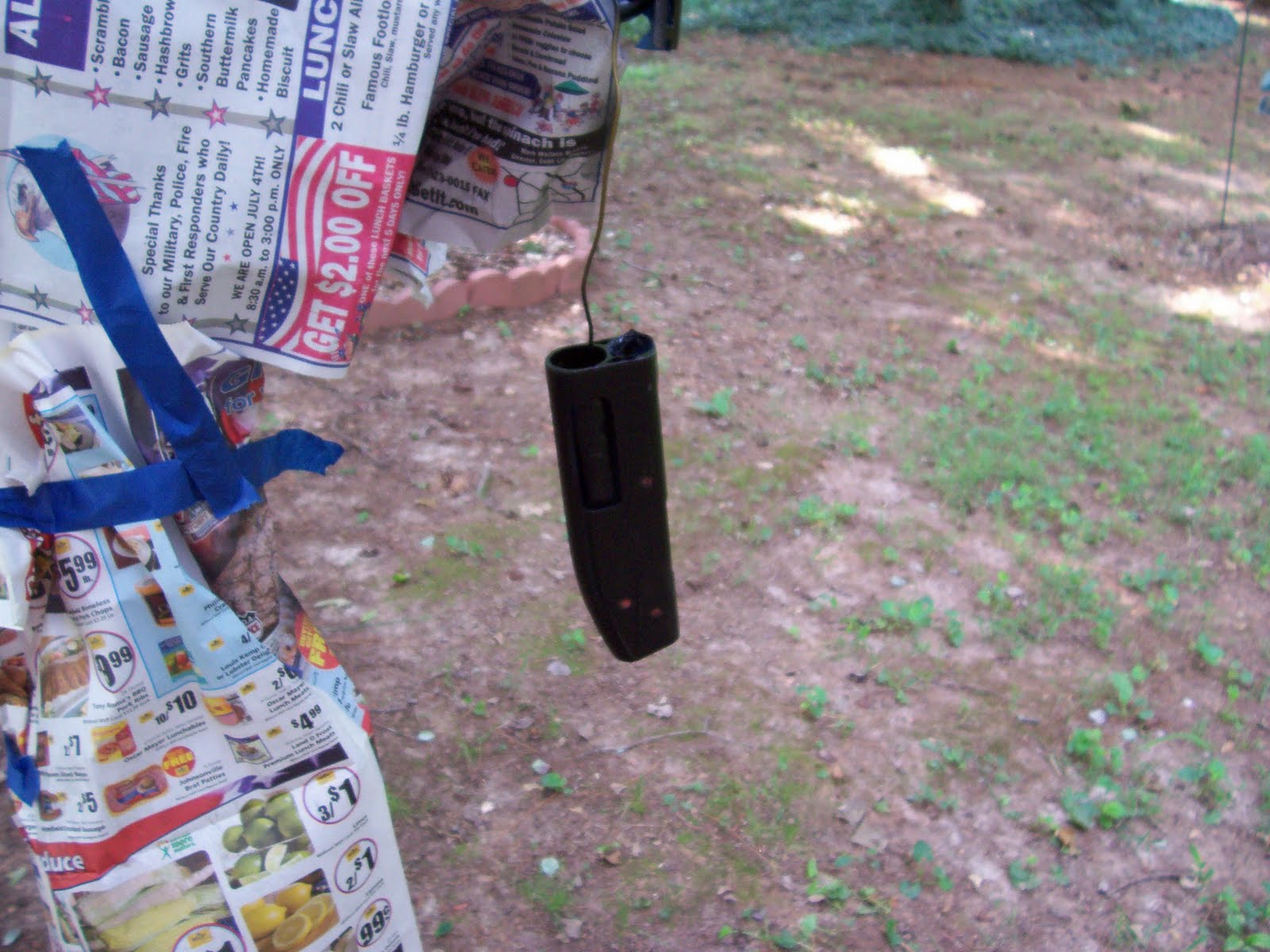
I also sprayed the barrel:
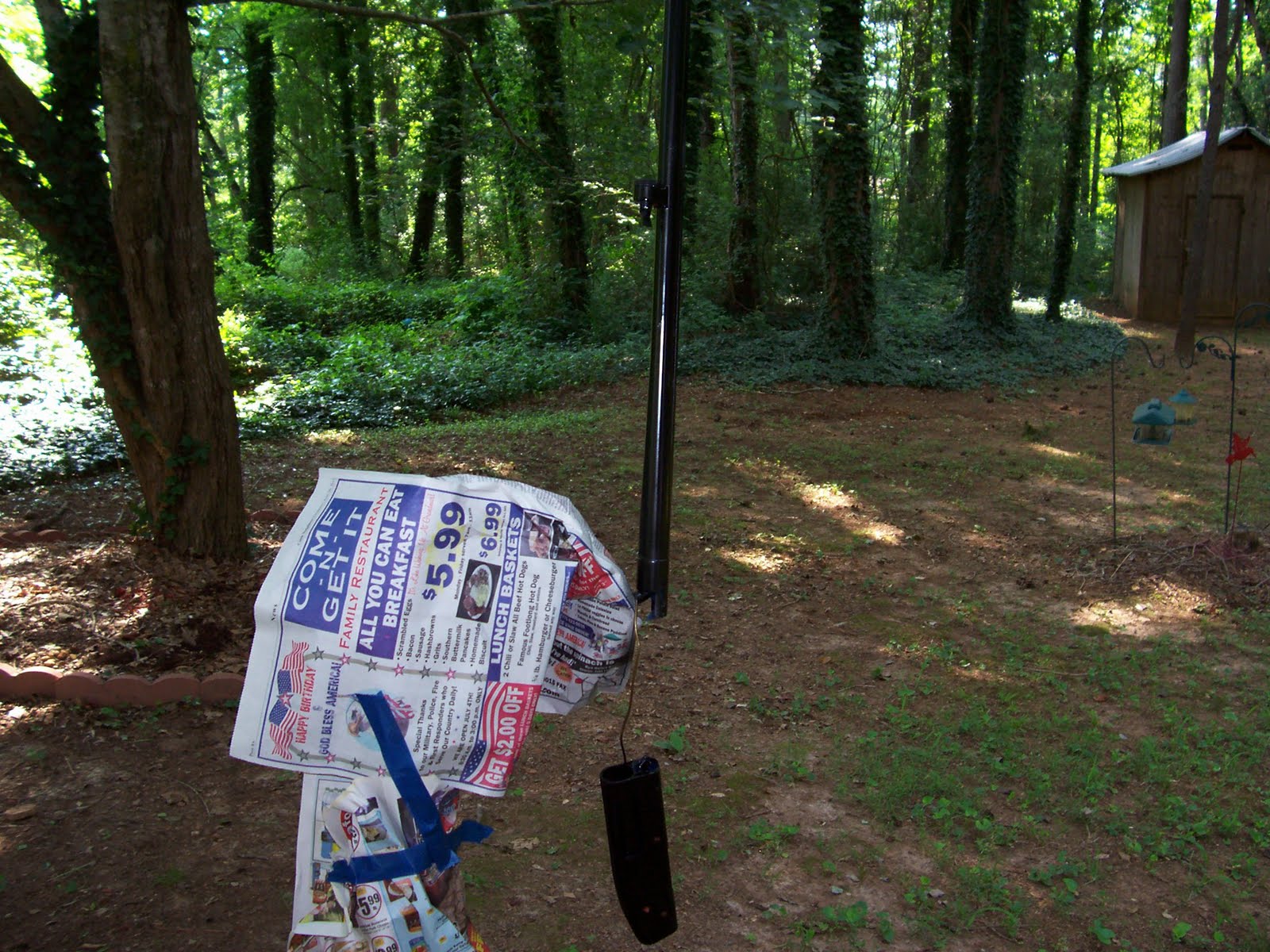
Three even coats, and all was done.

Sounds easy, right?

Ha!

First – the sprayer that Duracoat sold with the paint tended to sputter periodically. At random. Leaving some parts sprayed smoothly and evenly, and some running and dripping.

Actually, I’m surprised the paint stayed on, with the amount of cursing that I applied to the sprayer. I guess I’m glad the cliche isn’t really true.

So, instead of letting it dry five minutes between coats like the instructions said, I let it dry fifteen minutes, and tried to sand out all the drips.

Stupid idea. All I got was rolled up drips.

Eventually, my curse vocabulary exhausted, I managed to get it sanded well enough to get three coats on, and it not look like I had welded all the parts together.

Lessons learned:

First, I won’t use the sprayer that Duracoat sells again. Instead, I will invest a little more money in an airbrush sprayer and compressor.

Second – while it may work for bluing, I found that Silly Putty makes water bead up. This means it also repels paint, so that all the pin holes had halos around them, free of paint. I need to find something else to use, maybe just balled up paper.

So, while trying to sand out the drips, I also had to take out all the Silly Putty, and use the degreasing spray again. Then I could spray.

Third – in retrospect, I would not have Dremeled Lee’s name off the barrel. I now think it would have lent a sense of history, which I am trying, in a small way, to preserve here.

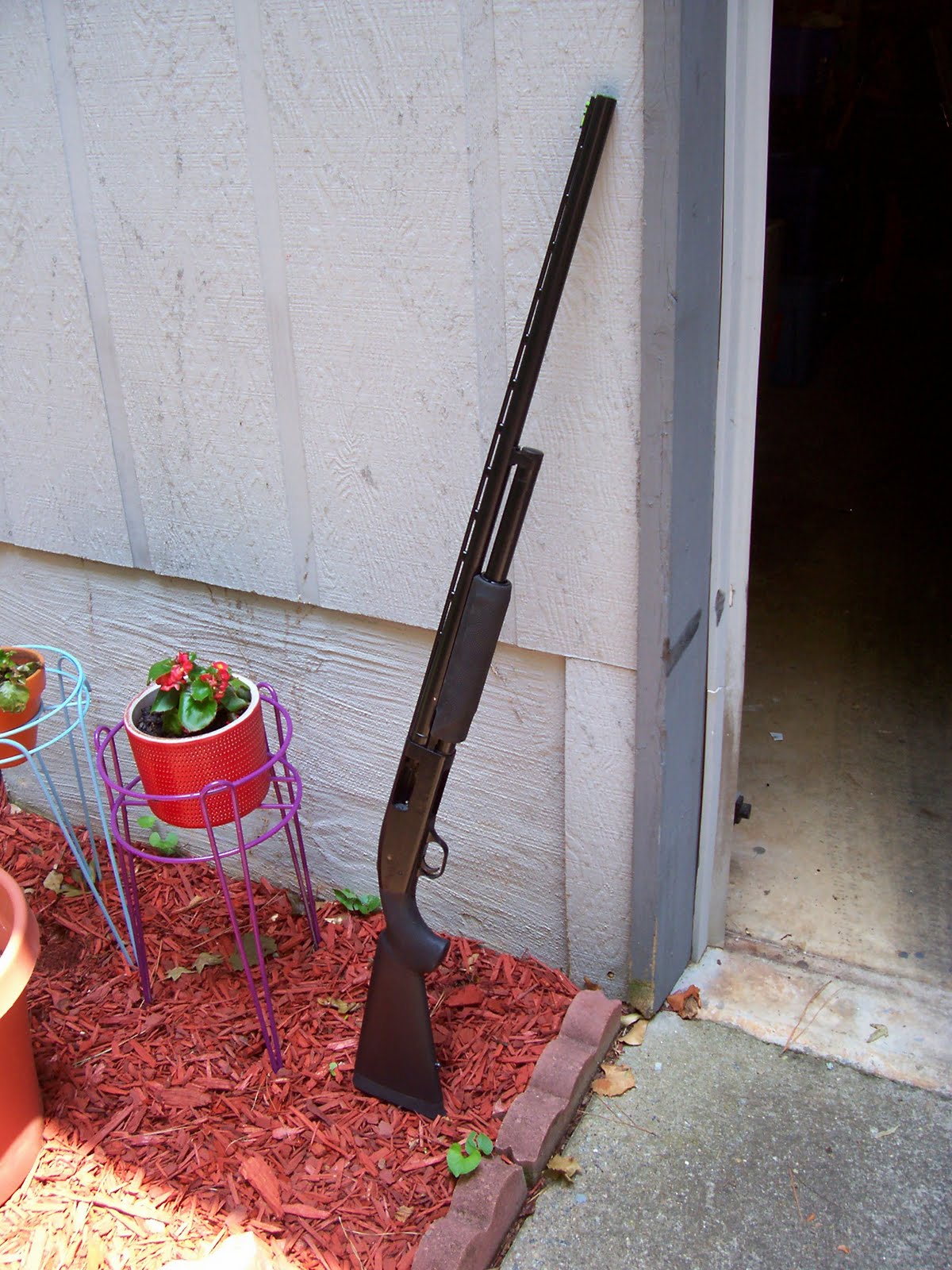
After drying overnight, I put the whole thing together. Of course, I had to watch a Youtube video, because I hadn’t done anything with this gun for 5 years. But the action is still smooth as glass, and it looks mean.

Behold, Lee, the Mossberg 500:
Podcast of the Week – the Gun Dudes

Carl, Stan, Tom, and Travis are four UPS drivers in Utah who share a love of shooting. They get together once a week and share that love with us as the Gun Dudes Podcast. For me, they are my Tuesday drive to work.

Imagine four good friends at a barbecue, eating meat sandwiches, cutting up, and talking about guns. That’s what this show is like, a sometimes irreverent mix of serious talk and general horsing around. Along the way they share some really good information, things they have used and they know work.

Now, I admit that this podcast took a while to grow on me. Sometimes the fooling around almost gets in the way of the real show, but they always come back to the topic. Somebody is almost always fiddle with a gun, and you can hear them racking the slide, working the cylinder, or handling the guns some other way. Sometimes there is a secondary topic going on with a couple of the guys. And there is always sarcasm and endless needling of each other, especially of the one or two of them who aren’t on this week’s show.

Because there are things they always do right, I keep coming back. They all shoot IDPA so there is a recurring focus on competition, training, and practice. Some of them are Glock guys, and they actually published the first Gen4 to Gen3 conversion chart I could find. They are also involved in Scouting so they talk a bit about training new shooters.

The show starts with the question, “What did you do this week with guns?” and each of them tells about their week. Then there are segments with news, emails to the show, and “Missfire Awards,” a round-up of miscues and gaffes, usually ending in a bad guy captured or worse. They always urge listeners to join the NRA, Second Amendment Foundation, and US Concealed Carry Association.

In addition to the regular segments, there is always a topic of the show. Some topics have included dry fire practice, IDPA competition, becoming an IDPA Safety Officer, taking new shooters, and various training classes they’ve taken. They also publish some videos of segments on the podcast, and they maintain a Facebook page as well.

I get a lot out of this podcast, and yes, I find myself laughing at a lot of what happens, and wincing at some of it. But despite the shenanigans, there is a lot of good information in this hour, and it’s time well spent for me.

Review – Gun Stories

Last night I watched the premiere of a new television series on the Outdoor Channel, Midway USA’s Gun Stories, hosted by Joe Mantegna. All in all, I enjoyed the show a lot.

Episode 1 focused on the Government Model 1911 pistol, designed by John Moses Browning. It went through the history of the gun, from the Army decision to abandon its .38 pistol, to the competition with the Savage pistol, to acceptance and distribution. Along the way, through interviews with a cross section of gun authorities, historians, competitors, and famous personalities, the depth of the 1911’s enduring legacy was firmly established.

Now, I have to admit, I had gone into the program expecting something else. Other programs produced by Michael Bane on the Outdoor Channel focus more on the firearm itself – how it operates, how to run it, how to fix it. After watching the whole show, I realize that there are probably a lot of people who are like me, who have focused our gun attention on the mechanics of guns and how they work, but not so much on how we got there. Gun Stories tells that story, and on this it delivers.

Far from being a bunch of timelines and historical footage, Gun Stories lets people do the telling. I especially enjoyed hearing Ted Nugent tell about how his father carried a 1911 in World War II and Korea. Buzz Mills, president and CEO of Gunsite Academy, told how his grandfather was issued a 1911 as part of the New Mexico National Guard, and carried one while fighting Pancho Villa, during the Banana Wars, World War II, and Korea. He also told of buying a 50th anniversary 1911 from the NRA in 1961, by mail order, for $15. And he still owns that pistol.

Given the 30 minute time frame, the show covered all it could cover. There were interviews with competitors like Gene “Evil Roy” Pearcy who told of its adaptation to improve accuracy so it could be effective in competition. Granted, no one went into how to improve the accuracy, but again, that isn’t the focus of the show – you can find that out on another show, or on Youtube.

I felt the same about the transition from the 1911 as the US Army sidearm to the Beretta 92F. There was a little discussion of the 9mm versus the .45ACP, but that was more from the political perspective of coordination with NATO, not on the ballistic compromises involved. Again, since the show isn’t so much about the 1911 as a weapon, but about the history of the 1911, that was okay with me. If you want that discussion, go on any gun forum and ask. (I dare you.)

Now, there was one area where I thought the show excelled – the slow motion footage of the 1911 in action was some of the best slow motion video I have ever seen. You could see the bullet leave the barrel, the working of the action, the ejection of the spent shell, down to the engagement with the extractor. Then, the stripping and feeding of the next round, all before the gun came back down to firing position. I have always imagined that this is how Rob Leatham sees his gun operate. Very impressive.

Joe Mantegna was a great host. The show style was him commenting and introducing segments, and the people being interviewed just told their stories, with no interviewer.

I look forward to future episodes, and to deepening my admiration of these guns by knowing more about their history.

That New Podcast Smell

This week, JP at the EyesNeverClosed blog posted the first episode of his podcast, the Empty Mags Podcast. If he keeps up with it, I think it’ll be a good one to watch.

The first installment was impressive, and not just because he told about this blog in the first five minutes.

JP’s style is relaxed and conversational. He really appeals to me because his target audience is the everyday shooter, the regular guy or gal who owns a couple of guns and shoots for fun, competition, and self defense, not an operator. He maintains an even pace throughout the show, and he changes topics effectively.

The main topic of the first episode is deciding whether to build your first AR rifle, or build it. I won’t give away his advice, but he convinced me. Give a listen and see if you agree.