Gun Control From A Simpler Time

When I was young, probably age 14, the boys in our neighborhood went through a BB gun phase. Prior to this, I had never had any exposure to firearms at all, beyond cap pistols.

I got a lever action Daisy gun, from where I don’t remember. Others in the neighborhood had pump pellet guns, and one guy, the rich kid on the block, had a CO2 powered semi-auto.

In the afternoons after school, we would meet at John’s house, a couple of houses down from mine, and choose sides, the head into the woods to do battle.

Full on BB wars. The rule was, one hit and you were out, and it was on an honors system. Not too difficult to enforce. I can still remember being shot. Ouch.

Late one session, as it was getting almost too dark to see, I was trying to flank the other team’s position, and I heard movement behind me. I turned, and there, probably 30 yards away, through the trees, was the captain of the other team. John.

John was large. That is, while I, at age 14, was probably 5′-8″ tall and weighed 140 pounds, John was easily 6 feet tall and probably weighed over 200 pounds. We all thought he was fat, although we didn’t say that to his face.

But there he was, and he didn’t see me.

So, I raised my gun quickly, and fired.

John cried out, and put a hand to his face.

To his eye.

I almost fainted.

“John.”

“Yeah.”

“You okay?”

“No, man. You shot my damn eye.”

I rushed to his side, and sure enough, even in the fading light, I could see that his eye was red, although there didn’t seem to be blood on him anywhere.

“We gotta go get you some help.”

So he and I made our way through the woods, back to his back yard, where some of both teams had come to retire, and they could all tell right away what had happened.

“Wow, man, you shot John in the eye!”

“Shut up! Do you want his Mom to shut us all down?”

We took a couple of minutes trying to decide how we were going to handle this. We quickly came up with a plan.

First, yes, this sounds like what happened to Ralphie in A Christmas Story. But we thought of it first.

In the woods we had an old metal sign, and, as dumb as it sounds, we would tape pictures of animals to it and shoot it for target practice. We all thought it was funny when BBs would come back and hit near us, or fly off into the woods. So the story was that the BB had come straight back and hit John’s eye. Easy.

Well, John’s Mom didn’t panic when she saw him, but quickly swept him off to the doctor’s to be sure.

Those who remained, we few, we happy few, we band of brothers, we breathed a sigh.

++++

The next day, Friday, when we got home from school, all our Moms had some news for us, courtesy of John’s Mom.

The BB had struck John’s eye just below the iris, and had almost penetrated the eyeball. But it didn’t, and that was the good news.

From there, it had skidded along the surface of his eyeball, and gone under his eyelid, lodging up under his cheek. They almost couldn’t find it, but X-rays are a wonderful thing.

They didn’t know if he would have any permanent eye damage, but right now, his eye was full of blood, and he couldn’t see. (Now you see – my image of a fat guy with an eye patch goes back a long way.)

There was no joy in the neighborhood, because we were all sure the BB wars were over, as much as we were scared of John’s prospects. John didn’t want to hang out with any of us, which was understandable, because he had been forced to take the blame for shooting himself.

The next day, Saturday, when all the Dads were home, was sure to be the worst.

Yet, as the day dawned, there were no lectures, no confiscations, no gun raids.

Instead, one of the Dads went out to Sears, and brought back a whole bunch of work goggles, and made sure all we combatants had a pair, and that we agreed not to shoot, anywhere, any time, anyone, without them. And the BB wars continued, at least until about the time a bunch of us got our drivers licenses and discovered girls.

++++

From that point, everyone in John’s family started calling me Deadeye, and it was then that I knew that John had told the real story. Years later, when I visited the old neighborhood, John was there, visiting his parents, and the topic got around to my nickname, and he admitted it. I asked him why he chose Deadeye, and he explained that I had to be the best shooter in the neighborhood – given the size of his eye in comparison to the rest of his body, that was some fine shooting.

John recovered full use of his eyes, and never held ill will toward me. I guess the nickname did a lot.

And thanks to the calm response of the parents in the neighborhood, nobody got their eye shot out again.
Thoughts on Storage State

Ron at When The Balloon Goes Up and Robb at Sharp As A Marble commented today on how they store their guns when not in use. I thought I would share my thoughts.

One of the first things I did when I bought my first pistol was to buy a safe to store it in. I got a good deal on a 8 gun rifle safe, and I stored my pistol there when I wasn’t carrying it. Soon I bought a Gun Vault pistol safe, which is where I keep my carry guns.

One of my rules of thumb with anything I store is to give as much thought to the next use as I do about how it is stored. In other words, how much trouble will it be to get to and use? This is doubly so when it comes to gun storage.

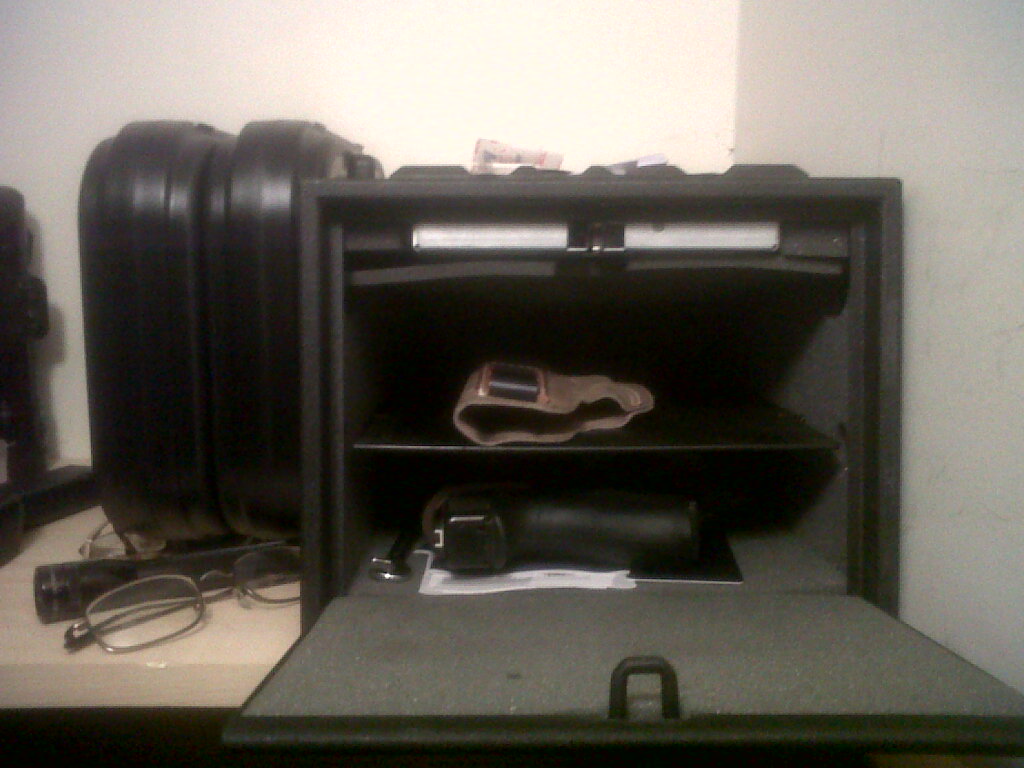
My pistol safe is used to hold my carry pistols, so the pistols are stored there in Condition 1, that is, with chamber loaded, and full magazines topped off, in a holster. When I or my family are home, the door to the pistol safe is open. This gives us the quickest access if we need it.

In the picture above, you can see Liberty, my Glock 19, in the bottom of the safe, along with some papers. On the top shelf is a leather IWB holster I use to house The Duke, my G21SF, when it’s in storage. At the time of this photo, The Duke was on my hip in a leather belt holster.

In my rifle safe I keep all my long guns, and my pistols that are not being used for carry. Since these pistols are not in the normal rotation, they are not stored ready to deploy, although there are loaded magazines in my ammunition storage that can be loaded quickly. The pistols are stored either in holsters or gun socks or zip-up pistol carriers, with no magazines, and with a orange flagged safety shell in the chamber.

Rifles and shotguns, on the other hand, are stored in a semi-ready state, with loaded magazines in place or with tubes loaded, but with the bolts open and yellow chamber flags installed. (I would never store a long gun in Condition 1, because the trigger is exposed.) When needed, a user would retrieve the gun, pull out the flag, drop the bolt, and be ready to go. On the other hand, when I’m transporting them to the range, I just remove the gun, drop the loaded magazine free, and put the rifle in the car with the chamber flag intact.

Sometimes I store my guns totally inert, unloaded. In that case, they are put into treated gun socks. Right now, only Vassily my Mosin Nagant is stored that way.

However you choose to store your guns, it is essential that you do it consistently, and that everyone who might be called on to use them knows how they are stored. This is part of what we discuss in our family when we talk about our guns, and everyone knows it.

Safety Rules In Depth – Rule 3

Is that what how they taught you?


RULE 3 – Keep your finger OFF the trigger until your sights are on the target.

This would seem as straightforward a gun rule as one could imagine. Since the way to make a gun fire is to pull the trigger, if you don’t want to shoot something, don’t touch the trigger.

Sadly, even a casual search of news reports and videos on Youtube show this to be the most violated safety rule of all.*

“But Rooster,” you say, “we see it all the time. What about when someone drops a gun, and it goes off?” After all, in movies or on TV, if you drop a gun, it goes off. If you drop a machine gun, it fires until the clip magazine is exhausted.

Every.

Time.

Fortunately, that image is a load of steaming dung, straight from my old horse Bo.

The design of modern guns has advanced to the point where the only way to get them to fire is to pull the trigger. They won’t fire if you drop them, or hit them, or kick them. They don’t “go off.”

Yes, you will read in news reports that a dropped gun fired – Google it yourself – but when you read those reports, you find one of two things present. First, the gun involved is some kind of older gun, like a derringer or Colt SAA. Yes, older guns like the Colt Single Action Army will fire if the hammer is struck from the outside. Even some older 1911’s will fire, unless the firing pin has been replaced with a lighter version.

The second possibility is the person involved is lying or has no idea what they are talking about. That”s because the trigger was pulled. Period.

++++

It follows then that the way to prevent guns from firing except when you want them to fire is not to pull the trigger. For the shooter, this means keeping your finger off the trigger until you are sure the gun is pointed at what you wish to shoot.

Now, since positive reinforcement is much better at altering behavior than negative reinforcement, let’s turn that around.

RULE 3 – When the gun is aimed at the intended target, then it’s safe to put your finger on the trigger.

Until then, put your finger on the frame alongside the trigger. For instance, find a spot like the front of the trigger guard, or the slide lock, as a tactile reference, like this:

Rule 3 – using the trigger guard or slide stop as tactile references

Or, you can find other tactile references. Then, train yourself to use them.

What about resting your finger lightly on the trigger, like Jack Bauer, until you’re ready to shoot?

Sadly, when we humans are startled, we experience a flinch reflex, and we will pull the trigger. And the gun will fire. (And we will tell the newspaper reporter “The gun just went off.” And they will know we are lying. And they will print it any way.)

So, train yourself to keep your finger off the trigger, and index your finger somewhere else. And practice it.


And, for heaven’s sake, ignore the people in the movies or on TV.


* tied with Rule 1 and Rule 2.

Gun Free Victim Zones

Once again, America comes face to face with the reality of what can happen inside a Gun Free Victim Zone. The widely publicized theater shootings in Aurora, Colorado needs no link from here.

A large focus of the discussion since has been to try to get anti-gun people to see that prohibiting firearms in any situation does not guarantee anyone’s safety.

The counter argument I have dealt with more than once is this: what could one lone armed individual do against someone with the kind of firepower that the Colorado shooter brought to bear?

My answer is and remains that the reaction of one lone gunner cannot be predicted, except perhaps in cases like this. But, the value of allowing lawfully armed civilians free roam is that potential criminals then do not know what kind of resistance they will encounter if they attack. They may encounter several people who are carrying, willing to resist.

This applies just about everywhere, from the movies to college campuses.

I took my family to see Dark Knight Rising on Saturday. The theater our family uses does not have a firearms prohibition policy. In fact, I’ve had a gun discussion with one of the off duty police they hire.

As always, I carried a pistol concealed, along with a spare magazine. I found myself watching others at the theater, looking for tells, signs that I wasn’t alone. I saw more than a few who were concerned that their shirt tales were down over their waist, and a lot of us were scanning the crowd. (I probably tipped my hand, too, but that’s not so bad.) I was very likely not alone.

There will always be evil people in the world. I might not be able to stop them, but, by knowing I might be there, maybe I can persuade them to go elsewhere. So, those of you who choose to go where guns are prohibited, you are on your own, relying on a sign on the door, and police who are ten minutes away, for protection. Good luck.