Thoughts on My Goals in Competition

The Wednesday before Thanksgiving I was running the leaf blower to get the yard clean before having guests on the holiday, while listening to Walt White’s podcast Shooting the Breeze. In a recent episode Walt shared that his strategy in IDPA competition is to shoot as accurately as possible, giving preference to accuracy over speed if necessary.

Yard work generally inspires deep thought, because, really, what else is there to do? So, this got me to thinking about my own strategy in competition, and I had to admit that, despite many attempts to change it, mine was exactly the opposite. That is, I shoot as fast as I can, being willing to give up accuracy for speed.

I know exactly where this started. When I first began to compete, at the Marengo County Shooting Club in Demopolis, Alabama, the club used a simple formula to calculate scores, which was total hit value divided by time. Unlike USPSA, IDPA, and GSSF, there was no penalty for misses per se, except that one got no value for the shot. I soon realized that I could win by shooting as fast as I could, since the difference between a 10 and an 8 was more than made up by the faster score.

Now, over the years I have vowed to improve my accuracy and give up the faster speed, only to find that absolute accuracy eludes me. D’s and misses still infest my scorecard, and I don’t like it.

++++

Beyond that, this got me to thinking about competition in general, and, eventually, to the Grand Question of competition: Why do I compete?

The obvious answer is that it improves my shooting and increases my chances of prevailing in a gunfight, should the time ever come. In fact, this lies at the heart of why the major shooting sports organizations  IPSC, USPSA, and IDPA, were created in the first place.

So, going deeper, how exactly does it increase my chances of prevailing? How am I a better shooter?

And that’s when I got a shudder. Can I prevail by shooting as fast a possible, just as long as I get hits?

I doubt it.

In fact, I ran across this observation by Lt. Colonel Jeff Cooper that eventually confirms the correctness of Walt’s strategy over mine:

Anyone who studies the matter will reach the conclusion that good marksmanship, per se, is not the key to successful gunfighting. The marksmanship problem posed in a streetfight is ordinarily pretty elementary. What is necessary, however, is the absolute assurance on the part of the shooter that he can hit what he is shooting at – absolutely without fail. Being a good shot tends to build up this confidence in the individual. Additionally, the good shot knows what is necessary on his part to obtain hits, and when the red flag flies, the concentration which he knows is necessary pushes all extraneous thinking out of his mind. He cannot let side issues such as fitness reports, political rectitude, or legal liability enter his mind. Such considerations may be heeded before the decision to make the shot is taken, and reconsidered after the ball is over; but at the time, the imperative front sight, surprise break must prevail.

Thus we have the paradox that while you almost never need to be a good shot to win a gunfight, the fact that you are a good shot may be what is necessary for you to hold the right thoughts – to the exclusion of all others – and save your life. This may come as a shock to a good many marksmanship instructors, but I have studied the matter at length and in depth, and I am satisfied with my conclusions.

According the the Colonel, Walt would stand a better chance of prevailing because his devotion to good hits, and knowing what it takes to make them, is superior to my practice of settling for a lesser hit, faster. This is not because Walt’s hits would be more fatal than mine. It is more because, in the heat of the fight, Walt’s concentration on what it takes to make a good shot would give him the concentration to see the fight through to the end, while my strategy would leave a crack, however slight, that might cause my concentration to falter, with bad results.

++++

So, I know now that I must, at last, get serious about marksmanship and accuracy. My life may some day depend on it.

And, who knows, my competitive scores may even improve.

Teaching the Next Generation

The Dauphin, ca. 2010

The other night at dinner, my son, the Dauphin, told me that, after giving the subject a lot of thought, he would like to take up competitive pistol shooting.

Needless to say, I am pleased, and excited. We talked about the different sports – GSSF, USPSA, IDPA, Steel Challenge – and which he would like to try first. Our conclusion was that GSSF would be a great start, given that it doesn’t require drawing, reloading, or moving.

However, there are only 3 GSSF matched in my area in any one year, and the next one won’t be until next February. It became clear that he really wanted to get into shooting quickly, and USPSA, with 3 matches per month in our area, gave the best opportunity for that.

So, we talked about what skills he would need to learn, and we came up with a training plan to get him competing the quickest. There are basically two phases – dry fire and live fire – and the two phases may naturally overlap depending on how fast he learns.

The skills he will need to learn include drawing from a holster, changing magazines, moving between shooting positions, and shooting on the move. Here’s how we saw him training and learning:

Dry fire Live fire
Drawing
Trigger control
Moving
Magazine changes

He can even do a lot of the moving-and-shooting training using his air-soft gun.

Next, I will post about the specific drills and skills he will be practicing.

++++

I will admit a certain caution in taking on this training program. Some time ago, my wife and I were learning to snow ski, and I tried to teach her what I knew. It was not pretty. Suffice it to say that, once I exhaust what I know about drills, I may skip the drama and go straight to paid instruction. Fortunately, in my area there are a lot of good teachers.

++++

Some day, soon, he will score better than I in a USPSA match. I’m not sure how I will feel when that happens.

Stay tuned.

The Cost Of Competing

Recently Walt at Walt in PA and Ron at When the Balloon Goes Up! posted discussions of the cost of pistol competition.

Here is a chart from Ron, showing the five year cost of competing in IDPA, 6 matches a year.

Courtesy of When The Balloon Goes Up

To me, this chart bursts a few bubbles.  The average shooter (that is, me) frets and worries about choosing the right gun, basing a lot of the decision on the cost of the gun, especially as a newcomer. Yet, as one can obviously see, the relative cost of the gun versus all the other costs – ammo, accessories, entry fees, practice sessions – argues that we should pick our guns based on the best gun for us as shooters, regardless of the price.

That is, of course, a very difficult thing to do. After all, we lay out the money for the gun in one lump, and most of the other money gets spent on an ongoing basis, certainly in sums less than what we laid out for the gun. For me, buying ammo a case of 1000 at a time, I spend $250 or so at a time, and it feels like a lot, even though it’s about half of what I spent on the gun.

++++

Having read this from Ron, I decided to calculate what I spend on my competition over 5 years.

Here it is, for the hardware.

Glock 17 $400
Parts 150
Magazines 60
Belt 50
Holster 60
Mag pouches 40
Hearing pro 30
Eye pro 0
Knee pads 10
Range bag 0
Total hardware $800.00

Some explanation – I bought my Gen2 G17 in 1992. For competition I added a set of Warren/Sevigny sights, a (-) connector, and an extended magazine release. My eye protection was given to me, and I made my range bag out of a bag I got at a trade show.

As for the cost of competing, let’s look at a 5 year cost of shooting GSSF:

GSSF $125
GSSF Match Fees 375
GSSF Ammo 540
Total GSSF $1,040

For 5 years of USPSA:I join on an annual basis, but you could get a 5 year membership for $95. The match fees assume I shoot 3 matches a year. I also assume to shoot 3 boxes of ammo at a match.

USPSA $200
USPSA Match fees 1,200
USPSA Ammo 2,880
Total USPSA $4,280

Again it would be cheaper to join as a five-year member. I assumed an average of one club match a month, although I have access to 3 matches easily. This does not assume any major matches, or overnight travel. I also assumed 4 boxes of ammo per match.

Then, of course, is the cost of practice.  Assuming I shoot 4 boxes of ammo per month in practice, at $12 per box, I would spend $2,880 over 5 years. Add to that the cost of range time. (For me, I shoot at a Georgia Wildlife Management Area range, which costs me $20 per year.)

So, in total, over 5 years, I would spend:

Hardware $800
GSSF 1,040
USPSA 4,280
Practice 2,980
Total $9,100.00

That is a chunk of change, no matter how you do look at it, an average of $1820 per year, or about $150 per month.

++++

But another way to look at it is fixed cost and variable costs.

Fixed $875
Variable 8,235

At the beginning, one would lay out $800 for hardware, plus $35 for GSSF and $40 for USPSA. Then, you could look at it as the balance of $8,235, spread out monthly over 5 years, or $137 per month, or $32 per week.

Now, it doesn’t seem like so much, which is why I suppose I still do it.

Thoughts on Storage State

Ron at When The Balloon Goes Up and Robb at Sharp As A Marble commented today on how they store their guns when not in use. I thought I would share my thoughts.

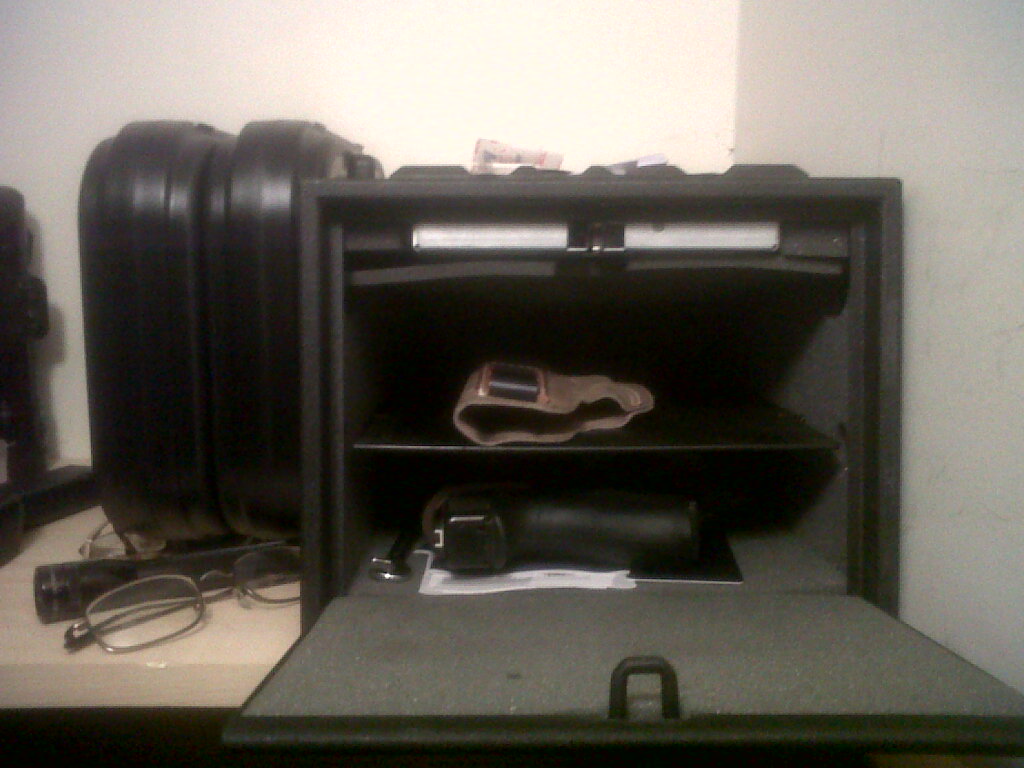
One of the first things I did when I bought my first pistol was to buy a safe to store it in. I got a good deal on a 8 gun rifle safe, and I stored my pistol there when I wasn’t carrying it. Soon I bought a Gun Vault pistol safe, which is where I keep my carry guns.

One of my rules of thumb with anything I store is to give as much thought to the next use as I do about how it is stored. In other words, how much trouble will it be to get to and use? This is doubly so when it comes to gun storage.

My pistol safe is used to hold my carry pistols, so the pistols are stored there in Condition 1, that is, with chamber loaded, and full magazines topped off, in a holster. When I or my family are home, the door to the pistol safe is open. This gives us the quickest access if we need it.

In the picture above, you can see Liberty, my Glock 19, in the bottom of the safe, along with some papers. On the top shelf is a leather IWB holster I use to house The Duke, my G21SF, when it’s in storage. At the time of this photo, The Duke was on my hip in a leather belt holster.

In my rifle safe I keep all my long guns, and my pistols that are not being used for carry. Since these pistols are not in the normal rotation, they are not stored ready to deploy, although there are loaded magazines in my ammunition storage that can be loaded quickly. The pistols are stored either in holsters or gun socks or zip-up pistol carriers, with no magazines, and with a orange flagged safety shell in the chamber.

Rifles and shotguns, on the other hand, are stored in a semi-ready state, with loaded magazines in place or with tubes loaded, but with the bolts open and yellow chamber flags installed. (I would never store a long gun in Condition 1, because the trigger is exposed.) When needed, a user would retrieve the gun, pull out the flag, drop the bolt, and be ready to go. On the other hand, when I’m transporting them to the range, I just remove the gun, drop the loaded magazine free, and put the rifle in the car with the chamber flag intact.

Sometimes I store my guns totally inert, unloaded. In that case, they are put into treated gun socks. Right now, only Vassily my Mosin Nagant is stored that way.

However you choose to store your guns, it is essential that you do it consistently, and that everyone who might be called on to use them knows how they are stored. This is part of what we discuss in our family when we talk about our guns, and everyone knows it.