Range Day

I took a day off last week to head to the range, more for relaxation than for any training or learning purpose. Of course, things being as they are, I managed to learn a few things any way.

++++

The first thing I learned is that I need to always keep a camera in my gun bag. It was a gorgeous day, and other people at the range had some really good looking guns with them, that I would have loved to documented. And, about halfway into the session, 6 men from the Georgia Department of Natural Resources enforcement division came to the range. It would have been a nice picture to have.

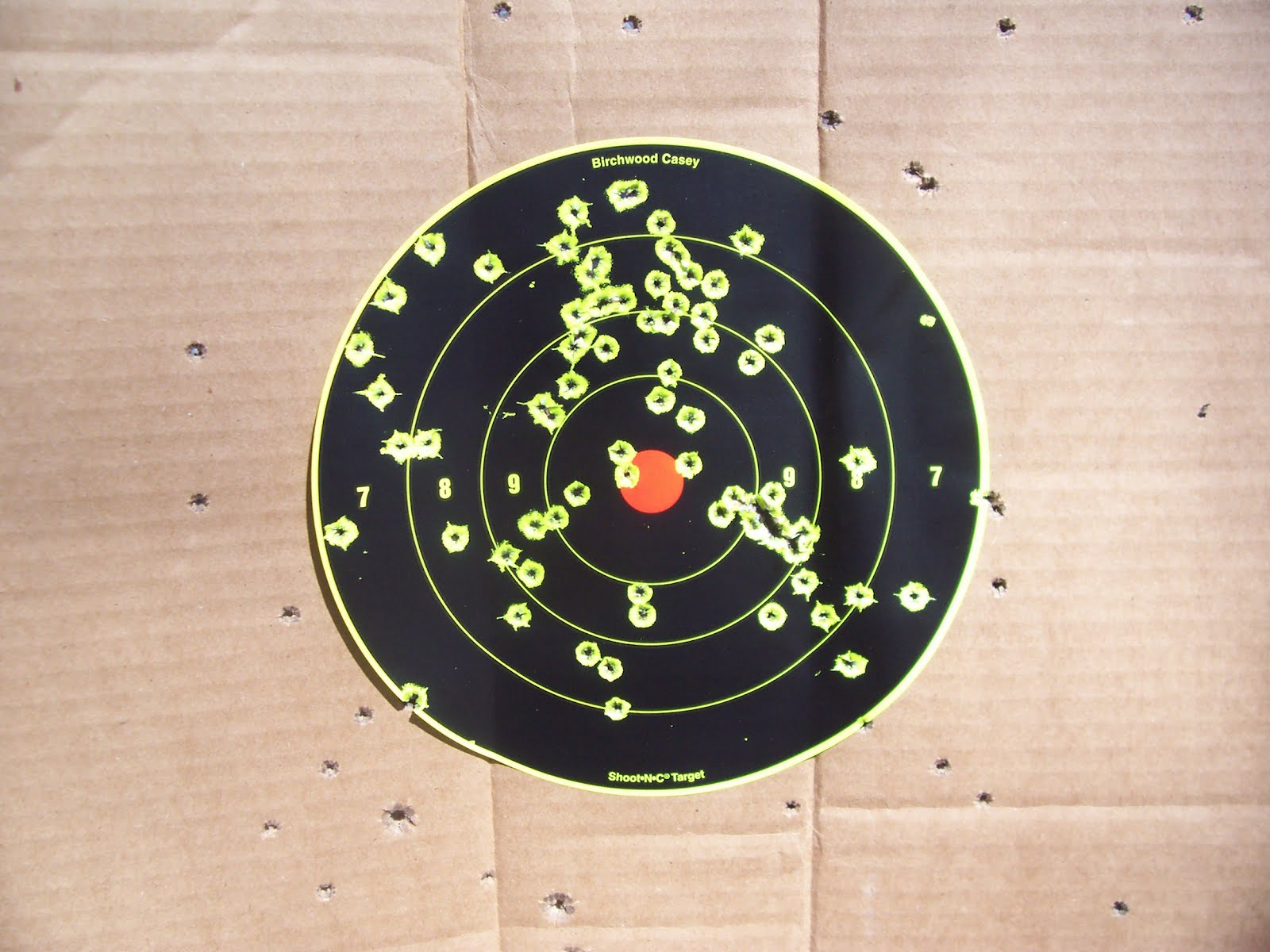
So, when I finished cleaning guns this morning, I dug through our collection of cameras, and found an older one, that I took this picture with. With fresh batteries, it now rests in my gun bag, ready for next time.

++++

Second, I learned that “customer golf” doesn’t always involve golf. The guy I arranged to meet at the range is in the same line of work as I am, and in between shooting, we had some interesting conversations that could well lead to new business opportunities.

In any case, he’s had a lot more formal training that I have, both shooting, and in our line of work. I plan to make use of both cases.

++++

Third, I learned something about long distance pistol shooting. I was doing a lot of 100 yard rifle shots with a scope, focusing my eyes on the target, overlaying the cross hairs, and making the shot. Then, I switched to using my Glock 21 for 100 yard shots, and I lazily used the same technique. In fact, it was the same technique I had to use for all my pistol shooting, before I got a contact lens for my right eye that allowed me to focus on the front sight, where I focused on the target (since it was the only thing I could get into focus) and laid the sight picture over it, in a blur.

My shots with the Glock were hitting low and left, or high and right, or full left – none were anywhere close.

Then, I remembered something I had once heard about, or read about, somewhere, and I tried it. I focused, as best I could, on the front sight, lined it up with the rear sight, and put that onto the slightly blurry target picture.

After a couple of shots to get a feel for the hold-over, my shots started hitting the target.

So, while I thought I had learned to focus on the front sight, line up the sights on the target, breathe, and squeeze the trigger smoothly, in fact, I learned to listen to everything I’ve learned before. There’s nothing new here, folks.

++++

Fourth, I learned a few things about Vassily, my Mosin Nagant. This was the first time I got to shoot it more than about 6 shots in one session.

I have found that the trigger, which at first I disliked, is not as bad as I thought. As Colonel Cooper wrote:

The most essential element of the “shootability” of rifle or pistol is its trigger action. The ideal trigger breaks clean without telling the shooter that it is about to do so. This quality is generally referred to as “crispness” and does not refer to trigger weight. . . . A trigger may be quite light, but still “mushy” in the sense that it moves perceptibly when activated. Such movement is called creep, but it is not “take-up,” which occurs before the trigger has reached the point of ignition pressure.

I added the emphasis, because it expresses what I learned. The Mosin Nagant trigger has a lot of take-up, which I interpreted as mushiness. But, once it reaches the end of it’s take-up, it breaks cleanly. This need for this long take-up can probably be easily be understood if one imagines shooting this gun in full Russian Army gear of a heavy wool coat and thick gloves. It is doubly understood if one does so in the face of a charging hoard of the Kaiser’s best troops, or Nazis in Stalingrad, or even Finnish rebels. I now officially like this trigger.

++++

What led to that conclusion was as much what follows, as it was due to Jeff Cooper.

One thing I like to do at the range is to place some orange clay pigeons out on the berm at 100 yards, and plink them with Captain America, my 10/22. Usually, the way this works is I shoot them in half with the .22, then shoot the shards.

I decided this trip to take aim at a pigeon with the Mosin Nagant.

I knew before now that the sights on the Mosin Nagant were very accurate, even given my untrained technique. My first shooting experience with the rifle, I had put four shots on a paper plate at 50 yards, then rung a steel sniper target four times at 120 yards.

I lined up on the top of the first pigeon and shot, and the earth exploded on the berm a half a foot above the target. So, I moved to a six o’clock hold, and shot.

The pigeon exploded.

I moved to the next target, and replaced it with a crater. And the next, and the next. Four shots on 4 inch targets from 100 yards, and four craters. For a novice, I was quite proud.

After a day of shooting .22LR, the force of the 7.62x54R cartridge was quite a surprise. Even more surprising was how easy it was to shoot accurately.

I shot up all my 7.62x54R ammo, so I will need to buy more, before I take it to a range with a longer test. But I think I know why this rifle lasted so long in service.

Holster Peeve

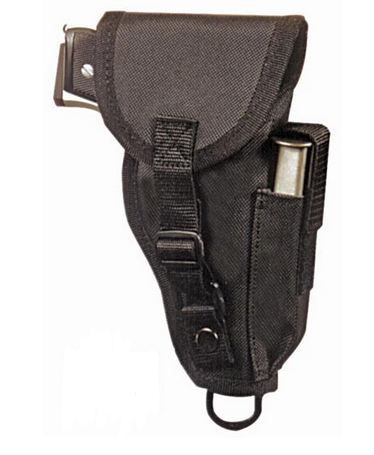
For the last few years, I’ve seen these holsters advertised in the discount catalogs – a strong side holster with a built-in magazine pouch. Something has always bothered me about these kinds of holsters, and my wife is tired of hearing me talk about it, so I’ll give it away here.

Say I’m using my gun drawn from this holster, and I need to change magazines. But the holster is on my strong side, so I have to move the gun to my weak hand, draw the holster, then either change magazines left handed and then move the gun back to the strong hand, or move the gun and change magazines.

All that extra gun handling, under stress, seems like a great way to drop the gun.

On first glance, it looks like a great way to carry a spare magazine. But for me, that’s way too much to have to learn to make this holster (or kinds like it) a good idea for me. I prefer to just carry a spare magazine in my left rear pocket.

+++++

If anyone has experience with these kinds of holsters, good or bad, please let me know in the comments.

+++++

There, I’m done.

How Many Guns Do I Need?

Michael over at the RKBArms Blog asked the same question recently. You can see his personal answers there.

First, let me say that I really think the question is almost invalid, especially to a law abiding American. On the one hand, the anti-gun crown will answer “zero,” which just leads to a pointless discussion.

On the other hand, it’s almost like asking how much money I need, or how many pages long should a resume be*. There is no real answer, or at best, any answers depend strongly on the assumptions that are made.

Here are the five essential guns Michael identified, which, given the nature of his blog, apply to a defense situation:

1. Every Day Carry
2. BUG (Back Up Gun)
3. Home Defense Sidearm
4. Home Defense Carbine
5. Home Defense Shotgun

I can’t disagree with any of these from a defensive standpoint.

All I would add would be the caveat that there should be enough additions for each able bodied shooter in the household. In a SHTF situation, having a carbine and/or handgun for each person would make survival a lot more likely.

It also occurs to me that, depending on the size and layout of the house or area being defended, the number of Back-up Guns may need to increase.

For me, my guns are

1. Glock 21SF
2. Glock 19
3. Glock 17
4. SKS with detachable magazines
5. Mossberg 500

Admittedly, I sometimes carry the Glock 19 in lieu of the Glock 21, depending on my clothing choices.

In a SHTF situation, I would carry the G21 and SKS, my wife would carry the G17, and my son would carry a Ruger 10/22 with 4 – 30 round magazines.

The key here is making sure everyone is proficient with their assigned guns, and knows where spare ammo, holsters, etc. are stored. Then train, train, train.

++++++

On the gripping had, this list touches addresses defense needs only. One could make any number of lists based on the category in question:

Competition: One for each competition type and class. Skeet gun, trap gun. 3-gun rifle, Camp Perry rifle. SASS: 2 pistols, a rifle in pistol caliber, and a shotgun. (That’s by far the easiest. Maybe.)

Hunting: Big game, small game, medium game.

Then there is collecting.

* On the issue of how many pages a resume should be, most people will respond one of two ways: either the resume should be all one page to make it easier to read, or the resume should be as many pages as it takes to convey the amount of information to get an interview.

But, in fact, this is a trick question: there is no answer any more, and here’s why. Most resumes will never be printed on paper, they will only be viewed and read on a computer screen. So, since there are no pages, the question is invalid.

I suppose I would go with the second answer at that point – include everything you need to include so you get the interview. Remember, no one hires your resume, they hire the person, after an interview.

Disclosure: I work as an engineering recruiter, to pay for ammo and match fees.

Got It On Camera

My Quest for C Class

Note: I thought about delaying this post until I found some good video editing software that I like, so I could illustrate my points. But I think the points need to be made. When I finally settle on editing software I will post a follow-up.

When I first took up golf, one of the best tools I found to help my swing was to watch myself on video. While most people have no problem pointing out my faults, I tend to politely dismiss their help. But, on video, the good parts and bad parts of my swing stand out clearly, without comment or advice. The camera doesn’t lie, and it isn’t trying to get in my head and mess me up to make that $5 Nassau.

This past weekend I was using some software to capture individual frames of my shooting videos as photos. In the process, I got to look at my shooting stance, grip, and follow through in slow motion, and I found out that video works the same way with my shooting as it did for golf.

When I shot video of my golf, I would tape my practice sessions as well as my play, so I could compare what I did when I concentrated on it, versus what I did when I wasn’t concentrating as much as relying on muscle memory and training.

For my shooting, I reviewed match footage, but I don’t have video of any practice sessions. I am focusing on the match, and on making good shots, not on the mechanics. So, what I am seeing on video is my ingrained habits, my training.

Here’s what I found out:

> My draw is smooth, and it does what I think I have been practicing for it to do. The gun comes out and up smoothly, and I press straight out while the support hand takes a grip. It also goes straight to the target, without any oscillation at the top. That’s good.

> I control recoil a lot better than I think I do. From the beginning of my shooting career, I’ve always thought that I did a poor job of recoil control, almost like I was shooting one of those .500 Magnums you see on Youtube. It turns out, however, that my muzzle rise is actually on par with some of the best shooters I’ve seen. It goes up just a little and settles right down. This proves that not only do I have a bad image of myself as a shooter, I’m also focused well on the target such that muzzle flip isn’t even noticeable. That’s good.

> I do a decent job of positioning my body as I shoot. But, as I suspected, I move a lot like a sea lion. That will improve as I lose weight. I full imagine to be moving like a penguin in no time.

> On close up targets, I lack the confidence to make double taps. I will instead take two measured shots. It’s not that I can’t do double taps, so it has to be confidence. That should come with practice.

> I do a decent job keeping the muzzle down range when I move. I’ve never been warned or DQ’ed by a Range Officer, so that confirms it.

> I need to pay a little more attention to my trigger finger when I draw or move. I have been warned about this, so this is something to pay attention to and practice.

> Compared to someone like Dave Sevigny, my magazine changes look like I’m trying to force a live snake into a coke bottle. I think I can make this better by practicing. But it’s not because of the direction the bullets face in my magazine pouch. (Yes, I had someone point this out to me, again.)

> My Glock 17 Bruce runs flawlessly in every video I’ve shot. This jives with the fact that I’ve never had a malfunction of any kind in a match. In fact, apart from a broken extractor and a couple of limp-wristing incidents with my son, Bruce has had exactly 2 failures to extract in the 19 years I’ve had him.

At my next match, I’m going to try to get video of me on every stage. By then I will have some better editing video, and I’ll make another report showing what I’ve found.

I’m also planning a range trip on a week day in a couple of weeks. If the range is clear enough, I will get some video of some standard drills like El Presidente and the Mozambique. I can then compare my results to those I find on line.