Be Prepared

When I was in school I was a Boy Scout, and while I never rose as far as I would have liked to (I made First Class), the principles of Scouting have stayed with me all these years. By far the best thing I learned was to live the Scout Motto, Be Prepared. Today, there are countless expressions of this concept, from Colonel Cooper’s color code, to the OODA Loop.

This is the fist in a series of postings where I plan to talk about emergency planning and what I have done. I don’t pretend that my way of planning is the only way or the best. It’s just what I have done. But I hope you can learn from it.

First, I sat down and made a list of the kinds of emergencies that my family and I could face. This was a brainstorming session, and I didn’t question the probability of any event at this time. Yes, the list was extensive, and it includes black holes and alien invasion. To me it was important to consider the larger emergencies, because when you really think about them, a lot of the preparations you make for more intimate events like a fire or home invasion would be the same you would make for them.

My wife and I then picked the most likely events, and the easiest preparations, and made our plan. We’ve been at the plan for a few years, and we are steadily making progress. Here are some of the low hanging fruit, as it were, that we found we could do right away.

Make a printed telephone list. We found that we were all relying on our cell phone address books for contact information, but, if we lost our cell phones in an emergency, that information is lost, too.

Make sure there is a family member or friend outside your immediate area who will agree to be a contact for everyone, if necessary. This came from some reports during Katrina and other emergencies, where local communications were impossible, but where people could call or email someone outside the affected area.

Make sure you have a texting plan on your cell phones. This is because text messages are sent by a different method than cell phone calls, using the carrier signal that the cell phone tower uses to keep track of where your phone is. Even if the all cell phone circuits are busy in an emergency, it may be possible to send short text messages. Make sure everyone knows short messages they can send quickly.

Make sure your guns are locked up away from any children. They should not only be out of reach, but out of the prying eyes. Our kids never knew where I kept our pistol safe until they were old enough and they were trained how to use them. Make sure all the responsible adults in your household are trained, and know how to access them.

Practice. Just as you should have fire drills, practice other kinds of drills – tornado drills, earthquake drills, home invasion drills. When you are out in public, always stay alert (Cooper’s Condition Yellow at a minimum), and practice finding the quickest path to safety.

Cross-Dominance Follow Up

Thank you to all who responded to my post yesterday on teaching my son to deal with his cross dominance. In addition to the comments on this blog, the topic came up last night on Twitter, and I received many first hand accounts.

Fortunately my son was still up at the time, and we talked about the comments. Everyone who commented told me they had learned (or were learning) to shoot long guns to match their eye dominance – in other words, even though they were right handed, since they were left eye dominant they taught themselves to shoot left handed. Most admitted it took them some time, about a month it seemed, to get comfortable with it.

So, he agreed to do a lot of dry fire, with his airsoft AR. He also plans to start dry firing his airsoft Glock right handed, so he can get better with it, too. He told me his goal is to be an ambidextrous shooter, which would definitely pay him back in the future.

I’ll keep you posted.

Dealing with Cross Dominance

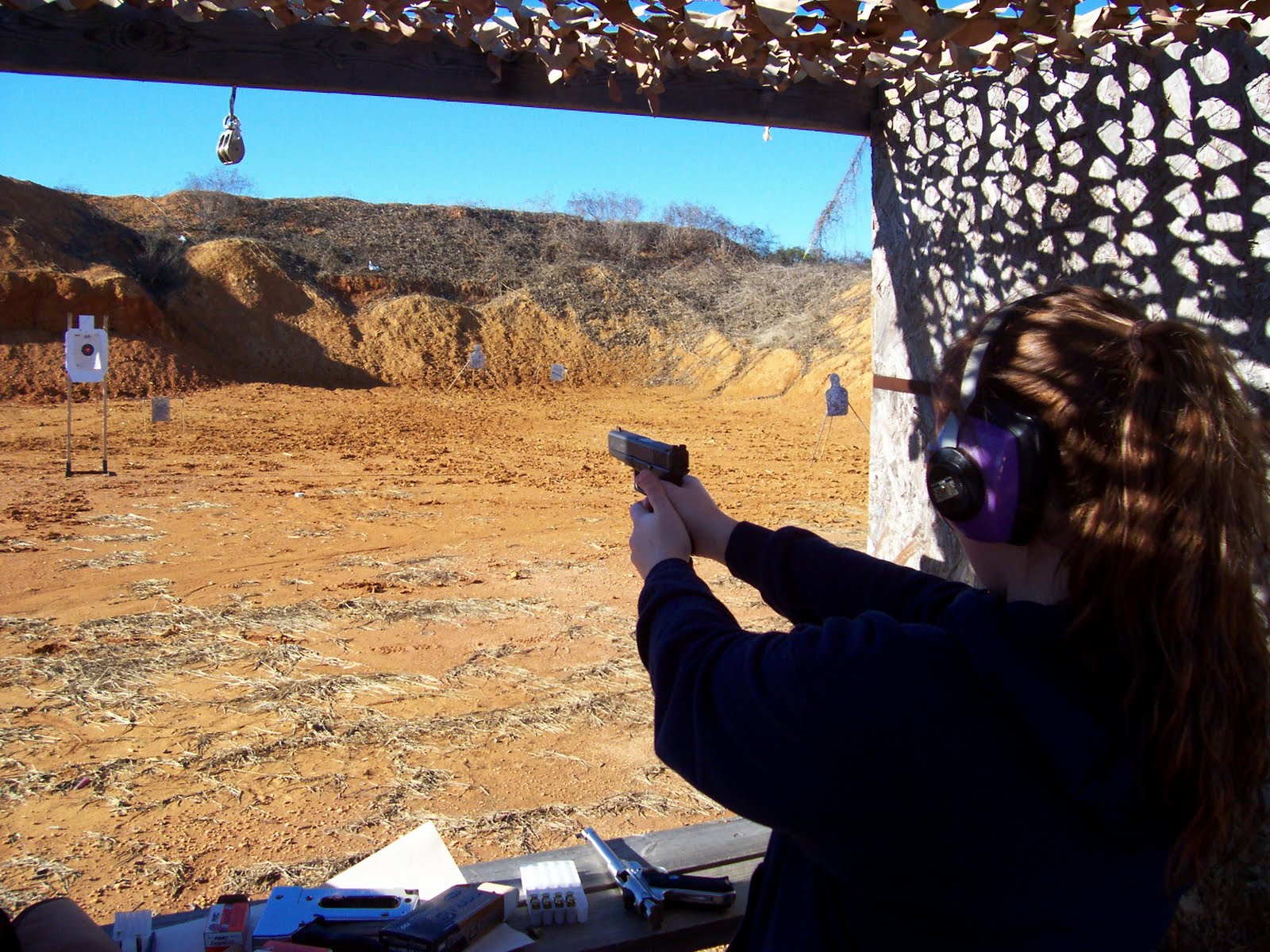
Yesterday I posted a picture of my son Joey, shooting Bruce the Glock 17. Today, I present my daughter, doing the same.

When you look at pictures of my kids shooting, you may notice something. My daughter shoots right handed, but my son shoots left handed. Ah, that it were that simple.

My daughter was born left handed, and she does everything left handed, except she shoots handguns right handed, because that’s what she saw me doing. My son is right handed. He writes and throws right handed. The only thing he does left handed is shoot handguns. But the reason is different.

Now, almost all of us have one eye that we use more than the other, and being right eye dominant or left eye dominant is as normal as being right handed or left handed. For most people their dominant eye is the one on the side they write with. Being right handed but left eye dominant (or vice versa) is called cross dominance. It’s certainly no big thing for a pistol shooter, but for shooting a long gun it can be problematic.

When I started plinking aluminum cans in the back yard with my son, I could tell he shot with his head sort of canted way down over the stock. I tried to show him the way to get what I thought was the right cheek weld, but in a few shots, he was back to the over wrap.

After a while I figured out he was left eye dominant. But even before we started shooting together, he had figured it out, since he already shot his Nerf pistols left handed, using his left dominant eye.

Once I realized he was cross dominant, I did some research, and it turns out a lot of really good shooters are cross dominant, people like Brian Enos and Dave Sevigny. So I asked them how I should teach Joey, they told me the same thing – if he’s figured it out on his own, let him shoot pistols left handed But they advised that I switch Joey to shooting rifles left handed, since he won’t be able to use a telescopic sight effectively with his head so far down on the stock.

So, now I’m up against trying to convince him to learn to shoot his rifles left handed. As one writer pointed out, if he will just shoulder a rifle left handed a couple of thousand times, muscle memory will take over and he’ll be fine. I’ll report as I go.

As for my daughter, it turns out she’s not cross dominant, she shoots pistols right handed because she copied Daddy when she was learning. Fortunately she was also smart enough to figure out to shoot rifles left handed to get a good sight picture.

A Noob Gets a Lucky Break

I bought my first pistol, a Gen 2 Glock 17, from a pawn shop in a small town in Alabama in the fall of 1992. It was the only Glock in town, and when I went to pick it up, I asked the owner if he had any 9mm ammo, too. He managed to scrape together 42 rounds of various weights and bullet types, and threw them in, gratis, with a couple of targets. He then showed me all that he knew about the Glock design, including how to field strip it, how to load it, and how to shoot it safely. And I left that shop a very proud gun newby, off to the range.

I was very fortunate that the town I lived in had an awesome outdoor range, one that I have only been able to fully appreciate as I have moved around the country and lived in areas without good public outdoor shooting ranges. Basically, the town had built a new sewer treatment plant, and taken all the excavated dirt up the road about a mile, and built a 10 foot tall 3-sided berm, 100 yards across, and 100 yards deep. The front 50 yards was all crushed gravel, and the last 50 yards was nice grass, planted by the local Boy Scout troop as an Eagle Scout project. That Eagle Scout project also included five covered rifle shooting benches, two large covered pistol bays, and a chain link fence all the way around.

I drove to the range with my new pistol, 42 rounds of ammo, and a target. When I pulled up, I noticed a police car there. Two uniformed police were shooting silhouette targets. Great. I was nervous enough about shooting for the first time, much less with cops there.

I moved my stuff to one of the pistol bays, and made busy while I watched the cops shoot for a while. Soon, they seemed to be finished, and started packing up to leave, so I went to put out a target.

Once of the cops noticed me and called out, and I waved, and he asked, “Hey, what have you got there?” I told him it was my brand new Glock. He smiled and looked at the other cop, and pulled his own Glock out of his holster. “Like this one?” We chatted for a few minutes, long enough for them to find out just how little I knew about my new gun.

So, two experienced cops gave me my first and best hands on training. They showed me how to clean it, what to oil, and, best of all, how to shoot it. In 30 minutes they taught me a decent modified Weaver stance, how to use the sights, how to reload, how to clear malfunctions, and basically how to run the pistol. 42 rounds didn’t last long.

As we parted, one of the cops gave me some of my best advice, too. “When you feel comfortable enough with that thing, get a carry permit, and carry it. We can’t be there all the time.”

Good advice, good teaching, and a good beginning. I was hooked.