More on Common Sense

Linoge at walls of the city also visited the recent FBI Crime Report, that I wrote about before. However, he crunches the numbers into graphs, which, being a graphical person, I really liked.

When he started talking r factors, I got downright hot.

Linoge said we could link to his graphs and data, but it might be better for you to read it in his words. Take a look.

Common Sense

The most vocal of the anti-gun crowd would love nothing better than to see the complete confiscation of all handguns. But, knowing that this goal is very likely out of their reach, they instead chant the mantra of “common sense gun laws.”

Their version of common sense goes like this: since everyone knows that guns are dangerous, and everyone knows that ordinary citizens can’t be trusted with guns, and everyone knows that guns cause crime, it’s just common sense to limit the availability of guns to ordinary citizens. And, in their minds, I’m sure that limit approaches zero.

Any time there is a high profile shooting, like Virginia Tech or Gabriella Giffords, this case gets driven home by the anti-gun crowd, using the most emotional images possible. The total nut-caseness of the shooters is ignored. After all, it’s the gun that kills.

But, sometimes a monkey wrench gets thrown into this anti-gun concept of common sense: the truth. In this instance, that monkey wrench comes in the form of the FBI Annual Crime Statistics for 2010, released on Monday.

According to the figures released today by the FBI, the estimated number of violent crimes in 2010 declined for the fourth consecutive year. Property crimes also decreased, marking this the eighth straight year that the collective estimates for these offenses declined.

The 2010 statistics show that the estimated volumes of violent and property crimes declined 6.0 percent and 2.7 percent, respectively, when compared with the 2009 estimates. . .

Each of the four violent crime offenses decreased when compared with the 2009 estimates. Robbery had the largest decrease at 10.0 percent, followed by forcible rape with a 5.0 percent decline, murder and nonnegligent manslaughter with a 4.2 percent decrease, and aggravated assault with a 4.1 percent decline.

The sticking point for the anti-gun crowd is that gun sales and CCW permits issued are both up. For those who have trouble keeping both concepts in mind, this means that crime went down while the number of guns and the number of lawful concealed carry holders went up.

I’m no statistician, although I have played an engineer on TV, but it seems like this negative correlation flies in the face of the “common sense” the anti-gun crowd spouts.

The truth is, more guns in the hands of more lawful citizens means less crime. That’s because guns don’t cause crime, criminals cause crime, and those criminals are deterred by the threat of armed victims.

So, the next time someone cries for “common sense” gun laws, explain to them the real definition of common sense. Then ask them Just One Question:

Can you demonstrate one time or place, throughout all history, where the average person was made safer by restricting access to handheld weapons?

No one has yet answered this “yes.”

The evidence is clear. Guns aren’t the problem. Criminals are the problem. And that is real common sense.

Good Weekend

My weekend started well. I shot the monthly Action Pistol match at River Bend Gun Club in Dawsonville, Georgia. This match consists of three stages that are moderately challenging, involving a mix of steel and paper targets.

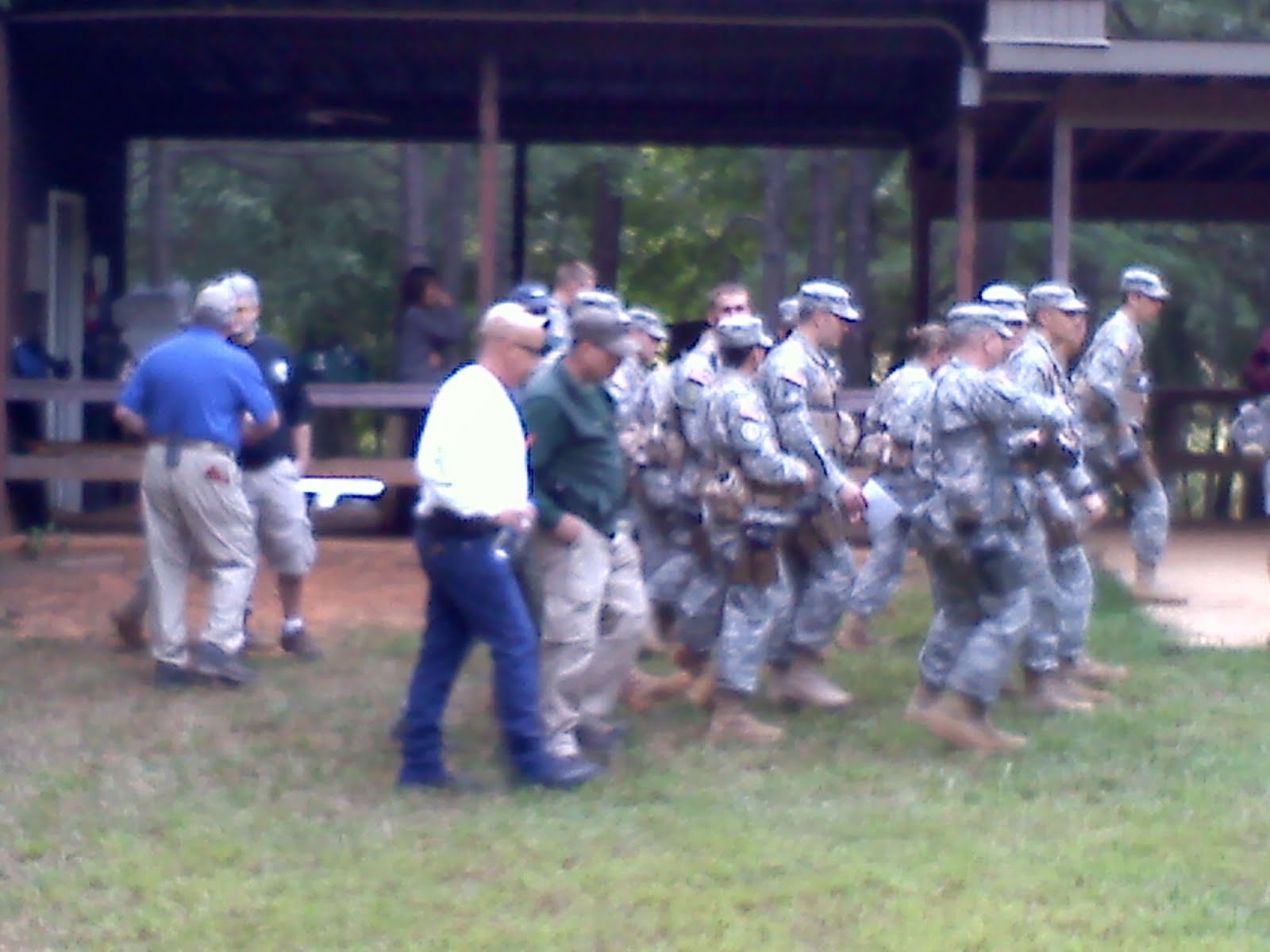
This month there were over 60 participants, including a group of Cadets from The Military College of Georgia, located at North Georgia College and State University, shown above. They shot in full combat gear including loaded rucks – talk about Train as you Play. Fortunately for me, they were shooting Limited to my Production. I felt unworthy.

I finished fifth out of ten in Production, 0.01 points back of fourth and 0.38 points behind third. Looks like my two weeks of dry fire practice is paying off.

+++

After the match, the club served a free hotdog lunch, then I was on the road home. I made it home at halftime of my alma mater Georgia Tech’s game against Kansas. The Yellow Jackets pulled away in the second half, winning 66 – 24.

+++

Sunday was a cleanup day. Next week is the Glock Annual Shoot at the South River Gun Club in Conyers, GA, the largest GSSF match of the year. To get ready, I completely detail stripped and cleaned Bruce, my G17, and the Duke, my G21, since I plan to shoot them in the match.

I also detail stripped Bucky, my Browning Buck Mark .22LR pistol. Between Bucky and my 10/22 Captain America I’ve shot over 1,500 rounds of ammo, without cleaning Bucky at all. To say the gun was dirty is an understatement. I spent a lot of time with gun scrub spray and buff pads.

I also did a little internal work, mostly polishing, that I read about on Rimfire Central.

One thing I know, if I am going to compete with Bucky, I will need to install an extended magazine release. I was not blessed with normal thumbs, and pressing the release now requires me to shift the gun quite a bit. In fact, while practicing mag changes, I found I needed to use my off hand to hold the gun around the trigger guard, then shift my hand to press the release. I can’t imagine how this will work in a match, with a hot gun, and the adrenaline flowing.

I tried drilling and tapping the existing magazine release button, but I found the material is too hard for me to do a good job. I will likely buy one off the interwebz.

I also played around with different sighting ideas on my 10/22 and Buck Mark. Right now I have a 2 – 6 x 40mm scope on the 10/22 and a red dot scope on the Buck Mark. In a .22 match, I would need something quick on the rifle, and I think I can make do with the scope at 2x. I tried the red dot, and that would work, but it leaves me with iron sights on the pistol. I might spring for a reflex sight for the pistol, which would be quicker to use than the red dot.

I may also buy a 45 degree offset Weaver base for the 10/22, and mount either the red dot or a reflex sight on it, and set the scope to 4x or similar. It would still be fast to use.

It’s a busy week ahead.

Be Prepared, Part 8 – Every Day Carry

This week on Tom Gresham’s GunTalk Radio, Tom presented a retrospective of the September 11 attacks. The focus of the show was people who survived the ordeal because of how they were prepared for emergencies.

To me, the most compelling story was from John Tucci, an undercover NYPD officer who was buried with others in the debris of the fallen towers. He told how they were being suffocated by a large plate glass partition, until a fellow officer managed to get his Glock 19 free and shoot the glass. John was then able to find his way to safety, in the dark, because he carried a flashlight.

This got me thinking about what I carry every day. I know that, compared to some, I’m probably a lightweight. Massad Ayoob, for instance, carries multiple of just about everything, including cell phones.

As you can see from the picture above, here’s what I carry, from right to left:

In my right front pocket:
– My car key on a ring with the door fob for my office and a shopper card from a local grocery store. The shopper card is for identification if my keys are lost. And, this is where I shop the most, so I carry the card.
– Cash in a money clip. I never carry cash in my wallet.
– A pen. I’m an engineer. I used to carry pens in my shirt pocket. With a pocket protector. Really.
– A knife. Most of the time it’s a 20 year old Swiss Army Tinker model. Sometimes it’s a folding knife I can open with one hand. I don’t clip it to my pocket, unless I’m camping. No need to telegraph anything.
– A Glock armorer tool. I took to carrying this a year or so ago when I was doing a lot of armorer work for friends. It’s probably my least used piece I carry, but it’s light.

In my left front pocket:
– My wallet. It’s a nylon police wallet, with a full view ID window. I carry my drivers license, my Georgia Weapons License, insurance cards, my debit card, one credit card, a few membership cards, my lawyer’s card, and some business cards.
– An LED flashlight. This isn’t an expensive tacticool Surefire, just an aluminum AA flashlight. I keep the batteries fresh, and I use it all the time.

In my left rear pocket:
– A notepad. Again, I’m an engineer, and I take notes all the time.
– A spare magazine for whatever gun I’m carrying. I practice mag changes with it there.

Not shown – a cell phone, that I either carry in my left front pocket or in my front right watch pocket, and a pistol.

Not much, but it works for me. The one thing I may add is a whistle.

Now, what I don’t carry:

I don’t carry a hundred keys on a caribiner clipped to a belt loop. I don’t use many keys enough to warrant the bulk. I keep a key ring in my car with my other keys, and there’s a home key in my get home bag, in case I get home and the power is out so I can’t use the garage door opener, or if I want to go in through the front door. A spare key to my back door is kept in a secure place on my property.

I don’t carry my cell phone in a holster on my belt. My pocket is fine.

I also don’t keep a hundred shopper cards on my key ring. They’re on a spare ring in may car, if I need them I take them in, then put them back.

I don’t keep money in my wallet. I went to college in downtown Atlanta, and I worked it out then that if I were mugged, I could throw the money to the right and run to the left. Then I’m not giving up my ID or credit cards.

I don’t carry all my life’s work in my wallet. I have a separate portfolio I carry in my briefcase, where I carry membership cards and coupons and all the other stuff, and if I need something, I get it.

I don’t carry an expensive flashlight. The one I carry is sold 2 for $4 at the local tool store. It’s bright enough to light up the living room, or the back yard. I have a dozen of them around the house. My kids carry one in their school backpacks, and I have one on top of both gun safes. The flashlight is probably the most useful thing I carry, and a week doesn’t go by that I don’t help someone connect a computer under their desk or check a furnace filter.

I don’t carry a fighting knife, because I’ve never trained to fight with one. I carry a pocket knife, because I used the screwdrivers and tweezers a lot. If I need a bigger knife, I carry two.

I did a quick poll of the people in my office, and I found that a lot of guys carried pocket knives, but few had flashlights. Two had flashlights in their briefcases, but if they didn’t have the case when the power went out, where were they?

A lot of people also moonlight as janitors or jailers, judging from their key rings.

Give some thought to what you’re carrying. Will it help you survive in an emergency?