Glock Sport Shooting Foundation

I am surprised when I talk with fellow Glock owners who are unaware of the Glock Sport Shooting Foundation, or GSSF. I then realized I hadn’t done a full post explaining what this organization was or how to join. Let’s correct that today.

The GSSF is owned and operated by Glock, Inc., out of their US headquarters in Smyrna, Georgia. They organize and run about 36 matches a year, all over the country, with the much appreciated assistance of a lot of people at local host ranges. The schedule can be found at the GSSF website, www.gssfonline.com. Joining GSSF is just $35 for the first year, and $25 to renew, plus $25 per match for each pistol you compete with. (More on that later.)

But the bounty comes with the prize packages. In addition to awarding Glock pistols for winners, and cash for other high finishers, they also award a lot of cash, complementary membership renewals, and free pistols at random to competitors. In the 15 years I’ve been competing, I have only won a prize once for my finish – I won $100 for taking second in my class. But I’ve also won $100 once, $50 twice, two annual renewals, and – YES – a brand new Glock of my choice. (That’s where Libert, my G19, came from!)

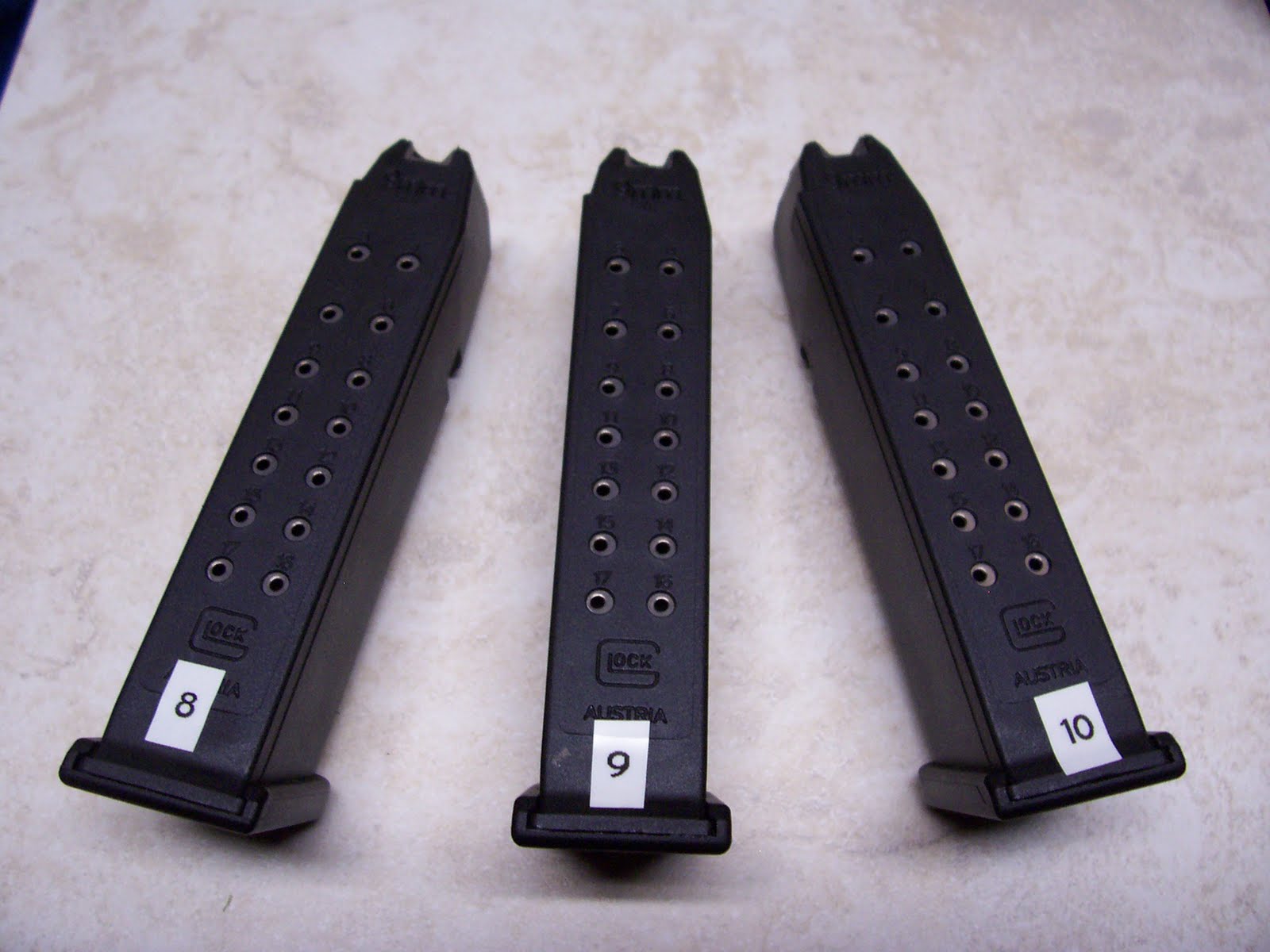
GSSF is open to any Glock shooter, regardless of age or experience. There are different classifications for shooters, ranging from Amateur Civilian (which would include most of us), to Guardian (for police and military) to Master (for those who are ranked Master or Grand Master in other groups). All you need is a Glock pistol and at least 4 magazines, plus 104 rounds of ammo. And, if you have more than one pistol, you can enter more than one classification, which increases your chances of winning a random prize.

Admittedly, GSSF seems like a rather low-intensity competition, when compared with USPSA or IDPA. There are no reloads or movement during the stages, and the stages start at low ready, rather than being drawn from a holster. This is perfect for the new shooter, but don’t think it makes matches a cake walk for experienced shooters. This just shifts the emphasis from transitions to accuracy.

To level the playing field, and to account for the restrictive gun laws in some states, all magazines start with 10 rounds, and you are allowed one in the chamber. There is an exception for the Glock 36, which only holds 6 rounds to start, in a class called Heavy Metal, and if you shoot another .45ACP or 10mm Glock, you can enter that class as well, and self limit your magazines to 6 shots each, plus one in the chamber.

Scoring is based on time, with penalties assessed for errant shots or misses. The match uses three kinds of targets – the NRA D-1 target, also called the Tombstone; steel pepper poppers; and 6 inch steel plates.

For the metal targets, scoring is easy. If you knock the popper or the plate down, there is no penalty. If you leave one standing, you add 10 seconds. Ouch.

For the Tombstone targets, all shots in the A or B area incur no penalty. Shots in the C area add 0.5 econds for each, and shots in the D area count for 3 extra seconds each. Complete misses add 10 seconds. Ouch.

Every match I’ve been to has included the same 3 stages, and they are run just about the same everywhere. I tried to find some good examples of these stages, but the best ones are actually on the GSSF website itself, which I liked above.

5 to Glock:

This stage is five Tombstone targets, spaced from 5 yards out to 25 yards. Sometimes these are in a straight diagonal, and sometimes they are staggered. The point here is to test transitions from target to target, and to test your ability to make the longer shots as well as the close shots.

This stage is shot three times. At the end of the stage, all three times are added up, and each target is assessed. There should be 6 shots on each target, and penalties are added accordingly.

Glock M

The stage is named for its similarity to the letter M. From left to right, there is a Tombstone target at 7 yards, a Tombstone at 15 yards, 3 pepper poppers at 11 yards, then another 15 yard Tombstone, and a 7 yard Tombstone. This stage is also shot three times, with only one popper being shot on each run through.

Here’s where a little strategy comes in. I generally shoot all the Tombstone targets, left to right, 2 each, then shoot the pepper popper. This means I’ve shot 8 shots, leaving me three shots to knock the popper down. If I leave a popper standing, then it’s my fault, but I’ve never left a popper standing.

Glock the Plates

This is the simplest stage of all – just 6, 6 inch steel plates, at 11 yards. Knock them all down in the shortest time. This stage is shot four times.

But, as is often the case, the simplest stage is not necessarily the easiest. I have probably left more plates standing in my GSSF career than any other. For me, this stage embodies all the fundamentals of good shooting – sight picture, trigger control, and follow-through. When I get all these where they should be, and my shot cadence is right, I clean this stage. My technique is to shoot each plate in order, whether I hit it or not, then come back and take the ones I miss.

GSSF can be an excellent entry into competitive pistol shooting, and it is also a great complement to other shooting games for more experienced shooters. If you own a Glock, give them a look. For that matter, sign up, and come shoot with me next Saturday, July 16, at the Riverbend Gun Club in Canton, Georgia.

Movie Rule of Thumb 1

From Night of the Living Dead

I love movies. I’m one of those guys who will quote a movie line to you whenever the situation is appropriate. If you know the movie, and continue the dialog, we can be friends.

Those who follow me on Twitter probably cringe when you see that Tombstone is on.

Some time, long ago, I started accumulating some rules for life, that were based on things that happened in movies. I few years ago, I wrote them down, and I’ve added and edited them a couple of times.

These are my Movie Rules of Thumb.

Over the next few months I will share with you my rules, where they came from, how they apply to movies, how they apply to Real Life, and how they’ve been important to me.

It all began with

Rule 1: Always Shoot Zombies Through the Head.

(Sometimes including the follow-up phrase, “Don’t waste ammo on body shots.”)

Source: Night of the Living Dead and every zombie movie since then.

Lesson: Don’t waste your time doing things you know aren’t going to matter. Consequently, if you try something you think is going to work, and it doesn’t work, believe the evidence. Try something else.

Rule 1 obviously applies to just about every zombie movie. It also applies to a lot of other movies. If you don’t have a silver bullet, don’t even shoot at a werewolf. The same thing goes for vampires, if you don’t have a wooden stake, although I have to admit, I have paid zero attention to Twighlight and other recent vampire movies and TV shows, so I can’t say whether this still applies.

Interestingly, I did a Youtube search and came across this test of zombie killing effectiveness. Apparently, it’s a good thing my shotgun is back in action. Enjoy.

Rule 1 has lots of applications in Real Life as well. Because of Rule 1, I don’t use sarcasm with the TSA agent at the airport. I always go ahead and give my dog his treat when I let him in. I don’t argue about visiting my mother-in-law. I tip the bellman at the hotel.

Self-defense lesson: Never shoot someone to wound, or fire a warning shot, or shoot to get their attention. If you pull your gun, be prepared to shoot until the threat stops. That means shooting center of mass, with follow up shots to other areas as appropriate.

And yes, that might be a head shot.

My Shotgun, Reborn

One spring day, not long after I had bought my first gun, I was at work, talking with a truck driver, while he was waiting for his trailer to be loaded. The conversation turned to guns. After all, it was spring, we were men, we were in Alabama, and I was a Gun Newbie. After a while, the truck driver mentioned that he happened to have a used shotgun for sale. Would I like to see it?

Sure.

It was a very nice pump shotgun, a 12 gauge. The wood was in good shape, and while some of the bluing on the barrel was worn, there was no corrosion. And the pump action was as smooth as glass. It had only one minor defect – a former owner had written his name on the barrel with a power inscribing tool.

I say it was a defect, but in fact, it was a blessing, because the person whose name was on the shotgun barrel happened to be the plant chief operator, and he was on shift that day. So I went and asked Lee about the shotgun. He told me of the large number of whitetail deer who were prancing in the fields of heaven because of that gun.

Was it worth $100?

Lee said he thought so, because that’s what he had sold it to the truck driver for, 3 years before.

So, at lunch, I went and cashed a check (these were the days before the ATM, friends) and the shotgun was mine. And I named it Lee.

Now, I had no idea what brand of shotgun it really was, and neither did Lee. The brand name on the gun is Revelation, sold by Western Auto. I tried taking it apart, but knowing nothing about shotguns, I didn’t get far.

The next day, my copy of American Rifleman arrived, and the monthly section on gun schematics and disassembly instructions featured the Mossberg 500 12 gauge shotgun. Everything looked the same as mine, and it came apart and went back together just like in the magazine. So, Lee was really a Mossberg 500. Thank you, Lord.

+++++++

A couple of years later, after I had moved away, I went back to my old plant for a visit, and Lee (the operator) asked about the shotgun. He then told me that he had been approached by the truck driver, to try to sell him the gun back, and he had steered him to me.

Again, thank you, Lord.

+++++++

Fast forward a number of years, and a lot of trap shooting, later. Now, the bluing on Lee had gotten a little more worn, so I decided I would like to re-blue it. I bought a re-bluing kit at the gun store, read the instructions, and completely de-blued the whole gun. I sanded all the pits and corrosion out, and – no offense – I used my Dremel to erase Lee’s name. Sorry, man.

Then I decided to search the Internet for info on how to re-blue guns, and I was confronted by tales of woe. It turns out that the Mossberg 500 has an aluminum receiver, which doesn’t take bluing well. So I decided I needed a little more experience in gun finishing before I gave it a try.

Fast forward a little more. Okay, probably 5 years more. The shotgun sat unfinished, all that time, while I periodically thought about refinishing, and stopped, because it made my head hurt. To assuage your fears, the barrel and steel parts were well oiled, and stored in a firearms sock in my safe. The small parts were stored in a plastic shoe box.

At last, thanks in part to the false sense of optimism this blog has given me, I decided to finally refinish Lee.

After a bunch of Internet research I decided to use Duracoat firearm finish, and a Hogue rubber overmolded polymer stock, to make Lee look like his Glock brethren.

++++++

The refinishing process began with the fitting of all the parts onto the new polymer stock, to be sure I didn’t need to do any gunsmithing to make it fit.

Everything fit perfectly.

I then laid all the parts out to get ready. In addition to the Duracoat with sprayer that I bought, I also bought painters tape. I also remembered back when I was researching bluing, and they told me to fill in all the holes in the receiver with Silly Putty, so the finish wouldn’t get in the holes, and make them smaller.

I also got some 600 grit sandpaper for the final sanding, and some nitrile gloves to protect my hands.

I then went over all the metal parts with the 600 grit sandpaper, per the Duracoat instructions.

Here’s the trigger group taped off below the parts that will show in the final gun assembly:

I filled in all the holes with Silly Putty, and taped all the threads and other parts that I didn’t want to spray. I then sprayed the whole gun with the degreaser spray provided in the kit.

Here’s the receiver, hanging and ready to spray.

I then mixed the paint and the hardener in the glass sprayer bottle, and shook it all for the time they told me to. Spraying with a smooth even motion, I laid down the first coat:

I also sprayed the barrel:

Three even coats, and all was done.

Sounds easy, right?

Ha!

First – the sprayer that Duracoat sold with the paint tended to sputter periodically. At random. Leaving some parts sprayed smoothly and evenly, and some running and dripping.

Actually, I’m surprised the paint stayed on, with the amount of cursing that I applied to the sprayer. I guess I’m glad the cliche isn’t really true.

So, instead of letting it dry five minutes between coats like the instructions said, I let it dry fifteen minutes, and tried to sand out all the drips.

Stupid idea. All I got was rolled up drips.

Eventually, my curse vocabulary exhausted, I managed to get it sanded well enough to get three coats on, and it not look like I had welded all the parts together.

Lessons learned:

First, I won’t use the sprayer that Duracoat sells again. Instead, I will invest a little more money in an airbrush sprayer and compressor.

Second – while it may work for bluing, I found that Silly Putty makes water bead up. This means it also repels paint, so that all the pin holes had halos around them, free of paint. I need to find something else to use, maybe just balled up paper.

So, while trying to sand out the drips, I also had to take out all the Silly Putty, and use the degreasing spray again. Then I could spray.

Third – in retrospect, I would not have Dremeled Lee’s name off the barrel. I now think it would have lent a sense of history, which I am trying, in a small way, to preserve here.

After drying overnight, I put the whole thing together. Of course, I had to watch a Youtube video, because I hadn’t done anything with this gun for 5 years. But the action is still smooth as glass, and it looks mean.

Behold, Lee, the Mossberg 500:

Fast and Furious Update

The day I decide to air my thoughts on the Fast and Furious scandal, comes word that Acting ATF head Ken Melson took it upon himself to come to Congressman Issa and Senator Grassley, and testify, without a lawyer, and without anyone from the Justice Department present.

On the Fourth of July.

I will let you read what he said here. Just let me say, it looks like the American System I talked about yesterday is working.