Evolution of My Holster Rig

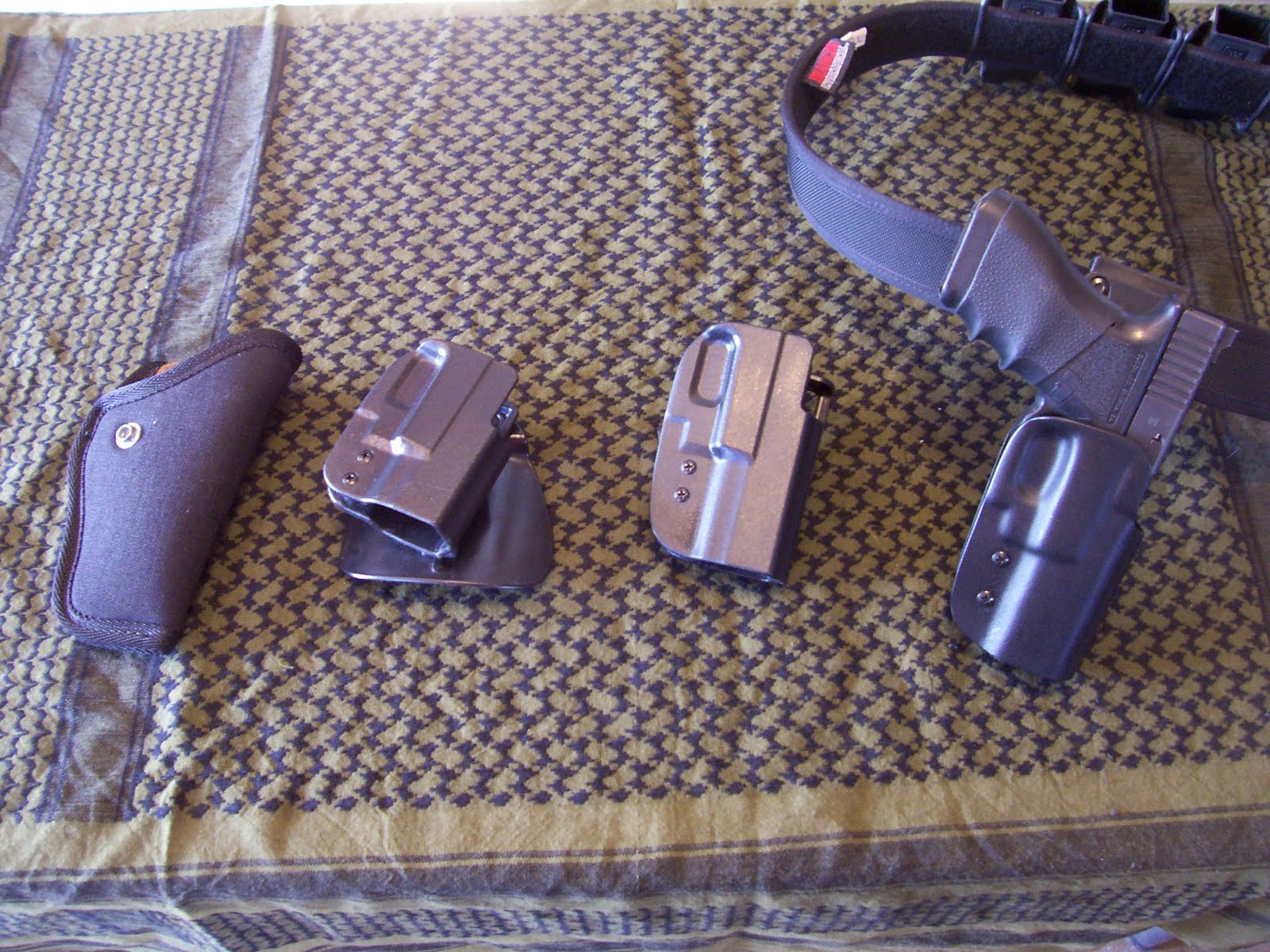
My competitive holsters, from 1993 to present.

About a week ago, I was asked by Walt in PA about the magazine holders I use for USPSA competition. I told him that I have been using the standard Glock Magazine Holder ever since I got into competition, for a number of reasons.

First, it’s what I use for every day carry, if I use a mag holder. Second, it’s lightweight and cheap. So cheap, I’ve never found anything else that meets my needs, for the price.

While my choice of mag holder hasn’t changed, I can’t say the same about my holsters.

The picture above shows my competitive holster collection, as it has evolved from 1993 to today.

When I bought my first Glock 17 in 1992, I went that same weekend and bought a very inexpensive nylon, one-size-fits-all holster, and I used that holster for club competition for about 3 or 4 years. It’s made by Gould & Goodrich, and I don’t know the model number because that part of the tag is missing now. The inside is a nice suede.

When I took up IDPA in 1995, I bought an Uncle Mike’s Kydex paddle holster. Because I carried my gun at about 4 o’clock at that time, I adjusted it to the maximum forward cant that I could. I still use it for IDPA.

At that time, I used a stiff leather belt, laced through my belt loops, as a gun belt.

Then, in 2002, when I took up USPSA, I changed from a 4 o’clock position to a 3 o’clock position, right on my hip, and I bought an Uncle Mike’s belt slide holster. About that time, I found a Bianchi competition belt on sale, and I started using that. I like the competition belt because it’s a little more rigid than the leather belt, and I can take the belt off and on a lot easier.

In 2005 or so, I started experimenting some with my draw stroke, and I changed my technique a little. Before, I moved my hand below the gun and swept it clear with the fingers, then grabbed the grip as I brought the gun to bear.

However, I found that this technique didn’t yield a consistent grip, so I changed, so that my first movement was to grip the gun with my strong hand, high, with a good shooting grip. Then I would draw the gun, while bringing my support hand in.

I found that the belt holster made the gun ride just a little too high, and someone suggested I try an offset holster, that mounted the gun lower.

Uncle Mike’s belt slide holster, left, versus BladeTech DOH holster, on the right. Note that both belts are at the same level. The gun rides almost 3 inches higher with the belt slide holster.

I ended up buying a BladeTech “DOH” double offset belt holster, that’s adjustable for cant at two points. After some experimenting, I have it set at a neutral position, not canted in any direction. I wear it right behind by the point of my hip bone, per the Production Division rules.

I find that the 3 inch difference between the belt slide holster and the DOH is enough to make my grip a lot more consistent.

Yes, I still have all these holsters, and many more. But that collection is for another day.
Knife Review – Victorinox Swiss Army

I’ve carried a knife of some sort just about every day since I was 10 years old. I’ve been carrying a Swiss Army Tinker from Victorinox for about 20 years. Before that, I carried a Boy Scout model Swiss Army knife since about the 7th grade, until I lost it when my canoe capsized when I was on a camping trip in Ohio when I was in college.

This year for Christmas, I presented the Dauphin with his first pocket knife, a Swiss Army Climber model. He was very pleased.

Here are our knives, side by side, with mine on the left and the new one on the right:

Since it had been about 20 years since I looked the Swiss Army line, I was also pleased with the changes Victorinox has made.

First, as the photo shows, mine is shinier than his, because his side panels are a matte texture, versus the old slick plastic. This makes the knife much easier to grip when wet. I tested it and I like it.

Second, there are a few more blades on the Climber versus my Tinker model. The scissors are much welcome. My wife carries a small Classic Swiss Army, and she tells me she uses the scissors at least once a week.

The Climber also has a hook and a corkscrew, but is lacking the Philips head screwdriver.

My impressions of the Climber are very positive, by itself, and compared to my Tinker. Opening is smooth, the blades are all solid and sharp, and the miscellaneous tools are easy to open and use.

I’m still pleased with my 20 year old Tinker, too. Although one panel is a little loose, the grip is still comfortable and usable. The blades have kept their edge, although I dress them regularly.

In all, this new knife should serve my son well for the rest of his life, provided he doesn’t put it in the pocket of an unsecured sweatshirt on any canoe trips.

++++

A note of thanks is due here to Sheriff Jim Wilson. Some time back he and I swapped some tweets about pocket knives, and about how I had resisted giving my son a knife, for fear that he would accidentally take it to school, and in today’s Zero Tolerance world, be expelled when it was discovered.

Sheriff Jim responded simply that this might also be a way to teach responsibility.

Later, he wrote in his blog

I especially like to see a kid with a good pocket knife. It’s usually an indication that someone trusts him. And it is tangible proof that he is growing up and that the day when he will have his very own .22 rifle is not all that far off. Kids need that sort of trust and responsibility.

I think he was right. Thank you, Sheriff.

Advice for Concealed Carry

I ran across a couple of posts from Rob Reed of the Michigan Firearms Examiner, ostensibly aimed at new Concealed Carry Permit holders. I would recommend them for people of all levels of experience – for the new permit holder as a check of your intent and understanding of the purpose and techniques of concealed carry, and for the more experienced holder as a check that you are still following good practice. I found them very useful.

Here is Part 1 and Part 2.