Getting Better by Going Small

One way I have found to get better at shooting is to make the target smaller, and make the caliber smaller if you can. An example – this past weekend I spent a couple of hours shooting bumblebees with a regular old Daisy BB gun. I stood on my driveway while the bees flew around the gutters on the back of my house, which are full of pollen these days. I figure most of the shots were from about 20 feet, and although they did go out to maybe twice that, I didn’t have any success out much farther than 25 feet.

Shooting bees with a BB gun is as hard as it sounds. In fact, I played around with the photo above, so that the bee is just about life size, to give you an idea of what you’re up against. But with practice, you can get pretty good at it. It uses a lot of the skills you need for wing shooting or trap – you basically follow the bee with both eyes open, and use the front sight of the gun like the bead on a shotgun. The difference is a clay pigeon doesn’t bob and weave.

I hit two bees while in flight, and believe me, when you can shoot that way, then when they land, they’re toast. A third bee landed on the under side of the gutter, and my first shot hit him mid thorax.

A quick word, if you try this – remember Rule 4! Always know what is behind the bees in case you miss. In my case, there’s 20 acres of woods, but if I slide around trying to get a better shot, the end of the parabola is probably in a neighbor’s yard, so I hold fire and move back around.

This isn’t my only Go Small drill. I also cut out some pieces of aluminum in the shape of a tombstone target, but sized much smaller. By making a 2 inch target, and setting it at 33 yards, I simulate a 2 foot target at 400 yards. Once I work out how high to hold, I can usually get hits half the time after that. The aluminum makes a nice ping, and down it goes.

My son and his friends had a ball with me Saturday, shooting these tombstone targets. Then I set out some 5 inch clay pigeons, and they didn’t stand a chance. Once they could Go Small, the bigger targets were easy.

We started out a couple of years ago, shooting 8 inch aluminum pie pans hung on the back fence, about 40 yards from the driveway. Unless it’s windy and they are swinging and fluttering, though, these don’t seem quite the challenge they once were.

Now, I’m not the first to discover this. I remember reading Rogue Warrior by Richard Marcinko, one of the founders of Seal Team Six. His standard was to use 3 x 5 index cards as targets for his Seal Team, since it represented the size of the target zone on a terrorist. It stuck with me, so I must give credit to Dead Eye Dick. Thanks!

Making Safety First Nature

I am a chemical engineer by training. All my life, in school or at work, safety and safety training has been the first thing we give our attention to. So when I started shooting, gun safety was foremost in my mind, and I’ve worked to keep it that way.

So when my wife and kids wanted to learn to shoot, I started by teaching them the rules of gun safety. In the case of my kids, I started early, and I repeat the rules often. For instance, the Rules of Gun Safety are posted in my garage and in my son’s game room:

0. Always wear eye protection, and hearing protection where warranted.
1. All guns are always loaded.
2. Never let the muzzle cover anything which you are not willing to destroy.
3. Keep your finger OFF the trigger until your sights are on the target.
4. Always be sure of your target and what’s behind it.
5. Never try to catch a dropped gun.

These modeled on the classic rules first listed in this form by Lt. Col. Jeff Cooper at the Gunsite Academy. The fifth rule comes from a recent an article in Shooting Illustrated by Chance Ballew of the Say Uncle blog. Rule Zero, or “Eyes and Ears!” as we call it, should be obvious, but will probably be the topic of a future post.

So, how do you teach these things so they become, not second nature, but first nature? Simply, by making training an everyday thing. Even the Bible says in Deuteronomy 11:19, “Teach them to your children, talking about them when you sit at home and when you walk along the road, when you lie down and when you get up.” When you see a gun rule violated on TV, point it out. Even better, when you see an actor or policeman or soldier on TV following a rule, point that out, too. Positive reinforcement works.

Sometimes, though, the training has to get tough. My son has a Daisy Lever Action Range Model BB Gun (alas, not with a compass in the stock, or this thing that tells time) that we gave him as for his birthday when he was 9. At that time, I kept it in my gun safe along with my other rifles, and we would only take it out to shoot together.

One day, I took it out and handed it to him. He checked to be sure the safety was on, and turned it muzzle down. As we got the rest of our gear out, I asked, “Hey, is that loaded?”

He shook it, and there was no sound of any BBs, so he said, “No.”

Wrong answer. “Sorry, Bud, what’s Rule Number 1?” At that point, the gun went back in the safe, and we had to wait to shoot another day.

Thus began the weeping and gnashing of teeth, but I held firm to my decision. Was I cruel to a young child? Or just being a tough teacher? I can tell you that he still remembers, 5 or so years later.

When we are on the range, we call each other on the rules. If someone has a finger inside the trigger guard, we call “Finger!” And if someone gets careless with the muzzle of a gun, we are all free to help them point the muzzle down, and call “Muzzle!” And because of that day with the BB gun and Rule 1, he knows that flagrant violations will make me call a stop to the shooting session.

Does the training work? For me, consider I’ve been shooting for fun and competitively since 1992, and I’ve never had a negligent discharge, nor been disqualified from a match for any reason. For my son, I think this says it all – when he and his friends break out the Airsoft or Nerf rifles for a little force on force “Tactical Tag,” every guy in the group has on safety glasses, fingers outside the triggers as they move, and move with muzzles pointed in safe directions. And as a bystander, I’ve never been hit by a stray round, which must speak to Rule 4.

Other People’s Money

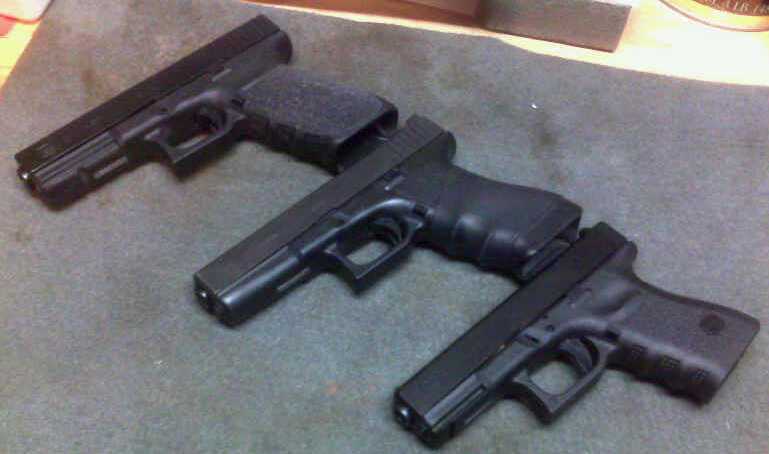
I am the proud owner of three Glocks. That’s Bruce in the middle, flanked by The Duke and Liberty. I’ve built this modest collection all on other people’s money.

Bruce was bought with the proceeds of some stock options that I had to exercise after changing jobs in 1992. I was fine with just one Glock for a while, but after a few years I wanted to add a second gun. My company had a sales contest one fall, and I managed to win enough Visa gift cards to buy a G21SF using my GSSF discount. This one I named The Duke.

Then, 2 years ago, I won a Glock in a random drawing at a GSSF match. A Glock 19 named Liberty joined the gang.

It doesn’t stop with Glocks. I’ve also used a company safety bonus to buy a very nice used Mossberg 500, bank bonus money to buy an SKS, and another sales contest to buy a Ruger 10/22.

The best deal – a coworker called me one Saturday from a gun show. He had found an excellent deal on a couple of Mosin Nagants, which he described as in excellent mechanical shape but needing substantial cleaning. His offer: if I would clean one of them for him, I could have the other one for myself. I agreed. Welcome, Vassily!

Now, if I could just figure out a way to get other people to pay for ammo!

Frankenglock

Starting this blog got me thinking about Bruce, my Gen 2 Glock 17, so I went back and looked through my notes I’ve kept over the years about the changes I’ve made. After marking up an exploded parts diagram, I’ve come to the realization that after 18 years there are only 6 original parts left – the frame, the barrel, the slide, the slide cover plate, and the two pins. Maybe, instead of Bruce, I should name it Frankenglock.

While some parts have been replaced because they broke, and some have been changed deliberately, most of the parts have been replaced as part of my yearly visit with the Glock Armorers at a GSSF match. This is a benefit of belonging to GSSF that cannot be overstated – you get to visit with a professional factory Armorer (not just an amateur like me), who goes over your Glock with a fine toothed comb. They replace any parts that even seem like they might fail in the near future, and in most cases they give you the old parts as spares. Beyond the obvious customer service advantage, this service makes sense economically from Glock’s point of view. Chris Edwards, the GSSF Director at Glock, once told me they save quite a lot of money every year just on shipping charges for warrantee work alone.

The only parts that have been replaced because they actually failed are the rear sight and the extractor. The rear sight was originally an adjustable target sight and was broken when I got it from the pawn shop, a fact I learned from the two policemen I met at the range that first day. The extractor got chipped over time, probably because I ignored good advice and would load a round directly into the barrel then drop the slide on it, rather than loading it through the magazine the way they tell you. Let that be a lesson, kids.

Parts that I’ve changed voluntarily probably aren’t as many as they would be if this were any other pistol. I installed an extended magazine release and an extended slide stop lever to compensate for my short fingers and thumbs. I’ve also installed Warren-Sevigny sights with the fiber optic front sight, and when I’m competing with Bruce, he gets the (-) connector to lighten the trigger pull a little. For carry, the normal connector goes back in, although the current connector is a GSSF replacement.

The only other change I’ve made is to use a slip-on Hogue rubber grip, just to provide some indexing for my grip. Since the Gen 2 frame doesn’t have molded finger grooves, this helps me get the same grip all the time.

All the other parts – trigger, firing pin, recoil spring, internal safeties, and the like – are all factory Glock parts, albeit replacements. I see no reason to mess with what’s worked.

So, that brings us to the point – is Bruce still Bruce? Certainly from the BATFE’s point of view, yes, since it still has the original frame and serial number. Beyond that, I think so. Look at his namesake, Bruce Willis. Is he the same man in Red as he was in Moonlighting? Less hair, move the muscles around some, maybe some additions or subtractions not publicized, but yes, he’s still the same, even better from the added experience. And so it is with my Bruce – still the same, in fact, arguably better.