What to Carry if You Can’t Carry

A couple of recent events in my life got me thinking about the topic of what to carry should you find yourself in a situation where you can’t carry a gun.

There are two situations where this would come up – involuntarily and voluntarily. While I have found the solutions are similar, they do differ some.

In the last week there have been 4 robberies or attempted robberies on or near the campus of Georgia Tech, in midtown Atlanta. This hits home because my daughter is a student there, and frequently passes by the place where some of the incidents happened.

Under the law in Georgia, students and faculty are prohibited from carrying guns, even with a valid Georgia Weapons Permit. Visitors to the campus are allowed to bring guns, but they must stay in your car. This leaves students on campus without firearms for defense.

So, for my daughter, there is a three-pronged solution to living in a gun-free victim zone. First, she doesn’t travel alone on campus at night, and even in the day, she doesn’t travel alone in areas that are not well traveled by others. As much as it pains me as a father, this is the one time I am glad she seems to be always surrounded by boys. Of course, with the Ratio at Tech, that’s not hard to achieve.

Second, she carries pepper spray with her almost always. It’s a cute little pink bottle I bought for her as a present when she first started school there.

Third, she’s taken self defense courses, and she stays in shape. That way, she can fight or flee as the situation allows.

Does this make me feel better for her? A little. Her Mom, not as much. But we have come to accept that we do what we can.

++++

The other situation is voluntary. I’m not talking about the time when you decide to leave your gun in the car instead of taking it into the doctor’s office – more the time when someone physically can’t use a gun.

My mother-in-law lives alone in an apartment near us. My wife calls on her often, but she can’t be there all the time.

Recently, my mother-in-law asked me for advice about what kind of gun she could buy for protection, and I had to be brutally honest with her – none. She isn’t physically able to use a gun reliably. And even if she could, she isn’t physically mobile enough to be able to go practice with it, or to be able to quickly reach her gun safe (required!) before an intruder did.

Plus she lives in an apartment, and Rule 4 means she would have no good field of fire any way. With the construction of her apartment, even .410 bird shot would take out her neighbor and her neighbor’s neighbor.

The solution? A trip to Wal-Mart and $20, and I came home with 4 large cans of wasp spray and an air horn. Wasp spray in the eyes will totally ruin an intruder’s day, and it looks a lot less menacing than a bear-sized can of pepper spray.

She now has a can of wasp spray in her bedroom, bathroom, living room, and kitchen, the four places she stays in the most. The air horn is by the couch, and she’s talked to her neighbors, who now know that’s her call for help.

I also got her a small can of pepper spray, that’s on her key chain, for when she’s going to and from her car.

++++

And my daughter’s dorm room got a couple of large cans of wasp spray. Take note, boys.

++++

It’s not a perfect world, and given that, we can’t always be guaranteed our Second Amendment protections. But by thinking through the possibilities and planning ahead, we can make the most of what we do have.
Wheel Spinning

Well, family and other responsibilities prevented me from shooting USPSA on Saturday. Then, on Sunday, I planned to get out all my guns and all my photo equipment and shoot gun pr0n, to illustrate some upcoming gun reviews.

But first, I think I’ll blow all the leaves off the driveway.

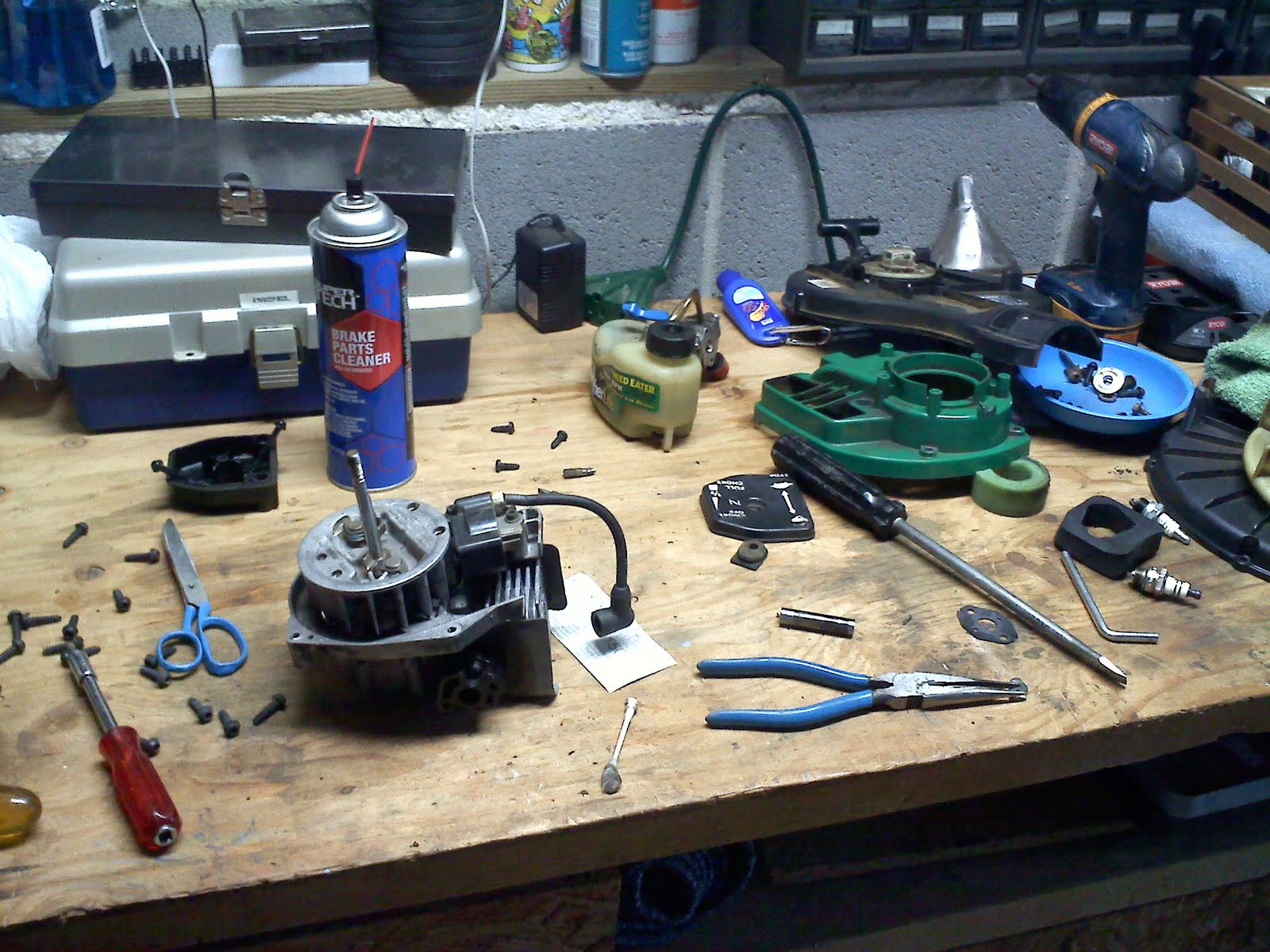
Only, now I remember the leaf blower won’t start. So I check the easy things – plenty of gasoline flow, filter is clean. Spark plug is ugly. Off to the home center for a new one. That doesn’t work.

So, I break it all down, and find the starter spindle has a tooth broken off. But the motor still turns when I pull the cord, so that’s not it. So I put the compression gage on in place of the spark plug, and when I pulled the cord, the pressure is all over the place, never the same reading twice.

According to the gurus on the interwebz, who are all experts, the means bad gaskets, a cracked cylinder, or worse. Maybe $50 to repair. Given this machine is 7 years old, it’s better to spend the money for a new one.

Back to the home center. But the only models they sell are the same make as the one I have. I’m not buying.

So I need more research, and maybe a backpack model.

But by now it’s getting late. Too late to take pictures. Besides, I’m too annoyed to do a good job.

++++

Now I know why I shoot guns and play golf. Besides the exercise (dubious) and the tension relief (less dubious), they both involve an individual solution to a problem.

When I’m shooting a USPSA stage, I don’t always solve the problem the best I can, but in the end, it’s solved. And the Range Officer says “Unload and show clear,” and I’m done.

I wish the rest of my life’s problems had a Range Officer. One thing’s for sure, when he asked at the beginning “Do you understand the course of fire? Any questions?” I would sure as hell speak up.

++++

Only now it occurs to me, when I breathe my last, and open my eyes in Glory, maybe the first thing I’ll hear will be “Unload and show clear.”

To Reload or Not To Reload

The deck under the Browning .30 cal machine gun at the Blogger Shoot. Who’s gonna pick up all that brass?

As I related recently, I am anticipating a bonus at work the end of the year, so I am looking at getting my first AR-15. While working over that decision, I came to the conclusion that an AR-15, even if it were given to me, would still cost me a lot of money to run. The reason is simple economics* – supply and demand. The supply of 5.56mm NATO ammunition is limited, and the demand is almost all going over to the Middle East or to military training, leaving a scant amount for civilian sales.

This lead me (back) to the idea of reloading.

The arguments for reloading are many, and they have different weights depending on your end use. For hunters, you can tailor a load to your specific need, or even load a caliber that isn’t even made any more.

For me, the draws are obviously cost, availability, and customized competition loads.

COST

Their are 2 parts of the reloading cost equation – total cost, and rounds loaded. This yields a cost per round fired, and when you multiply that by 50 or 20, you can compare that to commercial ammo.

Like any manufacturing process, there are fixed costs and variable costs. The fixed cost is mostly the reloading press, dies, case cleaning equipment, reloading stand, and the other parts you need to buy. The variable cost is the brass, primer, powder, and bullet that makes up each round.

The variable cost is further complicated by economies of scale – that is, just like diapers, beer, and fighter planes, the more you buy, the lower the price per unit.

To decide whether a project is feasible economically, you figure the total variable cost per year, and subtract that from the cost to buy the ammo commercially. This is the annual variable cost savings. You then divide that into the fixed cost, to see how many years of shooting it would take you to pay for the reloading equipment.

So, I figured what it would cost to buy components for 2,000 rounds per year of 9mm, 500 rounds of .45ACP, and 1,000 rounds of 5.56mm, assuming I could re-use my pistol brass I already had, and I would buy once-fired military 5.56mm brass.

Comparing that to the cost of store-bought ammo, I figured I would save about $300 per year, or about one year to pay back $300 worth of reloading equipment. Admittedly this is rather sensitive to whether I can re-use brass, but it is still enough of a payout to justify it to me.

AVAILABILITY

For availability, I only have to remember my history. When the current war broke out, the availability of a lot of ammo went to zero, along with components like primers. As long as I stay ahead by laying in components when they’re on sale, I can stay ahead of this as well as anyone, should it happen again.

CUSTOMIZED COMPETITION LOADS

Then there is the issue of customized loads, especially for competition. I can work up a low recoil 9mm load or .45ACP load, which would be easier to shoot, and cheaper as well. And since every AR is different, I can work up cheaper and easier shooting 5.56mm rounds too.

So, for me, the decision is made – I will buy a reloading press with the first part of the bonus, and whatever is left will go into the AR fund.

Now comes the next stage – what kind of reloading equipment to buy?

*Simple economics for capitalists, that is. If you’re a socialist, never mind. Just seize someone else’s ammo.

Thoughts on Methods of Carry

Sometimes you need to carry 2 Glocks.

JP over at the Empty Mags Podcast recently did an episode about pocket carry, that is, carrying a pistol in a pocket holster. I was reading other blogs who commented on this, and I wanted to share my thoughts.

There are several ways to carry a gun, and there is no way I can be exhaustive, but here is how I’ve done it.

My choice of carry method depends on several things, including the clothes I’m wearing and where I’m going.

By far the preferable way for me is belt carry, the traditional holster on the belt on the strong side, which I do when I can wear a concealing garment like a jacket or over shirt. I carry at almost the 3 o’clock position, maybe 3:30, and I would carry it even farther forward if I could work out reliable concealment. I just find that a draw at 3:00 or farther forward works best for me. When I open carry, I carry at 3:00.

I’ve used several kinds of holsters for this: Kydex paddle holsters, Kydex belt slide holsters, and leather belt slide holsters. Again it depends on what I’m wearing and where I’m going. If I need to take the holster off to go in a restricted place like the courthouse, I’ll use a paddle holster, although I’ve also taken to using a leather belt slide holster, and carrying a leather IWB holster to put the gun in, and put it in safe keeping.

I also have a Bladetech double offset drop belt holster that I use for competition. That’s it in the forward position in the picture.

Next on my preferred carry methods is Inside-the-Waistband, or IWB. All my IWB holsters are leather. I carry them at 3:00 also. I find that when the gun is canted forward a little, it rides right on my hip bone, which works really well.

Next is a fanny pack with an IWB holster in it. I stress that I always use a holster whenever I carry, even if it’s in a fanny pack, so that the trigger guard is covered to prevent accidentally pressing it. I use a fanny pack when I’m out walking, wearing gym clothes. I’ve also used a very large fanny pack to carry in the car, and I sling it over my shoulder like a ruck sack. No one knows.

I also have an ankle holster that I bought at a gun show on a whim. I’ve never carried using it. My plan was to use it to carry my G19 as a backup gun. Maybe I should work on it.

Now, back to the issue of pocket holsters. Admittedly, I’ve never carried a gun in a pocket holster. In fact, I don’t own a gun that’s small enough to carry in a pocket holster.

I don’t rule it out though. Michael Bane talks in his Down Range Podcast about methods of concealed carry, and I really like his strategy – whatever he’s carrying on his belt, he almost always has a pocket pistol in his left front pocket as a backup. In his case, it’s a Ruger LCP.

His thinking is this, and I like it – he doesn’t plan to have to draw the gun quickly in most cases because his plan is to have his hand on the pistol, already partially drawn, when trouble goes down. Weer’d also talks about having his pocket pistol out and on the console.

Of course, this assumes we know when trouble is happening, which isn’t always the case. But if we work on our situational awareness the chances of this go up a lot.