The Evolution of My Pistol Shooting Stance

I was looking at photos of people shooting, and I noticed the different ways people hold their guns when shooting. This got me thinking about how my own shooting stance has changed over time.

Here is a brief history of my shooting stance.

The Dueling Stance

This is the classic one handed bullseye stance. The shooter aims along the arm, and puts one hand in their pocket. I have no idea if this is still being done, but if I had to guess, it probably is, by bullseye competitors.

I’ve played around with this stance on occasion, but I don’t have the arm stamina to do it effectively. However, if I did need to do it, I would just get some training and practice.

The good news is I don’t have much reason to use this stance. I don’t shoot bullseye and I don’t settle quarrels with a duel.

Weaver Stance

This stance was the major stance in use in the early days of Practical Pistol. A lot of more experienced shooters still use this stance. A lot of Hollywood people who don’t have a good instructor use this stance, some of them using the Teacup method with the support hand.
R. Lee Ermey uses the Weaver stance. This is interesting, because the military taught a one-handed shooting style with the 1911, up until adoption of the Beretta M92 in the 1980’s.

I used the Weaver stance early on, because it gave me a better view of the sights. The gun is closer to the eye. It also turns your body a little bit, which stabilizes you against the recoil. Proponents also say it presents a smaller target to the bad guy, but to me that assumes you are standing there shooting at a bad guy, and not running like hell to get away, like you should be.

Isosceles Stance

This stance is named for the triangle that the arms make when holding the gun in front of the shooter. It was pioneered by Brian Enos and Rob Leatham in the 80’s.

I noticed that a lot of shooters used this stance, and I tried it a number of times. Some of them lock their elbows, like Dave Sevigny, and some leave the elbows a little bent, like Doug Koenig. I tried it both ways.

But because it was uncomfortable to me – that is, unfamiliar – I quickly went back to the Weaver stance.

On a couple of practice occasions, I decided to see how accurate I could be with each stance. I found out that I was a lot more accurate using the Isosceles stance than the Weaver, and I mean a lot more accurate. I think it has to do with the variability of the hold. In the Weaver I kept my strong arm a little bent, and I think this led to differences from shot to shot.

After a few sessions, I finally convinced myself to switch to Isosceles. It wasn’t easy – no change ever is. But it’s paid off for me.

Now, I occasionally find myself back in the Weaver stance, for no apparent reason. Habit I guess.

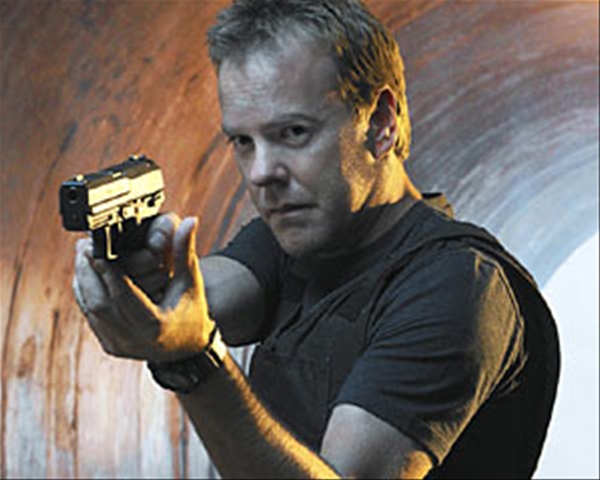
My point of all this is to say, try all the stances. Don’t use a stance just because you think it looks good on Jack Bauer. Use what works. And if people give you grief, let your score do the talking.

Stuff

I write myself notes all the time about ideas for blog posts. From time to time I get them together and try to make sense of them.

+++

I found another shooter at work last week. He and I spent lunch at the range on Friday. He’s got a Glock 21SF like me, so we shared our experiences with them. I noticed his has the normal Glock magazine release, while mine has the ambidextrous SF release. To be honest I would prefer the normal release – I should have asked when I bought this one.

I was cleaning out my stuff Sunday and found an old G21 magazine, 10 rounds, that I’ve had 10 years or more. A guy I used to work with flipped repo’d cars as a hobby, and I was helping him detail a Corvette when we found it under the seat. I tried to trade it a couple times over the years, and I was disappointed that it didn’t work with my new gun when I got it.

Anyway, I gave it to my friend. I guess kept it all these years just for this time.

+++

I’m working on a post about my Rules of Engagement, and it’s sparked some interesting discussion around the house. What started out pretty straightforward turns out to be more complicated than I thought. The post will likely involve not only my rules, but the process behind them.

+++

Reviewing my traffic numbers, the most hits I get from Google are for my ammo reviews. Not that I’m writing for more traffic, but is that something I should be doing more of?

Thoughts?

Other People’s Money – revisited

As you may have read before, all my guns have been bought with other people’s money – bonuses, stock options, awards, and the like.

The company I work for has offered an end of year bonus, if we meet certain goals, which we are on target to achieve. If my performance matches last years, I will make enough in bonus to build a new AR-15. That’s my goal.

But I was thinking this through the other day, and I realize, as I’ve said before, that adding a new gun like an AR-15 means adding a new caliber of ammo for me to buy.

So, I’ve decided to amend this goal. I decided to take the bonus and make my first foray into the world of reloading. Then, if I have enough left over, I’ll build the AR. At worst, the AR will be my next project after that.

I’ve never been a great one for deferred gratification, but what’s working for me is the economic analysis. It’s sweet that I can shoot for half the price by reloading. And, if I buy the reloading equipment using other people’s money, it’s even sweeter.

Movie Rule of Thumb 4: Never Take Your Shoes Off At a Christmas Party, or When There Are Terrorists in the Building

Source: Die Hard, my favorite Christmas movie.

WARNING: Harsh language!

Lesson: it’s never really okay to let your guard down. I covered this once before in my post about awareness. Always maintain a state of alertness, whether things seem normal or not.

Always be alert. Always be in Condition Yellow. Can we ever relax, then? Yes, but with caution and alertness.

In the movie Die Hard. New York police detective John McClain, played by Bruce Willis, goes to California to visit his wife for the holidays. He arrives at her office during the Christmas party. Someone he meets along the way gives him some advice on how to relax after a long trip – take off your shoes and scrunch your toes in the carpet. John does this in his wife’s office, and it seems to help. But just then, a group of terrorists take over the building. Now John has to fight a building full of terrorists in his bare feet. Mayhem ensues.

Now, if John McClain had kept his shoes in his hand, ready to put back on, things would be have gone differently. Not for the bad guys, but for certainly for John.

The Rule started out as “Never take your shoes off when there are terrorists in the building.” But this implies that we can know when there are terrorists in the building, or a mugger around the corner. So I added the innocent phrase “at a Christmas party.”

Yippee ki yay, Mister Falcon.