I found these questions posted by Ben Stoeger in the USPSA section of The Doodie Project:
What do you guys want to get out of this sport and what are you willing to put in to get it?
Wow. This hits to the heart of this blog, and to me this will take a little more thought and answer room than one post on a forum. Look for my thoughts in future posts.
Meanwhile, here is what Ben’s answers were:
I want to have fun, learn, and compete against the best.
I am willing to make shooting the number one thing in my life outside of eating and breathing.
When someone asked about what his wife thought of this, he clarified:
She knows where she stands. I leave my family behind to go and shoot just like pretty much everyone else on this board, the difference is I don’t pretend to put family first.
This is the second in my series of posts about practicing for competition. It is intended to lay out what a competitive shooter (me) can do to build muscle memory and improve pistol shooting. I should say by way of disclaimer that this isn’t a primer on practice for self defense – that will come in a later series. But a lot of the skills we will practice here will be useful for self defense, so this is where I start.
In competitive pistol shooting, seconds count. I’ve watched a lot of shooters at all levels, and one thing that separates the top shooters from the others is the time it takes to get the first shot off.
There are two parts to this – drawing the gun, and making the first shot. For some sports that start at a ready position not in the holster, like GSSF or Ruger Rimfire, this is distilled to the latter part.
I’m not going to go through the parts of the draw stroke, because a lot of people better than me have covered this in a lot better detail than I could. I suggest going to Youtube or Google and searching for “draw from holster” or similar.
BEGIN PRACTICE
Remember the mnemonic SPAR – Safety, Purpose, Action, Reflection. In this case, the purpose of the session will be to hone getting the pistol from rest to a first shot in the fastest time possible.
DRAWING FROM THE HOLSTER
To practice this, don your normal holster rig, and, if you’re practicing for IDPA, your normal cover garment. As with before, make sure your gun is unloaded, and all ammunition is removed from the room. This is especially vital if you will be practicing with magazines.
Starting with your hands in the desired initial position (relaxed or surrender) start out by drawing very slowly and intentionally, pressing out, and getting a good sight alignment. Press the trigger, and make sure the sights stay aligned. Concentrate on getting all the parts of the draw perfect. Speed is not the issue at this point.
Slowly increase speed until you are perfectly drawing as fast as you can. Then slow that back to 3/4 speed for most of the session.
Perform this with as many different hand positions as you can think of. Work on these with both hands, and with your strong hand and weak hand alone. Remember, you will see this in a stage, as well as a classifier or qualifier.
STARTING WITH THE GUN SOMEWHERE OTHER THAN THE HOLSTER
Many USPSA stages start with the gun unloaded on a table or somewhere other than in the holster. So it make sense to practice this. I usually practice it several ways:
Standing, gun unloaded on a table. Grab the gun, insert a magazine, rack, press out to aim, and fire. Repeat.
Seated, as above.
Standing, gun unloaded on a table some distance away, magazine on a different table, some distance away. There are two ways to do this, grab the magazine first or grab the gun first. In a perfect world I grab the magazine first, but I practice it both ways, since I never know what sill come up in a stage.
Standing or seated, with the gun in a drawer. This one is used a lot in IDPA stages.
STARTING WITH THE GUN AT READY
I devote the most practice to this, because this move is the most versatile. Think about it – starting with the gun at ready, I press out to the target, aim, and fire. This is what happens at the start of a GSSF stage and a Ruger Rimfire stage, but it’s also what happens every time I move from one shooting position to another in USPSA or IDPA.
This is where I have cut out the most wasted time, and I’ll share with you how. Watch a lot of shooters and you will see this: from ready, they press the gun out, bring it up to eye level, overshoot, bring it back down, overshoot, bring it back up, get the sights in alignment, and shoot.
What you see if the gun going out, then up, then bobbing up and down a few times until it stops. Then, they take aim, and fire.
What I learned to do is to bring the gun up to eye level as I press it forward. When it gets to eye level, I am still pressing out, and I am aligning the sights. Once the arms are extended, the sights are aligned, and I fire. Using a shot timer, I can go from ready to a first shot on target in less than a second. The key is to start aiming as the gun goes forward, and when the sights are on the target, fire.
As before, work on these with both hands, strong hand and weak hand.
PUT IT TOGETHER
Once you are comfortable with all these parts, put together a practice session, based on your upcoming competition. Here’s an example:
From ready, press out, fire. Start slow and work up to full speed. 20 reps.
From ready, strong hand, press out, fire. 10 reps.
From ready, weak hand, press out, fire. 10 reps.
From holster, draw, press out, fire. Start slow and work to full speed over 10 reps.
From holster, draw, press out, fire, strong hand. 10 reps.
From holster, draw, transfer to weak hand, press out, fire. 10 reps.
Again, there are countless permutations, and you can customize them to the matches you are shooting, and to the areas of your game you know need improvement.
REFLECTION
Now, as you put away your gun and holster, make note of what went well in your practice session. I like to keep a journal, and keep track of the drills I’ve worked on. When I find I have trouble with one, I can track my improvement, and make sure it gets fixed.
After shooting the GSSF match on Sunday, I was on Twitter, and I did a simple search for “GSSF.” one of the tweeters who showed up the most was @GlockingTall, who is Andy at the blog Glocking Tall.
One thing led to another, and Andy asked me to contribute a post about the modifications I’ve done to my Glock for GSSF. Check it out.
Thanks, Andy, for having me, and I look forward to contributing more about Glocks in the future.
On Sunday July 15, 2012, I traveled to the River Bend Gun Club in Dawsonville, Georgia, for the GSSF River Bend Ballistic Challenge V.
As usual, I shot my Gen2 Glock 17 Bruce, and it performed perfectly, as expected. For those unfamiliar, you can refer to the GSSF course of fire here.
MATCH PREMLINARIES
The GSSF course of fire consists of ten strings – 4 on Glock the Plates, and 3 each on 5 To Glock and Glock M. So, owning 11 magazines, I am able to pre-load my magazines and not have to do so at the range. That’s a nice thing.
One thing to remember is that we are allowed 11 rounds total per string, so if I load all my magazines with 11, and I don’t shoot the gun dry, I will need to strip one round off the next magazine before using it.
In fact, since 5 To Glock is exactly two shots per target, with no chance of make-ups as there are on the other two stages, I load my magazines 11 – 10 – 9. Then, I have one in the chamber after the first two strings, but the slide is closed. And, the slide locks back empty after the last shot, so showing clear is simple.
Life has a way of throwing curve balls, though, and one thing I learned in baseball was never to sit on a pitch, that is, never assume you know what’s coming next. This came to the forefront with a pre-match malfunction.
For dry firing I almost always install my plastic 5.11 training barrel. However, during the course of practice, the end of the recoil spring must have slipped off the notch in the barrel, because I couldn’t get the slide to slip off as I disassembled it, no matter how hard I tried. I tried everything I knew to get the slide off, to no avail. Finally, I had to resort to cutting the guide rod, and replacing it with a spare.
SHOOTING THE MATCH
When I arrived, it had been raining, sometimes hard, for about an hour. Footing was still good, but some stages had the cardboard NRA targets covered with plastic to protect them.
I elected to shoot Glock The Plates first, without a warm-up round, since the plates weren’t affected by the rain. Bad idea. I left 4 plates standing my first round, and I could tell from the paint missing from the support that I had been shooting low and a little left, meaning I was jerking the trigger. I know enough from golf not to try and diagnose and fix problems mid match, so I just aimed a little high and right, and I had no misses the rest of the day. My Plates runs were in the mid-7 second range, which was about a second longer than normal, but that was okay.
I had one other close call, when I flinched on one of the long 25 yard shots on 5 To Glock. I called the shot low, and I thought it might be a miss, but it was a D, low and left. Even the RO commented when we were scoring. Some of my other 5 To Glock shots were in the D range, and those 3 second penalties hurt.
Some time while I was waiting for the third stage, Glock M, it stopped raining and the sun came out, all in the space of about 2 minutes. The temperature climbed, but the humidity stayed the same – 100 percent.
All this meant good hydration was essential. I had already drunk about 300 ml of the 1L of sports drink I had brought, and I drank another 500 ml while I waited, and ate a couple of granola bars. Of course, none of this alleviated the temptation to walk across the way to the Holy Smoke barbecue stand operated by a local church. The wind was blowing that tempting smoke our way all day. But I resisted.
I shot the last stage in a decent time, with all Alphas and three Charlies. One thing I did now that the sun was out was step forward a foot or so, so that my fiber optic front sight was fully illuminated by the sun. This helped a lot.
All in all, my overall match score was 188.1, not a good time at all. Four Mikes and a bunch of Deltas, combined with subconsciously slow shooting in the rain, add up.
AFTER THE MATCH
There are usually a decent number of booths at the Dawsonville match, but a lot of them called it quits during the rain, before I arrived. So, I didn’t get to buy any cool Glock items.
I did pay a visit to the factory Armorer, even though Bruce had been given the once over just a couple of months ago to relieve the Gen2 frame. I also told him about my training barrel incident, and he gave me a new recoil spring, making this the third year in a row my recoil spring has been replaced. Everything else was fine, though, as I expected.
I was tweeting after the match, and found a new blog, Glocking Tall(@GlockingTall), whose author was at the match as well. I am looking forward to getting to know him, and I added him to the blog roll today.
So now we wait for Glock to post the scores. I won’t win a gun for coming in first, but in a few weeks the final scores will be posted, including the random drawings. There’s hope for me yet.

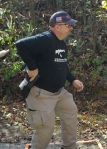


 Fill Yer Hands