The Wall Drill, a video

My Quest for C Class

In a recent post I talked about the Wall Drill. I’ve been doing these fairly regularly for about 4 weeks now, and I have found my performance is improving. The sights hardly move at all as I break the trigger.

I was surfing the instructional videos on the interwebz, and I came a cross a really good video on the Wall Drill, presented by its inventor, MSG George Harris of the US Army Reserve, who is also Director of the SIG Academy. It really helped to see it in action.

Match Report – River Bend USPSA

This past weekend I returned to River Bend Gun Club in Dawsonville, Georgia, and shot in their monthly USPSA match. I had shot there before, and once again the match was well run and very enjoyable.

The match consisted of 7 stages, with 3 field courses and 4 more stationary stages. As usual, the shorter stages gave me some fits, since they usually involve things like off hand shooting.

I’ve also had some time to think about the match, and here are my take-aways.

Note: I’m going to use a lot of USPSA terminology, some of which I am not going to take the time to explain. Feel free to do an interwebz search for what you don’t understand, and if you still don’t have an answer, leave me a comment or send me an email and I will try my best to explain.

How Division affects my stage strategy

I normally shoot in the Production Division. All Production shooters are scored as minor, and must limit magazine capacity to ten rounds. You are also allowed to start with one round in the chamber.

This means that a lot of what I worry about when I devise my strategy of how I am going to shoot a stage revolves around magazine changes. Rather than waste time on a mag change in the middle of a string of fire, I would much rather change mags when I’m on the move from one string to another.

As an example, one stage ran like this: in the first door, there was a IPSC target and a popper. The popper fell and activated a swinging target, that was accessible from both the first door and through a window where the second string of fire was. If I shot like a lot of people, I would have shot the IPSC target, shot the popper, then moved to the second window for a shot at the swinger, along with the whole second string.

If I were shooting Limited or Open, where I could have more shots available, then this made sense. But for me, it made more sense to shoot the popper first, then the IPSC target. By that time, the swinger was going, and I could lean left and shoot the swinger from the first door. This gave me 8 shots if I needed them, then change mags and move to the second window.

On this stage, there was a second swinger, that was engaged by a popper from the second window. This swinger was different, as I couldn’t shoot it from the second window, only from the third.

What I need to work on

I need to work on one-handed shooting, and transition from my right hand to my left hand for one hand shooting. The problem is, practicing one-handed shooting is boring to me. I would much rather practice double taps, or transitions. I am just going to have to suck it up and do it, if I’m going to get better.

I also need to work on shooting small targets at 25 yards.

Both of these are going to take some individual time at an outdoor range, where I’m not entertaining teenagers, or paying for range time by the hour.

But it will be worth it, I know.

Tying Up Loose Ends

Well, I didn’t get to shoot any over the Independence Day weekend. There was a Steel Match I had penciled in, but I didn’t get to it. But that doesn’t mean I didn’t get to do anything with guns.

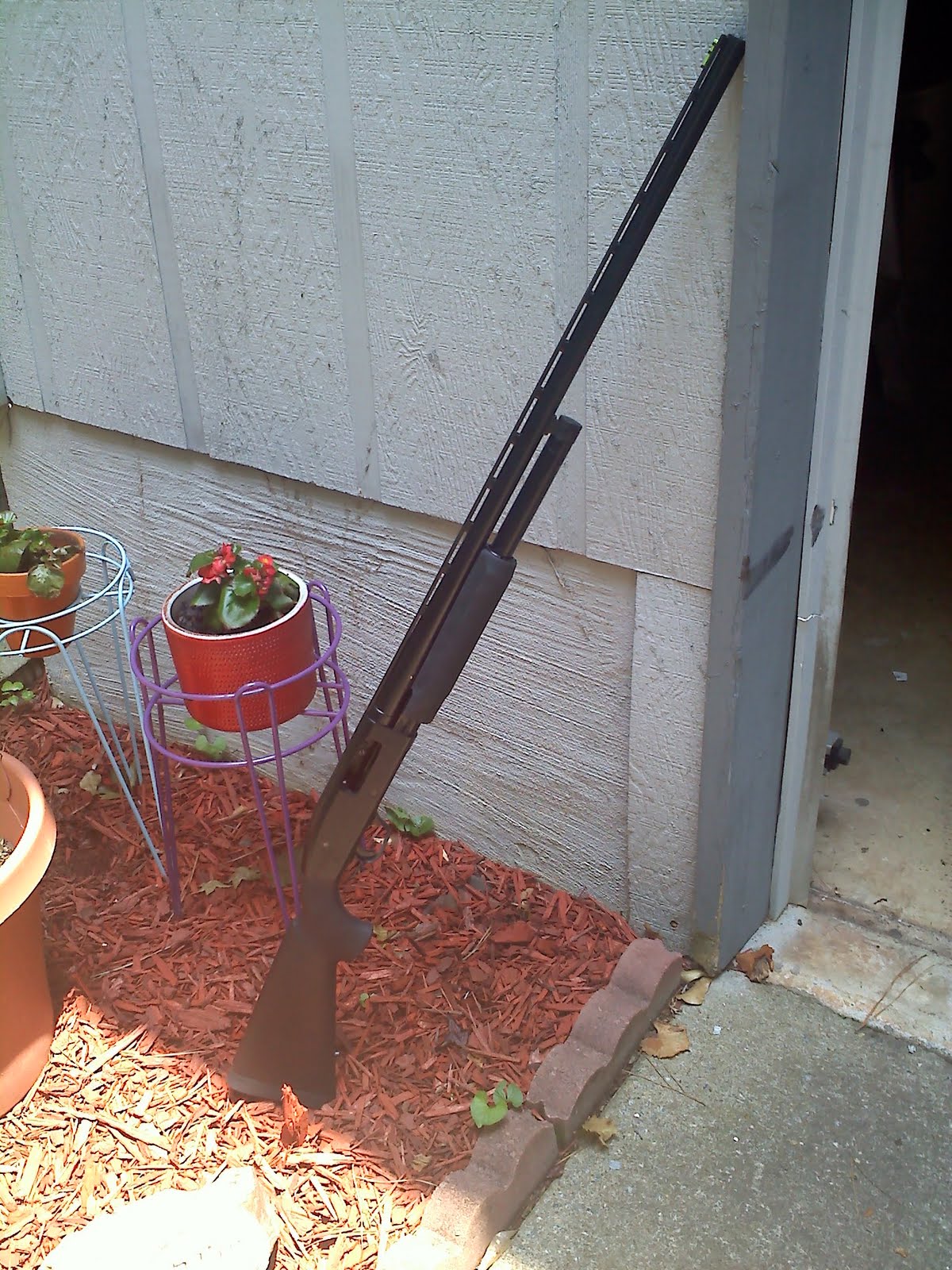
First, I finished Lee, my Mossberg 500 shotgun. It feels good – I now have a functioning shotgun in the safe. I got a wild hair a couple of years ago, and stripped the bluing off my shotgun, before I read up on how hard it was for a dabbler like me to do a goos job bluing. I will post a more detailed report of the work I did, but overall I am satisfied with the results. I learned a lot about using Duracoat, and I would do it again, just with different spray equipment, Again, more later.

Second, I spent some time dry firing and practicing magazine changes. In particular, I spent some time changing magazines without looking at my gun, to test whether this was a viable reason for the changing my magazine orientation to “bullets forward” in the mag pouches.

My conclusion: after probably 3 dozen repetitions at various speeds, with my magazines oriented so that the bullets faced to the rear, I didn’t find that I had a difficult time changing magazines without looking. In fact, it was easier to do with my eyes closed than it was with my eyes open when I changed the orientation to “bullets forward.” I did find that I needed to slow down a little to make it smooth, but that’s probably not a bad thing.

For me, it is all about muscle memory, and I think that supports my original observation.

However, I think that when the time comes to teach someone else how to change magazines, I will tell them to orient the bullets facing forward. The idea of using the index finger on the nose of the bullet, to guide it to the magazine well, is valid and can be used effectively. No surprise, since much better teachers than I have been teaching it this way for a long time.

Lessons Learned and Re-learned

Courtesy of Warren Tactical

Writing this blog has forced me to look at my shooting techniques in black and white terms. One thing I am confronting is the lack of actual training I have gotten, and how my shooting has suffered as a result. It’s one thing to read in a forum or see on TV how something should be done, and another thing altogether to realize I am not doing it that way.

For 18 plus years I was a self taught shooter. I taught myself a lot of things that I’ve found out not to be the best way. Notice I don’t say these techniques are “wrong,” because I managed to shoot decently. But, I know now I would have shot a lot better if I had done things the other way. That’s the reason for my post the other day about bullet orientation in my magazine pouch. If there’s really a better way I want to use it.

Today I’m writing about the biggest mistake I made, and how I fixed it. And boy, has it made a difference.

Drum roll.

Until recently, I didn’t really look at the front sight.

I started out focusing on the target, and the gun’s sights would be blurry at best. Because I was shooting competitions where the targets were at 3 to 15 yards, it’s how I did it, and I got away with it. My shots were mostly As and Bs on an IPSC target, with Cs on the far targets. Sometimes I would have complete misses, and I was at a loss to tell you why.

Yes, I always heard teachers say “focus on the front sight,” but I didn’t think I needed to do anything different.

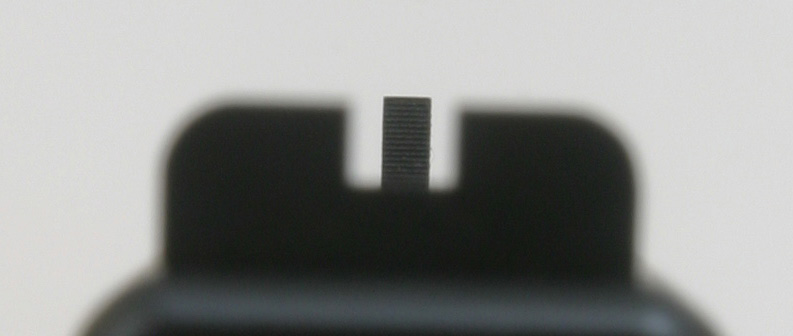
Then, about two years ago, I was watching the Pro Tip on an episode of American Shooter. KC Esubio was talking about calling your shots. To me this was a foreign idea at best, but he was using a helmet camera that actually focused on the front sight. I could see the rear sight alignment great, and the target was somewhat fuzzy, just like I had heard it described.

Then he shot a string of fire and told us to call his shots. I was surprised – I could tell exactly where the sights were aligned when the front sight lifted. I called his shots.

So I thought, maybe I should start focusing on the front sight, and maybe I could call my own shots, and figure out why I was missing targets.

There was a problem, though. Thanks to presbyopia, “old eyes” for you young whipper snappers, I physically couldn’t focus on the front sight. I wear contact lenses that give me good vision at normal distances, but I’ve had to wear reading glasses for the last 12 years or so. Even with my glasses, I couldn’t make something that close come into sharp focus.

So I got an idea. The next time I went for my annual eye exam, I asked the optometrist to help me out. He isn’t a shooter, but he understood what I wanted. He ended up giving me a sample contact for my right (dominant) eye that corrects it to 20/20 at arm’s length. Suddenly, my fingernail was in focus at arm’s length. The rest was up to me.

It was harder than I thought to train myself to look at the front sight. But to make it easier, I changed my sights on my competition pistol to a set of Sevigny competition sights with a fiber optic front sight. The difference has been amazing.

The first competition I shot with the contact in was the GSSF Annual Shoot, and it was my best GSSF match ever. Before this, my personal best was four misses in a match. This time I had only one miss, and I even called that one when it happened, and I knew I had jerked the trigger when it happened.

This contact has lasted me over a year, since I only wear it for about 6 hours at a time a few times a month. And, at my annual visit this year, my optometrist gave me another sample that I can use when this one wears out.

So, what’s next in my rebuilding of my technique?