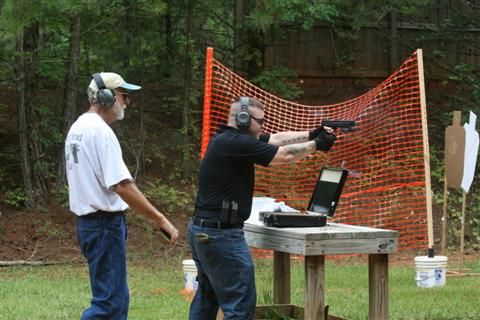
Shooter Ready?

I’ve been spending the week preparing for the biggest GSSF match of the year, the Glock Annual Shoot at the South River Gun Club in Conyers, Georgia, this weekend. My prep has been a little more focused this year.

I did a deep clean of my G17 last weekend, and cleaned and inspected all my magazines. I have enough magazines to shoot the whole match without reloading now, so that will make my day easier.

I have been doing the Wall Drill for ten minutes every evening, and I can only trust that this has helped. It sure seems like the front sight is a lot more stable than when I started.

Yesterday, I went to the range at lunch, and shot my 100 round GSSF practice routine:

Using a 1/3 scale NRA D-1 target from GlockFAQ:

From the ready position, I come up and shoot one round into the A or B ring. Repeat for a 16 round magazine.

From ready, come up and shoot 2 rounds into the A or B ring. Do this for 2 16 round magazines.

From ready, come up and shoot 2 rounds into the A or B ring, then transition to a second target and shoot 2 rounds. Repeat 3 times.

From ready, shoot 2, transition, shoot 2, and continue to transition until the magazine is empty.

I was careful to use good form with follow-up, as I learned at my training with Tom Givens.

I also shot my Buck Mark a bunch. The work I did last weekend paid off. I kept the targets, but the first photos I took didn’t come out well. From 7 yards, shooting 1 round a second, I was able to shoot a ragged hole. At 10 yeards, I shot 20 rounds as fast as I could, and all 20 were in a 3 inch circle.

I also had zero failures to extract, which had been a source of annoyance for us at the range the last time we went. Part of the work I had done involved removing the extractor, cleaning it well, and polishing it with the Dremel buffing wheel.

On thing I noticed was the Browning extractor had sharp edges all around, unlike the factory Ruger extractor on my 10/22. I assume Browning’s manufacturing process involves cutting instead of stamping. In any case, the extractor was very nice, especially once I smoothed it up with the buffer.

I plan to shoot Saturday at Conyers, in the morning. If any of you plan to be there, email me and we’ll get together.

Otherwise, look for some video on my Youtube channel, probably Sunday evening.

Match Report

Photo courtesy of River Bend Gun Club Action Pistol group

Saturday July 16 was quite a shooting day. I had planned on shooting the GSSF match at the River Bend Gun Club in Dawsonville, Georgia, and I found out late in the week from Staci Boudreau, a fellow shooter on Twitter, that the club’s monthly Action Pistol match was also held that morning. So I met Staci and her husband Bruce at RBGC for a full day of shooting.

The River Bend Gun Club, RBGC, is a very well kept and well run club located a few miles off I-575 about 50 miles north of Atlanta. I first shot there as a guest of a co-worker a few years ago, and it’s only gotten better since. I’ve shot GSSF and USPSA there, and now Action Pistol.

The RBGC Action Pistol match is very much like the matches I first shot in Alabama 18 years ago. It’s not affiliated with any organization like USPSA, which gives them a lot of freedom in stage design, gun classifications, and the like. I shot Production class, because that’s what I shoot in USPSA, and I wanted to keep the more frequent magazine change as a part of the test. Oh, I was tempted to shoot Limited, since I could have loaded my magazines to 19 and blazed away. Maybe next time.

First, I think the safety briefing that was given was about the best briefing I have ever had. He went over all the rules of the match, and all the safety points. Nothing was glossed over, that there was no assumption about anyone’s previous shooting experience. It was presented with ease, and no one seemed anxious to move on. Very refreshing.

Also refreshing – literally – was the weather, around 75 degrees at the start of the match, and drizzling most of the time. Shooting a Glock, all I had to do was wipe off my grips before shooting. The weather started to dry up by the end of the match, though.

There were three stages, and each tested different shooting skills. The first stage was all steel plates, either classic round plates, steel bowling pins, pepper poppers, or steel IPSC targets. You either hit or not, and it all came down to time. The second stage was classic run and gun, with an added twist – the last series of targets included one target that had a badge around its neck, representing an undercover policeman, and the ROs changed which target was the LEO before each run. At least one shooter in our squad shot the cop.

Stage 3 took advantage of the non-USPSA rules, in that it only required shooters to neutralize the targets, which was defined as one shot in the A area, or 2 in the B and/or C area. Shots in the D range just made the target angry. There were several shots around barricades, and if you aimed center of mass and saw an A hit, move on.

There were unpleasant surprises, though, as some shooters received Failures to Neutralize, because they assumed a single headshot was a neutralizer, not seeing that they had actually hit the B area in the head.

After that, we enjoyed a great hamburger and hotdog lunch, then headed up the hill to the Cowboy range, where the GSSF match was already under way.

After signing in, we shot the three stages I talked about last week. I shot a very good match for me, with zero misses except one steel plate left standing. My score was 121 seconds and change, which is a 15 second improvement over my personal best.

Bruce shot a lot better than I, with a score of 83. Well done.

I arrived home about 4:30, after leaving the house at 7 AM. A quick peak as I cleaned out the car revealed that my Glock didn’t really need cleaning. I just brushed out the trigger group, ran a rod brush through the barrel, and put him away. The Glock 19 I took as a backup got the carry loads back in, and went in my waistband.

The GSSF scores will be posted later today, Monday, and in a few weeks, the prizes will be awarded. But believe me, before then, we’ll be back on the range.

Glock Sport Shooting Foundation

I am surprised when I talk with fellow Glock owners who are unaware of the Glock Sport Shooting Foundation, or GSSF. I then realized I hadn’t done a full post explaining what this organization was or how to join. Let’s correct that today.

The GSSF is owned and operated by Glock, Inc., out of their US headquarters in Smyrna, Georgia. They organize and run about 36 matches a year, all over the country, with the much appreciated assistance of a lot of people at local host ranges. The schedule can be found at the GSSF website, www.gssfonline.com. Joining GSSF is just $35 for the first year, and $25 to renew, plus $25 per match for each pistol you compete with. (More on that later.)

But the bounty comes with the prize packages. In addition to awarding Glock pistols for winners, and cash for other high finishers, they also award a lot of cash, complementary membership renewals, and free pistols at random to competitors. In the 15 years I’ve been competing, I have only won a prize once for my finish – I won $100 for taking second in my class. But I’ve also won $100 once, $50 twice, two annual renewals, and – YES – a brand new Glock of my choice. (That’s where Libert, my G19, came from!)

GSSF is open to any Glock shooter, regardless of age or experience. There are different classifications for shooters, ranging from Amateur Civilian (which would include most of us), to Guardian (for police and military) to Master (for those who are ranked Master or Grand Master in other groups). All you need is a Glock pistol and at least 4 magazines, plus 104 rounds of ammo. And, if you have more than one pistol, you can enter more than one classification, which increases your chances of winning a random prize.

Admittedly, GSSF seems like a rather low-intensity competition, when compared with USPSA or IDPA. There are no reloads or movement during the stages, and the stages start at low ready, rather than being drawn from a holster. This is perfect for the new shooter, but don’t think it makes matches a cake walk for experienced shooters. This just shifts the emphasis from transitions to accuracy.

To level the playing field, and to account for the restrictive gun laws in some states, all magazines start with 10 rounds, and you are allowed one in the chamber. There is an exception for the Glock 36, which only holds 6 rounds to start, in a class called Heavy Metal, and if you shoot another .45ACP or 10mm Glock, you can enter that class as well, and self limit your magazines to 6 shots each, plus one in the chamber.

Scoring is based on time, with penalties assessed for errant shots or misses. The match uses three kinds of targets – the NRA D-1 target, also called the Tombstone; steel pepper poppers; and 6 inch steel plates.

For the metal targets, scoring is easy. If you knock the popper or the plate down, there is no penalty. If you leave one standing, you add 10 seconds. Ouch.

For the Tombstone targets, all shots in the A or B area incur no penalty. Shots in the C area add 0.5 econds for each, and shots in the D area count for 3 extra seconds each. Complete misses add 10 seconds. Ouch.

Every match I’ve been to has included the same 3 stages, and they are run just about the same everywhere. I tried to find some good examples of these stages, but the best ones are actually on the GSSF website itself, which I liked above.

5 to Glock:

This stage is five Tombstone targets, spaced from 5 yards out to 25 yards. Sometimes these are in a straight diagonal, and sometimes they are staggered. The point here is to test transitions from target to target, and to test your ability to make the longer shots as well as the close shots.

This stage is shot three times. At the end of the stage, all three times are added up, and each target is assessed. There should be 6 shots on each target, and penalties are added accordingly.

Glock M

The stage is named for its similarity to the letter M. From left to right, there is a Tombstone target at 7 yards, a Tombstone at 15 yards, 3 pepper poppers at 11 yards, then another 15 yard Tombstone, and a 7 yard Tombstone. This stage is also shot three times, with only one popper being shot on each run through.

Here’s where a little strategy comes in. I generally shoot all the Tombstone targets, left to right, 2 each, then shoot the pepper popper. This means I’ve shot 8 shots, leaving me three shots to knock the popper down. If I leave a popper standing, then it’s my fault, but I’ve never left a popper standing.

Glock the Plates

This is the simplest stage of all – just 6, 6 inch steel plates, at 11 yards. Knock them all down in the shortest time. This stage is shot four times.

But, as is often the case, the simplest stage is not necessarily the easiest. I have probably left more plates standing in my GSSF career than any other. For me, this stage embodies all the fundamentals of good shooting – sight picture, trigger control, and follow-through. When I get all these where they should be, and my shot cadence is right, I clean this stage. My technique is to shoot each plate in order, whether I hit it or not, then come back and take the ones I miss.

GSSF can be an excellent entry into competitive pistol shooting, and it is also a great complement to other shooting games for more experienced shooters. If you own a Glock, give them a look. For that matter, sign up, and come shoot with me next Saturday, July 16, at the Riverbend Gun Club in Canton, Georgia.

The Advantage of Youth

Number One Son and I spent the late afternoon Sunday in the back yard playing a few plinking games. First we ran a little run and gun using his Airsoft pistols against the garden flags. They give definite feedback when hit.

Then we played Horse (actually, we called it Daisy) with the BB gun on various targets, always mindful of Rule 4, of course. I noticed he was already shooting the BB gun left handed to match his eye dominance, and I asked him how it felt. He answered with a hit on the pie plate at 40 yards, and said, “Pretty good. Your turn.” I missed left handed. “D.” He then switched and shot right handed, and hit the plate. This one I matched.

Ahh, to be young.

While we were running and gunning I asked him to come with me to the next USPSA match that I shoot, probably in May. I think he’ll at least come watch.

He also agreed to come with me to the GSSF match in Dawsonville in July. My guess is that by then he will be a member and will compete. And by 2012 he will probably beat me.

That’s the breaks.